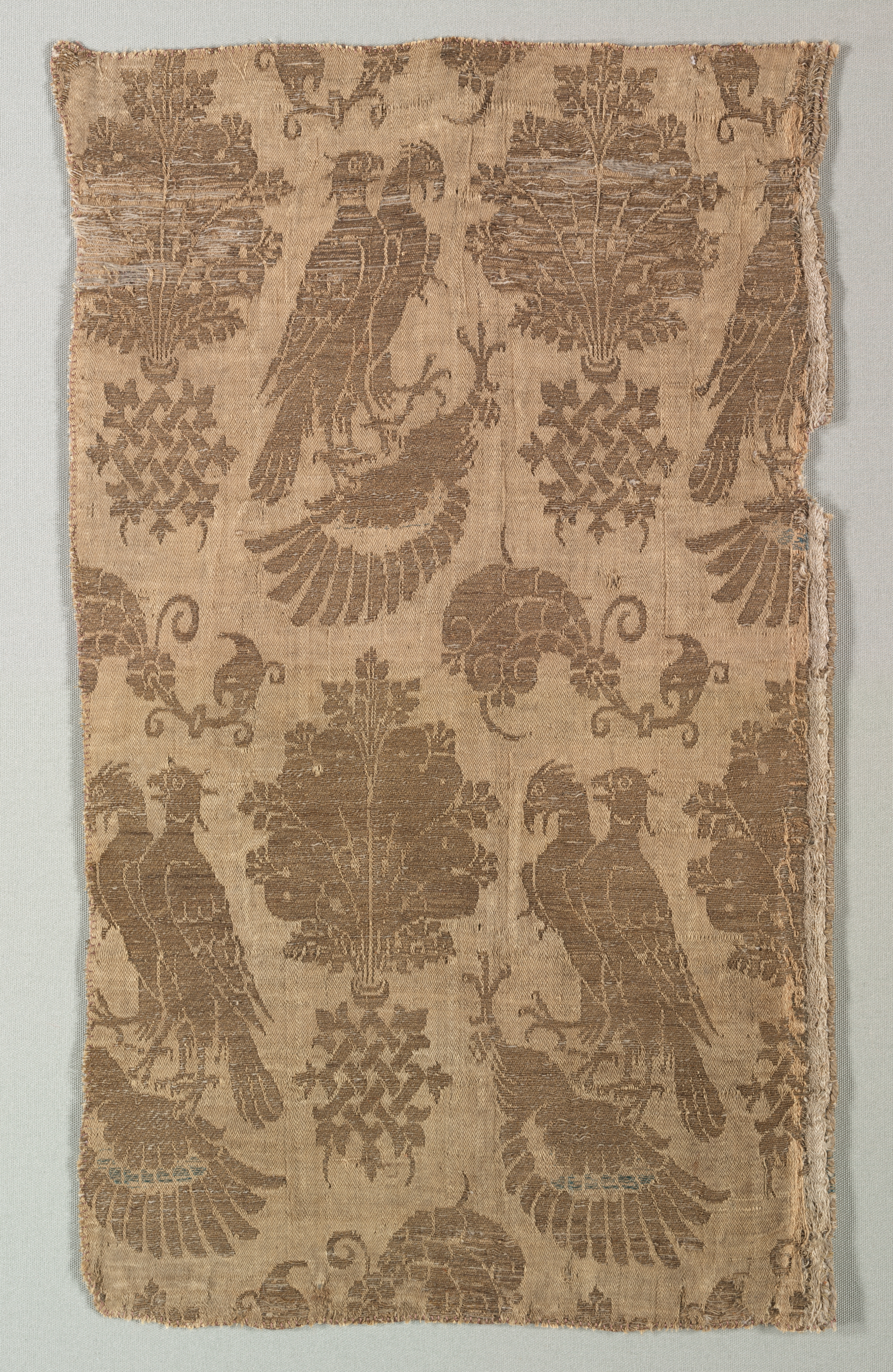
Deconstructing a 14th-Century Masterpiece: The Gold-Patterned Silk with Falcons and Heraldry
At Zoey Fashion Lab, our mission is to dissect historical textiles not merely as artifacts, but as living DNA strands that can be spliced into avant-garde design. The subject of this analysis is a rare and opulent silk fragment from Italy, dating to the last third of the 14th century. Composed of silk and gold thread, and woven using a complex lampas technique, this fabric is a testament to the intersection of power, artistry, and trade in the late medieval period. Its motifs—falcons and heraldic devices—are not decorative whims but encoded messages of status and territorial ambition. For the avant-garde designer, this textile offers a blueprint for rebellion: a way to weaponize history against the sterile minimalism of contemporary fashion.
Technical Anatomy: The Lampas Weave as a Structural Statement
The foundation of this fabric’s power lies in its technical construction. Lampas, a compound weave that emerged in the 12th century, involves a ground weave (typically a plain or twill) and a supplementary weft that creates the pattern. In this case, the ground is a fine silk, while the supplementary weft is a tightly wrapped gold thread—likely gilded silver or gold leaf wound around a silk core. This dual-weave system is not merely decorative; it creates a physical dichotomy of texture and weight. The silk ground provides fluidity, while the gold weft introduces rigidity and a reflective, almost metallic surface.
For the avant-garde designer, this structural duality is a direct challenge to the homogeneity of modern synthetic fabrics. The lampas technique is a metaphor for layering contradictions: soft versus hard, matte versus reflective, organic versus metallic. In a contemporary context, this can be reinterpreted through digital jacquard looms or laser-cut metallic foils bonded to silk charmeuse. The key is to preserve the tension between the two weaves—not to blend them, but to let them clash. A 2024 avant-garde collection might feature a coat where the gold pattern is raised, almost sculptural, while the silk ground is left deliberately frayed or distressed, creating a dialogue between decay and opulence.
Iconography: Falcons, Heraldry, and the Politics of Flight
The motifs on this silk are not random. The falcon, a bird of prey, was a symbol of nobility, martial prowess, and the hunt. In 14th-century Italy, falconry was a pastime reserved for the aristocracy, and the bird’s image on fabric served as a visual declaration of rank. The heraldic devices—likely shields, crowns, or geometric patterns—are equally loaded. They represent specific families, city-states, or alliances. This fabric was not meant to be seen; it was meant to be read.
For the avant-garde designer, this iconographic density is fertile ground. The falcon can be abstracted into a geometric silhouette, repeated at scale across a garment, or fragmented into a digital print that mimics a glitch. The heraldry can be deconstructed into its raw components: lines, angles, and negative space. The goal is to strip the symbols of their original power and reassign new meaning. For example, a heraldic lion might be rendered in neon thread against a black silk ground, transforming a symbol of feudal authority into a critique of modern power structures. The falcon, once a marker of privilege, can become a motif of liberation—a bird breaking free from the constraints of the weave itself.
Historical Context: The Silk Road and the Italian Renaissance
This fabric originates from a period of intense cultural and economic exchange. Italy in the late 14th century was a hub of the Silk Road, with cities like Venice, Florence, and Lucca dominating the production and trade of luxury textiles. The use of gold thread was not merely aesthetic; it was a display of liquid wealth. A single garment could cost as much as a small ship. The falcon and heraldry motifs reflect the influence of both Byzantine and Islamic design, filtered through a distinctly Italian sensibility. This is a fabric of hybridity—a fusion of Eastern technique and Western iconography.
For the avant-garde designer, this historical hybridity is a license to experiment. The fabric is a reminder that fashion has always been global, long before the term was coined. A contemporary reinterpretation might merge this 14th-century Italian silk with Japanese shibori dyeing or West African strip-weaving. The gold thread could be replaced with recycled metallic fibers, and the heraldry could be reimagined as QR codes or data patterns. The point is not to replicate the past but to use it as a catalyst for new forms of visual storytelling.
Avant-Garde Application: The New DNA Strand
At Zoey Fashion Lab, we view this textile as a new DNA strand—a genetic code that can be mutated, spliced, and recombined. The avant-garde designer is not a historian but a molecular biologist of form. Here are three specific applications for this fabric in a contemporary context:
1. Deconstructed Armor: The rigidity of the gold weft can be exploited to create structural pieces that function as modern armor. Consider a bodice where the gold falcon pattern is woven into a corset-like structure, while the silk ground is left sheer and vulnerable. The garment becomes a commentary on protection and exposure, power and fragility.
2. Digital Glitch and Noise: The heraldic devices can be scanned, distorted, and printed onto silk using reactive dyes. The result is a pattern that appears to be breaking apart—a visual representation of the decay of historical meaning. This technique honors the original fabric while subverting its authority.
3. Kinetic Weave: Using smart textiles, the gold thread can be replaced with conductive fibers that respond to movement or light. The falcons could appear to “fly” across the garment as the wearer moves, turning the static pattern into a dynamic performance. This is the ultimate evolution of the lampas technique: a weave that lives and breathes.
Conclusion: The Fabric as a Living Document
This gold-patterned silk from 14th-century Italy is not a relic. It is a living document, a genetic code waiting to be expressed. Its technical complexity, iconographic density, and historical context make it an ideal subject for avant-garde deconstruction. At Zoey Fashion Lab, we believe that the most radical future of fashion lies in the most distant past. By dissecting this fabric, we are not preserving history; we are rewriting it. The falcon, the heraldry, the gold thread—these are not artifacts of a bygone era. They are the raw materials for a new visual language, one that speaks of power, flight, and the eternal human desire to adorn the body with meaning.
This is the new DNA strand. And it is ours to splice.