Deconstructing the Demigod: A Tapestry of Force Re-woven
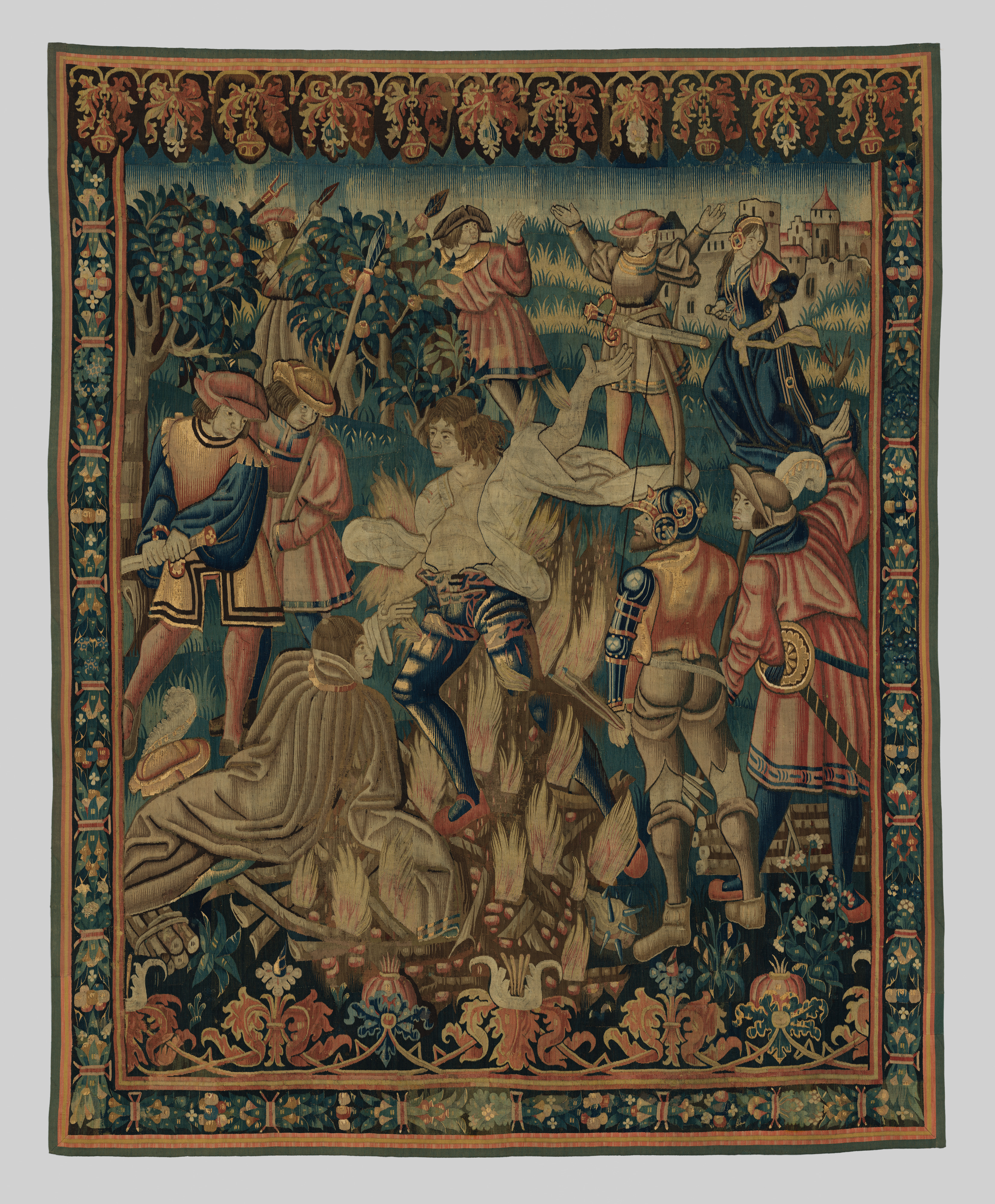
The narrative of Hercules, a cornerstone of Western mythos, is not merely a story of labors but a profound dialectic on the nature of force itself—brute, redemptive, chaotic, and ordered. This South Netherlandish tapestry, with its woolen warp and silken weft, presents a flattened, medieval chronology of heroic episodes. For Zoey Fashion Laboratory’s SS26, this artifact is not an inspiration but a specimen for radical sartorial dissection. We transpose the two-dimensional allegory into a three-dimensional exploration of the body under tension, proposing a collection that interrogates the very architecture of strength and vulnerability in a post-human context. The warp becomes our foundational biomechanics; the weft, our neural-silken pathways.
Episode I: The Nemean Lion – Exoskeletal Integrity & Biomimetic Armature
The first labor—the subduing of the invulnerable lion—translates not into animal print, but into a principles of protective articulation. The pelt that Hercules dons becomes a point of departure for a wearable exoskeleton. Imagine garments constructed from a proprietary, lightweight polymer composite, molded through 3D-scanning of the wearer’s own topography, creating a second skin that is both shield and constraint. Silhouettes are rigid yet organic, with overlapping plates inspired by myofascial chains, suggesting an amplified musculoskeletal system. Seams are not concealed but exaggerated as tensile ligaments, often threaded with luminous, fiber-optic "sinew" (a direct transposition of the silk weft’s narrative function). The color palette derives from the raw wool warp: undyed ecru, stone, and the shadowed grey of weathered monument, abruptly interrupted by the stark, lacquered black of the lion’s maw, manifested as asymmetric, jaw-like closures that clamp across the sternum or hip.
Episode II: The Lernaean Hydra – Proliferative Form & Reactive Topology
Confronting the multi-headed Hydra presents the problem of chaotic, regenerative growth. Our sartorial interpretation moves beyond the decorative into the domain of reactive garment architecture. Dresses and outerwear are engineered with kinetic appendages. Using shape-memory alloys and pneumatic micro-tubules embedded within a wool-blend substrate, sections of the garment inflate, extend, or reconfigure in response to environmental stimuli—heat, light, or proximity. A seemingly minimalist column gown might, with movement, generate a cascading, hydra-like train of articulated silk-covered protrusions. The concept of "cutting one head, two grow back" is realized through modular design: detachable sleeves or cowls can be replaced or multiplied by the wearer, creating infinite stylistic permutations from a single core garment. This represents a futuristic critique of fast fashion, proposing a single, evolving piece versus disposable multiplicity.
Episode III: The Augean Stables – Hydro-Dynamic Cleansing & Purified Silhouettes
The diversion of rivers to cleanse corruption is a labor of hydrological engineering. For SS26, this episode informs a philosophy of fluid dynamics and purified form. We envision garments that appear to be in a state of perpetual, elegant erosion. Techniques involve laser-cutting wool felts to create porous, cellular structures that mimic riverbank sedimentation. Silk is used in its most liquid state, engineered into seamless, bias-cut gowns that appear as a single, flowing volume, channeling water’s path of least resistance. The innovation lies in hydrophilic and hydrophobic fabric treatments within the same garment, creating controlled moisture maps—areas that darken or repel in patterns reminiscent of diverted waterways. The silhouette here is one of stark, relentless clarity: sweeping, unbroken curves that suggest a force of nature, cleansed of superfluous detail. It is austerity as power.
Episode IV: The Capture of Cerberus – Chthonic Restraint & Kinetic Containment
The descent into Hades and the binding of the three-headed hound Cerberus symbolizes the ultimate containment of primal, chaotic force. This final episode culminates in the exploration of constrained movement and multi-focal perspective. Silhouettes are structured around harness-like systems, not as accessory but as integral chassis. These harnesses, crafted from molded bioplastic and carbon fiber threads woven with wool, create geometric frames that both sculpt and restrict the body’s movement, echoing the act of binding. The "three heads" are interpreted as a tripartite focus in garment construction: a single garment may present three distinct necklines or back treatments, viewable in rotation as the wearer moves. Fabrics combine the dense, matte gravity of wool with sudden, glossed silk voids, suggesting the abyss. This collection’s finale pieces are about controlled potential, a tense equilibrium where immense power is held in a precise, elegant stasis.
In conclusion, Zoey Fashion Laboratory’s SS26 manifesto, derived from these Four Episodes, proposes a couture of conceptual force majeure. We move beyond representation into embodiment. The South Netherlandish tapestry provides the archaic code; we rewrite it for a future body. The result is a collection that is neither costume nor historical homage, but a rigorous, avant-garde study in how foundational myths can be deconstructed to engineer new paradigms of wearability. It is fashion as a laboratory for power dynamics, where every seam, articulation, and textile fusion asks: what forms does strength take when the labors are internal, and the arena is the self?