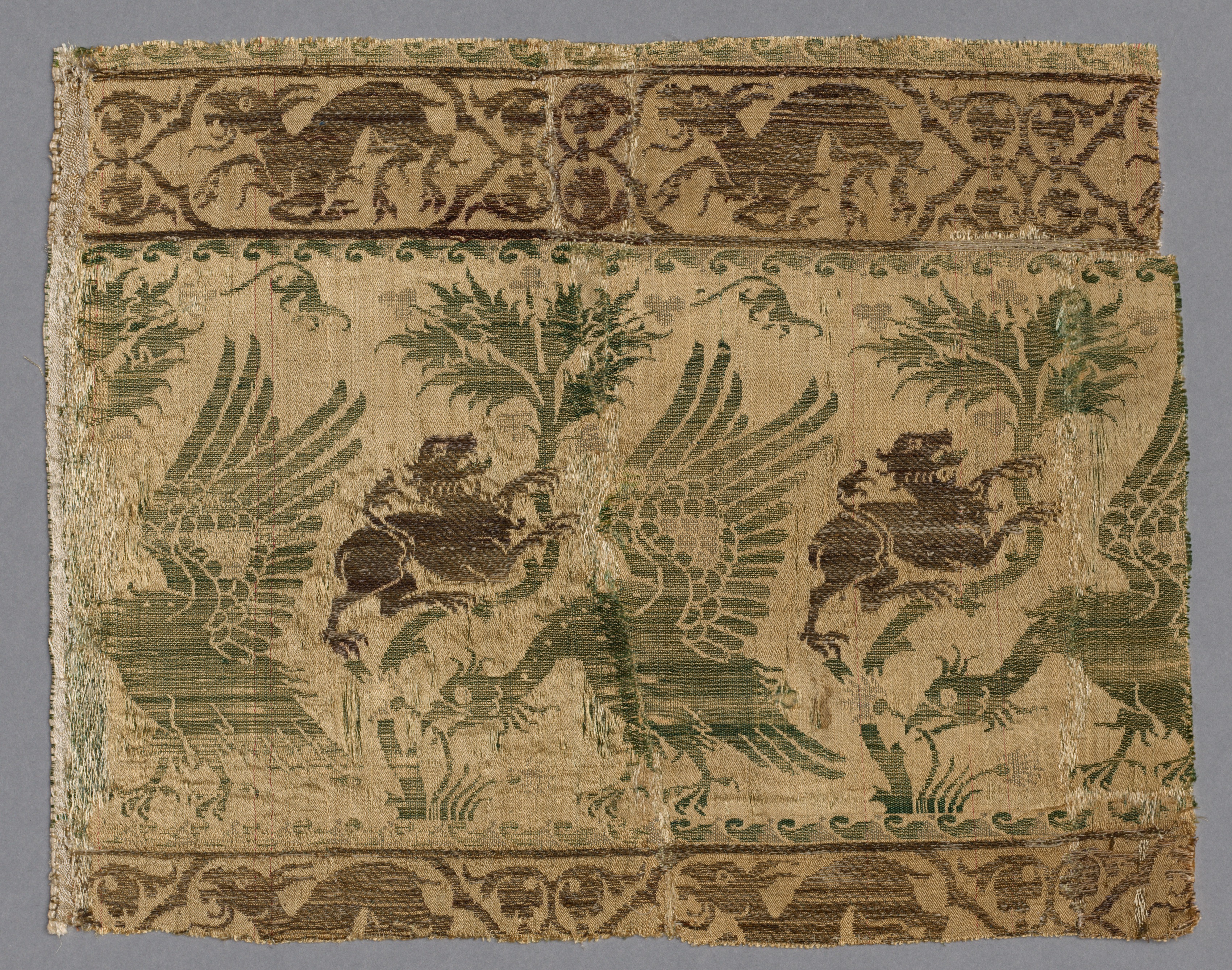
Deconstructing the Avant-Garde: A Technical and Stylistic Analysis of a 14th-Century Italian Silk and Gold Lampas
At Zoey Fashion Lab, our practice of fabric deconstruction is not merely an act of unraveling threads; it is an archaeological excavation of material culture, a dialogue between historical craftsmanship and contemporary aesthetic rebellion. The subject of this analysis—a silk and gold lampas weave from Italy, dating to the last third of the 14th century—represents a pinnacle of medieval textile technology and luxury. Yet, for the avant-garde designer, this artifact is not a relic to be preserved in a vitrine. It is a new DNA strand, a genetic code of opulence, structure, and symbolic weight that can be isolated, mutated, and recombined to challenge the very definitions of fashion, wearability, and time.
I. Technical Deconstruction: The Lampas Weave and Its Avant-Garde Potential
The technical foundation of this textile is the lampas weave, a complex structure that emerged in the high medieval period, particularly in Italian silk-weaving centers like Lucca, Venice, and Florence. Lampas is a figured weave in which a pattern is created by an additional weft (or wefts) that floats on the surface, bound by a ground warp. In this specific case, the ground is a fine silk, typically a tabby or twill, while the supplementary weft is composed of gold thread—usually a gilded silver strip wrapped around a silk core.
From a deconstructionist perspective, the lampas weave is a hierarchical system. The ground weave provides structural integrity and drape, while the gold weft introduces a layer of ornamentation that is both visual and tactile. The gold thread, being metallic, is inherently rigid and non-elastic. This creates a tension within the fabric: the silk offers fluidity, the gold imposes structure. For the avant-garde designer, this tension is a point of departure. One could extract the gold weft from its silk matrix, creating a fragmented, skeletal pattern that speaks to themes of decay, wealth, and the passage of time. Alternatively, one could overlay additional metallic yarns in a chaotic, non-repeating pattern, subverting the original, highly ordered design.
The 14th-century Italian lampas often featured intricate heraldic or botanical motifs, rendered in gold on a colored silk ground (commonly crimson, sapphire, or emerald). The technical precision required to weave such patterns was immense; each thread was meticulously counted and manipulated on a drawloom. For the avant-garde, this precision can be deliberately disrupted. Imagine a garment where the gold thread is left unbound, creating long, trailing loops that catch light and movement, transforming the wearer into a kinetic sculpture. Or consider a process of selective dissolution: using chemical agents to remove sections of the silk ground, leaving only the gold “skeleton” of the pattern. This would produce a lace-like, ghostly remnant—a textile that is both fragile and precious, a commentary on the ephemeral nature of luxury.
II. The New DNA Strand: Material as Code
The concept of the “new DNA strand” is central to our analysis. In biological terms, DNA is a sequence of instructions that dictates form and function. In this textile, the silk and gold are not merely materials; they are encoded with cultural, economic, and aesthetic information. The silk speaks to the transcontinental trade routes—the Silk Road—that brought raw materials to Italian workshops. The gold signifies wealth, power, and the patronage of the Church and aristocracy. The lampas weave itself encodes a specific technological knowledge, a mastery of the drawloom that was a closely guarded secret.
To treat this textile as a DNA strand is to recognize that it can be sequenced, edited, and re-expressed. For an avant-garde collection, one might isolate the “gold thread gene” and express it in a new context—perhaps embedding actual gold nanoparticles into a bio-engineered silk, creating a fabric that is both ancient and futuristic. Another approach is to reverse the polarity of the original code: where the 14th-century lampas was designed to be seen in static, reverential settings (churches, courtly ceremonies), the deconstructed version could be engineered for motion, for the urban street, for the digital screen. The gold thread could be replaced with fiber-optic yarn, turning the historical pattern into a programmable light display. The silk ground could be replaced with a breathable, stretchable synthetic that allows for radical silhouettes—asymmetrical, sculptural, deconstructed.
Furthermore, the act of deconstruction itself can be a form of genetic mutation. By physically cutting, fraying, or reassembling the original fabric, we introduce randomness and unpredictability. A 14th-century lampas fragment might be sewn onto a modern, raw-edged jacket, creating a collision of centuries. The gold threads could be pulled loose and re-woven into a three-dimensional, free-standing structure—a collar, a headpiece, a wearable architecture. This process transforms the textile from a finished object into a living system, one that continues to evolve and adapt.
III. Avant-Garde Stylistic Implications: From Relic to Disruption
The avant-garde is not merely about novelty; it is about questioning established norms. A 14th-century Italian silk and gold lampas, in its original context, was a symbol of orthodoxy—of religious devotion, dynastic power, and social hierarchy. To use this textile in an avant-garde manner is to subvert its original meaning. One could create a garment that deliberately exposes the weave’s construction, showing the warp and weft as raw, unfinished edges. This is a direct challenge to the medieval ideal of perfection and hidden labor.
Consider a dress that is half-finished: one side is the pristine, golden lampas, the other is the reverse, showing the silk ground and the loose threads. This duality speaks to the tension between public facade and private reality, a theme that resonates deeply in contemporary fashion. Alternatively, the gold thread could be used to write text—perhaps a fragmented line from Dante’s Inferno or a modern political slogan—directly onto the silk ground. This would transform the fabric from a decorative surface into a protest banner, a bearer of subversive messages.
The weight and structure of the lampas also lend themselves to architectural silhouettes. The gold weft, being stiff, can be used to create sharp, angular folds that stand away from the body. This is reminiscent of the work of designers like Rei Kawakubo or Yohji Yamamoto, who treat fabric as a three-dimensional medium. A coat made from this deconstructed lampas could have exaggerated shoulders, a sculptural collar, or a train that trails like a medieval banner. The gold would catch the light, creating a sense of movement even when the wearer is still.
Finally, the color palette of the original—deep reds, blues, and gold—can be manipulated. Through dyeing, over-dyeing, or bleaching, the silk ground can be altered to create a monochromatic, almost ghostly effect, with the gold pattern barely visible. This evokes a sense of memory, of a once-vibrant culture now faded. Alternatively, the gold could be patinated to a dull, tarnished finish, rejecting the idea of eternal luxury in favor of a more austere, conceptual beauty.
IV. Conclusion: The Fabric as a Living Archive
In conclusion, the 14th-century Italian silk and gold lampas is far more than a historical curiosity. For Zoey Fashion Lab, it is a new DNA strand—a rich, complex code that can be decoded, recombined, and expressed in ways that challenge the boundaries of fashion and art. By deconstructing its technical weave, its material hierarchy, and its cultural symbolism, we unlock a vocabulary of disruption: the tension between silk and gold, the precision of the drawloom versus the chaos of the cut, the sacred versus the profane. The avant-garde designer who engages with this textile is not simply borrowing from the past; they are rewriting history, creating a new narrative that is as much about the future as it is about the 14th century. This is the essence of our work: to see the ancient in the new, and the new in the ancient, and to weave them together into a fabric that is truly timeless.