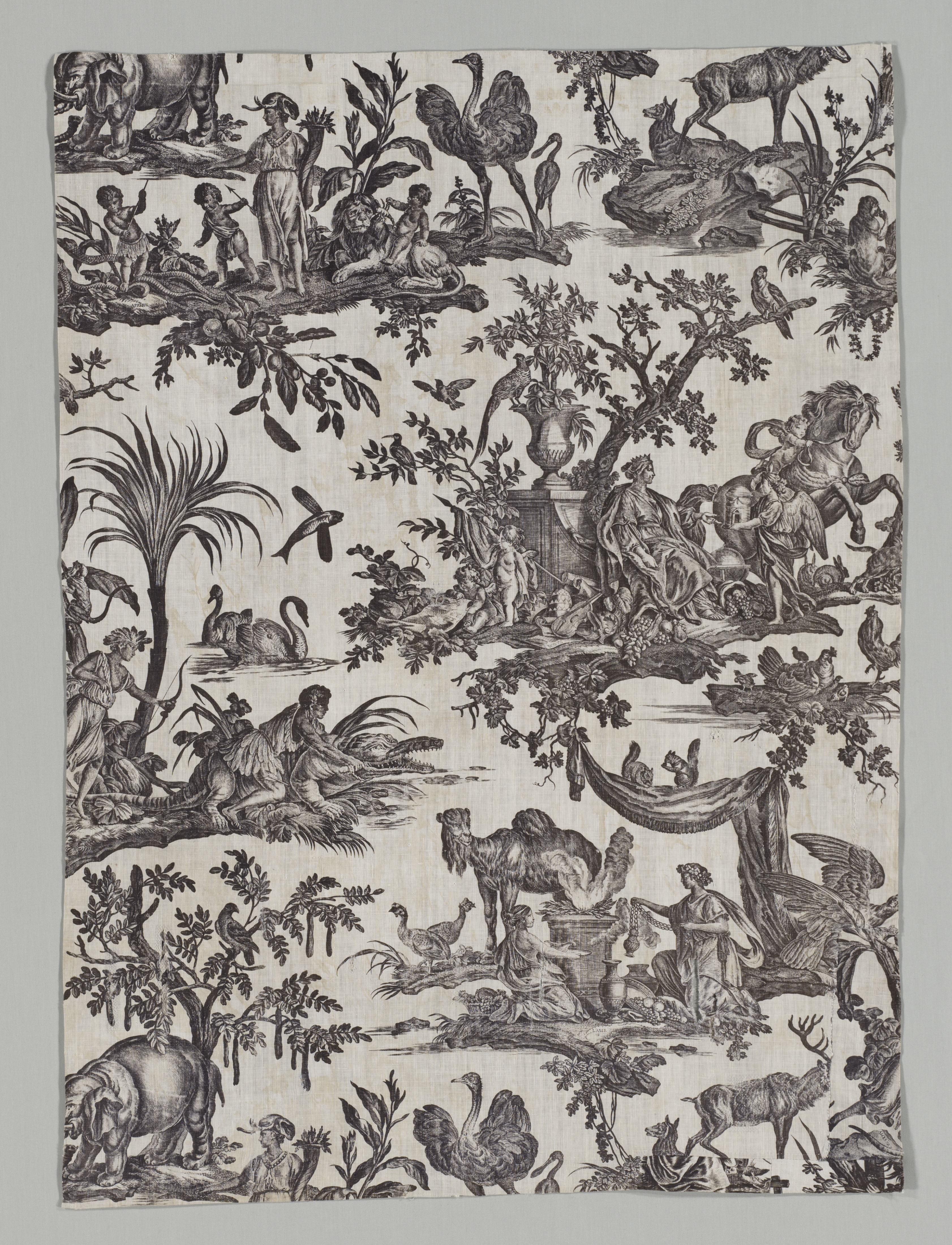
Deconstructing the Cartographic Gown: An Avant-Garde Analysis of "The Four Continents" Copperplate Print
At Zoey Fashion Lab, our mandate is not merely to observe historical textiles but to deconstruct their DNA—to extract the latent codes of power, perception, and materiality that define an era. The artifact before us, a fragment of 18th-century French copperplate-printed cotton depicting "The Four Continents," is a quintessential specimen for this exercise. It is a fabric that speaks of Enlightenment ambition, colonial cartography, and the nascent global textile industry. Yet, for the avant-garde designer, this is not a relic; it is a rupture point. It is a surface where the neat allegories of the Old World begin to fray, revealing the dissonance between representation and reality. This analysis will dismantle the technical, iconographic, and cultural strata of this fabric, re-synthesizing them into a blueprint for radical, forward-facing fashion.
I. Technical Tectonics: The Copperplate as a Tool of Mechanical Dissection
The choice of copperplate printing on cotton is the first and most critical act of deconstruction. In the 18th century, this was a revolutionary technology—a shift from the laborious, hand-painted or block-printed textiles of the East to a mechanically reproducible, precise, and linear aesthetic. The copperplate, engraved with infinite care, could render the most delicate hatching, the curl of a wave, the musculature of a classical allegory. But for the avant-garde eye, this precision is a form of violence. The plate imposes a rigid, monochromatic (typically red, blue, or purple) grid of meaning onto the supple, organic surface of cotton. The fabric becomes a passive receptor for an imperial narrative, its weave subjugated to the metallic bite of the engraver's tool.
Technically, we must observe the material paradox. Cotton, a plant fiber of immense global significance (often grown via colonial labor), is here dressed in the visual language of European high culture. The copperplate print does not dye the fiber; it stains the surface. The color sits on the cloth, a superficial skin. This creates a tension between depth and surface. The allegorical figures of the Four Continents (Europe, Asia, Africa, America) are rendered with illusionistic depth—shadows, folds, perspective—yet they are literally skin-deep. For the avant-garde designer, this is a provocation. We can exploit this surface/depth dichotomy. A garment could be designed to fray, tear, or be reversed, exposing the unprinted, raw cotton underside. The printed narrative becomes a fragile, peelable mask. We can laser-cut the copperplate lines, turning the allegorical figures into negative-space lace, allowing the body to breathe through the very voids of the colonial gaze.
II. Iconographic Fragmentation: The Four Continents as a Fractured Mirror
The subject matter—The Four Continents—is a cornerstone of 18th-century European allegory. Typically, Europe is depicted as a queen in regal attire, holding a scepter and orb, surrounded by symbols of art, science, and religion. Asia is a richly dressed figure with incense and a camel. Africa is often a semi-nude figure with a sun-dial or a lion, and America is a feathered warrior with a bow and a severed head. This is a hierarchical taxonomy of the world, a visual encyclopedia designed to naturalize European supremacy. The copperplate print freezes these figures in a static, theatrical tableau. They are not interacting; they are specimens in a cabinet of curiosities.
For the avant-garde, this iconography is a minefield of signifiers to be detonated. The "harmony" of the composition is a lie. We see the violence of categorization. The African figure, often shown with a broken chain, is a sanitized reference to slavery. The American figure, with a feathered headdress, is a romanticized erasure of genocide. The Asian figure, with her exotic silks, is an object of trade. The European figure, calm and central, is the curator of this zoo.
Our deconstruction must fragment these figures. We can isolate a single hand, a foot, a crown—blow it up to monstrous proportions, distort its scale. The copperplate's linear precision can be used to create optical illusions on the garment. For example, the European queen's scepter could be elongated into a structural boning element that distorts the wearer's silhouette, making them a prisoner of their own regalia. The African figure's lion skin could be abstracted into a pattern of threatening, jagged teeth that wrap around the torso. The American warrior's bow could become a deformed, asymmetrical sleeve. The Asian figure's incense smoke could be rendered as a toxic, swirling digital print over the copperplate lines, suggesting the pollution of cultural exchange.
III. Cultural Resonance and the Avant-Garde Re-Scripting
The Archive Resonance reference speaks of "器物与绘画" (artifacts and paintings) as "无声见证" (silent witnesses) to cultural collision. This fabric is a witness to a crime—the crime of epistemic violence. The 18th-century French mind used this textile to domesticate the world, to make it safe for consumption. The cotton itself, likely sourced from plantations in the Americas or India, is a material witness to global exploitation. The avant-garde designer must not simply "reappropriate" this image; they must interrogate its material and ideological conditions.
How do we re-script this narrative? We can employ subversive tailoring. The garment could be a deconstructed gown—a bodice that is all sharp, boned structure (mimicking the copperplate's rigid lines) but with a skirt that is a tangled, un-hemmed mess of raw edges, suggesting the unraveling of the colonial order. We can use textile manipulation: pleat the cotton so that the figures of the Four Continents only become visible from a specific angle, like a ghost in the machine. The wearer becomes a living palimpsest, with the historical print as the base layer, overlaid with contemporary embroidery, beadwork, or even digital screens that project real-time data on global inequality.
Furthermore, the color palette of the copperplate print (typically a single, strong color like indigo or madder red) can be weaponized. We can use color-blocking to isolate each continent's figure, then saturate them with toxic, industrial dyes—a neon pink for the European queen, a synthetic green for the American warrior. This creates a jarring, post-colonial clash that rejects the "natural" harmony of the original. The garment becomes a protest sign, worn on the body.
IV. Synthesis: A Blueprint for the "Cartographic Dissident" Collection
For Zoey Fashion Lab, this analysis yields a clear design directive. We propose a capsule collection titled "The Cartographic Dissident." The key pieces include:
1. The "Allegory of Rupture" Gown: A floor-length dress in raw, unbleached cotton. The copperplate print of the Four Continents is applied only to the front panel, but it is deliberately misaligned and slashed, with the cuts revealing a lining of bright, iridescent silk. The back of the dress is a blank, scarred canvas, with the copperplate lines re-embroidered in black thread as if they were surgical sutures.
2. The "Colonial Skeleton" Bodysuit: A second-skin bodysuit in stretch cotton, printed with a negative-space version of the allegorical figures. The lines of the copperplate become the boning of the garment, creating a structural cage that constricts and shapes the body. The bodysuit is worn under a sheer, deconstructed tulle overlay that has the figures printed in fading, ghostly tones, suggesting the erasure of history.
3. The "Taxonomy of Violence" Trench Coat: A classic trench coat, but the fabric is a patchwork of copperplate-printed cotton fragments, each fragment showing a different, isolated body part from the Four Continents. The coat is asymmetrical, with one sleeve longer than the other, and the pockets are lined with a map of 18th-century trade routes. The wearer is a nomadic archivist, carrying the fragments of a broken world on their back.
In conclusion, this 18th-century French copperplate print is not a passive artifact. It is a provocation. It challenges the avant-garde designer to look beyond the surface beauty of the engraving and see the political geometry of its lines. By deconstructing its technical processes, fragmenting its iconography, and interrogating its cultural resonance, we can transform this "silent witness" into a loud, dissenting voice. The fabric becomes a site of resistance, a garment that does not just clothe the body but re-writes the map of history itself. At Zoey Fashion Lab, we do not preserve the past; we unravel it to weave a new, more critical future.