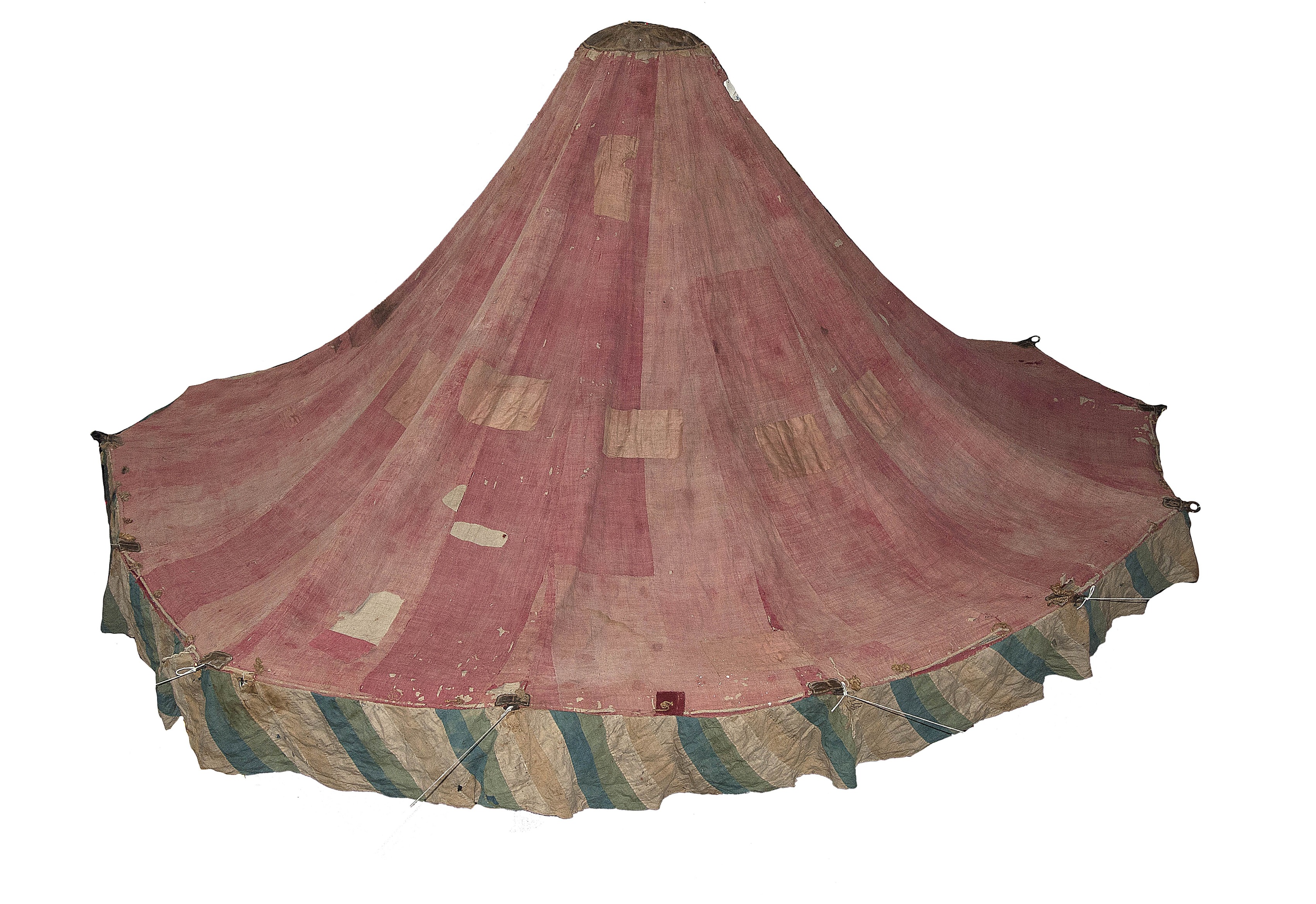
Deconstructing the Regal Canopy: An Avant-Garde Analysis of the Qajar Royal Round Tent
At Zoey Fashion Lab, we do not merely observe historical artifacts; we dissect them, probing their structural and symbolic DNA to extract blueprints for radical, contemporary design. The subject of this analysis—the Royal Round Tent (Roof) made for Muhammad Shah, originating from Rasht, Iran during the Qajar period (1779-1925)—presents a paradoxical challenge. On the surface, it is a relic of imperial power, a portable throne room woven from wool, silk, and leather. To the avant-garde eye, however, it is a deconstructed manifesto of nomadic luxury, a proto-installation of spatial hierarchy, and a masterclass in textural tension. This analysis will strip the tent of its historical reverence to reveal its radical potential for Zoey Fashion Lab’s future collections, focusing on its structural archaeology, material dissonance, and symbolic recontextualization.
Structural Archaeology: The Inverted Dome of Power
The tent’s defining feature is its roof—a circular, domed structure that once sheltered the sovereign. In architectural terms, this is a nomadic inversion of the palace dome. Where stone domes assert permanence, this textile dome declares engineered transience. The interior wool plain weave serves as the foundational canvas, a neutral ground for the explosion of silk embroidery in chain stitch. This is not mere decoration; it is a cartographic representation of power. The chain stitch, a technique often used for outlining and defining forms, here creates a dense, tactile topography that would have shimmered in candlelight, delineating the Shah’s supreme position at the center.
From an avant-garde standpoint, we see a deconstructivist pattern-making opportunity. The roof is not a single piece but a composite of segments, seamed and reinforced with leather and tape. This construction logic—of breaking a monumental form into manageable, portable units—is a direct precursor to contemporary modular design. For Zoey Fashion Lab, this suggests a collection of garments that are disassembled architectural elements. Imagine a coat whose shoulders mimic the tent’s radial seams, with leather-reinforced stress points that echo the iron ring at the apex. The iron ring, a brutal, functional anchor, is the antithesis of the delicate silk. This juxtaposition of the industrial (iron, rope) with the artisanal (chain-stitched silk) is a core tenet of our avant-garde ethos. We would translate this into hardware—oxidized iron clasps, raw-edged leather straps—that fracture the softness of silk and wool in a garment.
Material Dissonance: A Dialogue Between the Nomadic and the Courtly
The technical description of the tent reveals a profound material dichotomy. The exterior is utilitarian: cotton and wool plain weave, rope, and iron. This is the armor of the tent, designed to withstand wind, sun, and travel. The interior is opulent: fine wool inlaid work and silk chain stitch. This is the soul of the tent, designed to project wealth and divine right. This inside/outside reversal is a critical avant-garde concept. In traditional fashion, the exterior is the public face, while the interior is hidden. The Qajar tent inverts this: the rough, protective shell is the public face for the outside world, while the exquisite, fragile interior is reserved for the elite within.
For Zoey Fashion Lab, this suggests a reversible or dual-purpose garment. Consider a jacket where the outer layer is a coarse, raw wool plain weave, perhaps distressed or treated to appear weathered, with visible rope-like stitching and heavy iron grommets. The lining, however, would be a revelation: a meticulously embroidered silk surface, using chain stitch to create a dense, almost baroque pattern inspired by the Qajar floral and geometric motifs. The garment would be a portable sanctuary, a wearable tent that protects its wearer from the elements while hiding a secret world of luxury. The “inlaid work” of the wool interior is particularly inspiring. This technique, where one material is set into another, suggests a patchwork or piecing method for our designs. We would use contrasting textures—a panel of smooth, fine wool set into a field of rough, nubby wool—to create a visual and tactile rhythm that mimics the tent’s construction.
Symbolic Recontextualization: The Tent as a Mobile Throne
The Archive Resonance reference places this tent within the context of 16th-17th century cultural collisions. The Qajar period was a time of intense interaction between Persian, Ottoman, and European aesthetics. This tent is a product of that friction. The chain stitch embroidery, while deeply Persian, also shows influences from European needlework, just as the tent’s form echoes Central Asian yurts. This hybridity is the foundation of modern avant-garde design. We are not bound by purity of origin; we are free to mix, match, and mutate.
We recontextualize the tent’s primary function: it is not a shelter, but a stage for performance. The Shah sat at the center, the apex of the roof above him, the embroidered walls around him. In our interpretation, the wearer becomes the Shah. A garment derived from this tent must create a force field of presence. The circular form of the roof translates into a dramatic, circular collar or a cape that extends into a train, creating a silhouette that commands space. The chain stitch embroidery is not just pattern; it is a narrative code. We would abstract the floral motifs into sharp, geometric fragments, using metallic silk thread to catch light and create a sense of movement, as if the tent is alive and breathing.
Avant-Garde Application: The Zoey Fashion Lab Collection
From this deconstruction, we propose a capsule collection titled “Nomadic Throne.” Key pieces would include:
- The Inverted Dome Coat: A floor-length coat with a circular, structured yoke that stands away from the shoulders, like the tent’s roof. The exterior is a raw, undyed wool plain weave, with visible seams and leather patches at the elbows and shoulders. The interior is a shock of deep indigo silk, entirely covered in a dense, abstract chain stitch pattern. The closure is a single, oversized iron ring and rope toggle.
- The Radial Seam Dress: A column dress constructed from multiple gored panels, each seamed with a strip of black leather. The seams radiate from a central point at the back of the neck, mimicking the tent’s construction. The fabric is a heavy wool inlaid with panels of silk, creating a subtle, shifting surface.
- The Portable Throne Accessory: A large, circular bag or “pod” made from the same materials, with an iron ring at the top and a rope handle. It is both a functional bag and a sculptural object, a miniature tent that the wearer carries.
In conclusion, the Royal Round Tent is far more than a historical artifact. It is a blueprint for radical design, a testament to the power of material contrasts, structural ingenuity, and symbolic layering. By deconstructing its roof, we have unearthed a philosophy of portable power and hidden luxury that is perfectly aligned with Zoey Fashion Lab’s avant-garde vision. We do not replicate the past; we resonate with its frequencies, translating the whispers of a Qajar throne room into the bold, wearable statements of tomorrow.