Deconstructing the Il-Khanid Leaf: An Avant-Garde Analysis of Silk and Gold
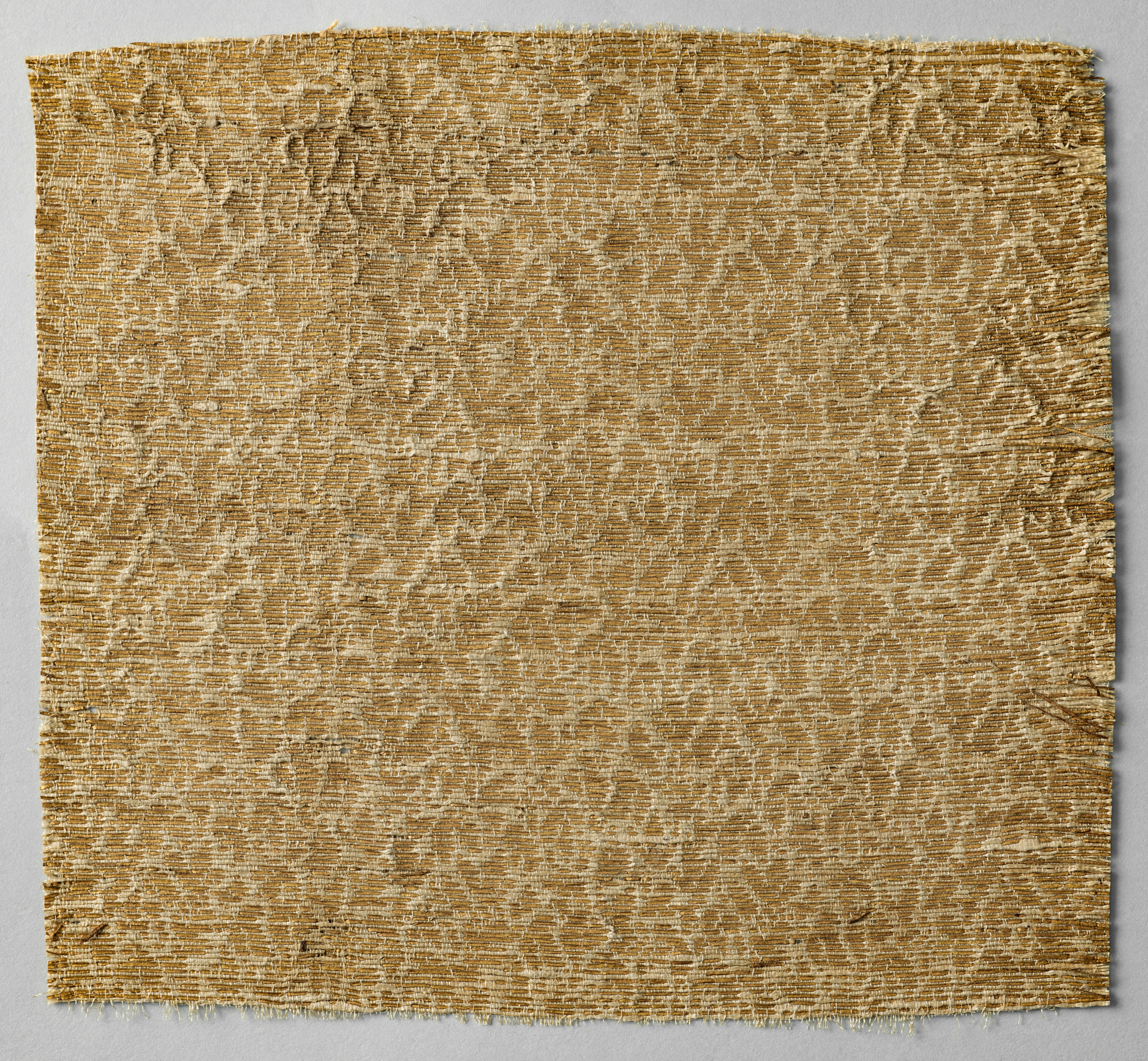
As the Chief Fabric Deconstructionist for Zoey Fashion Lab, my role is to dismantle not merely the physical threads of a textile, but its historical, cultural, and technical DNA. The subject before us—a textile fragment from the Il-Khanid period of Central Asia, woven in silk and gold thread with a tabby weave and supplementary weft, and bearing a motif of tiny leaves—presents a paradox. It is a relic of imperial power and nomadic heritage, yet its core structure contains the blueprint for a radical, avant-garde future. This analysis will dissect the fabric’s technical architecture, its historical symbolism, and its latent potential for a new design language, one that we at Zoey Fashion Lab will call the "New DNA Strand."
Technical Architecture: The Tabby as a Grid of Possibility
The foundation of this textile is the tabby weave, the simplest and most ancient of weaves, where each weft thread passes over and under every warp thread. This creates a grid-like structure, a neutral canvas of pure functionality. For Zoey Fashion Lab, this grid is not a limitation but a primary code. It represents the fundamental algorithm of textile construction—a baseline from which all complexity emerges. The supplementary weft, however, is where the deconstruction becomes fascinating. This is not a structural necessity; it is an additive layer of information. In the original Il-Khanid piece, this supplementary weft was used to introduce the gold thread, creating the shimmering leaves. In our avant-garde reimagining, this supplementary weft becomes a vector for disruption. We can program it to carry non-traditional materials—conductive threads, biodegradable polymers, or even micro-encapsulated pigments that respond to temperature or light. The tabby grid remains stable, while the supplementary weft mutates, allowing the fabric to perform rather than merely exist.
The use of silk and gold thread is equally instructive. Silk, a protein fiber, is prized for its luster and strength. Gold, a metal, is prized for its permanence and value. Together, they create a binary of organic and inorganic, soft and hard, ephemeral and eternal. In the context of the New DNA Strand, we see this as a hybridization protocol. The silk represents the biological, the natural, the inherited. The gold represents the synthetic, the industrial, the constructed. Our avant-garde approach will not merely combine these; it will recombine them. We will extract the silk’s protein structure and re-engineer it into a bio-composite that can be 3D-printed. The gold thread will be replaced with a nano-filament that can harvest kinetic energy from movement. The original textile’s luxury becomes a functional, interactive system.
Historical Symbolism: The Leaf as a Mobile Identity
The motif of tiny leaves is deceptively simple. In the Il-Khanid period, the Mongol rulers of Persia adopted and adapted local artistic traditions. The leaf, often derived from Chinese lotus or peony motifs, was a symbol of paradise, renewal, and the eternal cycle of nature. However, the scale—"tiny"—is critical. These are not grand, monumental leaves; they are micro-narratives, repeated across the fabric’s surface. This repetition creates a rhythm, a pattern that is both decorative and structural. For Zoey Fashion Lab, this is a lesson in distributed agency. The leaf is not a singular icon; it is a unit of a larger system. In our avant-garde interpretation, we will scale this concept down further, to the molecular level. The "leaf" becomes a molecular marker, a DNA sequence that encodes the fabric’s origin, its maker, and its intended lifecycle. Each tiny leaf on the new textile will be a data point, readable by a scanner, that tells the story of the garment’s production, use, and eventual decomposition or reincarnation.
The Il-Khanid period was one of syncretism—the fusion of Mongol, Persian, Chinese, and Islamic influences. This textile is a physical document of that cultural collision. The tiny leaves are not purely Chinese, Persian, or Mongol; they are a hybrid, a new species born from contact. Our New DNA Strand approach embraces this syncretism as a design methodology. We will not simply replicate the leaf motif; we will cross-breed it with other motifs from the Zoey Fashion Lab archive—digital glitches, fractal geometries, urban graffiti. The result will be a textile that is not a historical reproduction but a living archive, where past and future coexist in a single weave.
Avant-Garde Application: The New DNA Strand in Practice
How do we translate this deconstruction into a tangible design? The first step is to reprogram the loom. Instead of using a traditional shuttle, we will employ a robotic weft inserter that can handle multiple materials simultaneously. The tabby grid will be woven from a base of recycled silk and biodegradable cellulose. The supplementary weft will be a programmable thread that contains a core of copper wire, coated with a thermochromic polymer. As the wearer moves, the heat from their body will activate the polymer, causing the "tiny leaves" to change color—from a deep indigo to a vibrant gold, echoing the original textile’s precious metal.
Second, we will redefine the leaf motif. Using a generative algorithm, we will create a family of leaf shapes that are not identical but genetically related. Each leaf will have a unique curvature, vein structure, and size, yet all will be recognizable as variations on a theme. This mimics the natural variation found in actual leaves, but also introduces a digital logic of mutation and selection. The pattern will be printed onto the supplementary weft using a micro-dispensing system, allowing for precise placement of the conductive and thermochromic elements.
Finally, we will embed a narrative layer. The copper wire in the supplementary weft will be connected to a small, flexible circuit board at the garment’s hem. This board will contain a memory chip that stores the fabric’s "DNA"—its origin story, its carbon footprint, its care instructions, and even a digital signature from the weaver. When a consumer scans the garment with a smartphone, they will access this information, transforming the textile from a commodity into a communicative artifact. The tiny leaves, once symbols of paradise, become nodes in a network of transparency and accountability.
Conclusion: From Relic to Catalyst
The Il-Khanid textile with tiny leaves is not a museum piece to be preserved under glass. It is a catalyst. Its tabby grid provides the structure for a new digital-physical hybrid. Its silk and gold point toward a future of bio-industrial synthesis. Its tiny leaves offer a model for distributed, data-rich design. At Zoey Fashion Lab, we do not deconstruct to destroy; we deconstruct to reconstruct. By understanding the original fabric’s technical and symbolic DNA, we can engineer a new strand—one that honors the past while leaping into an avant-garde future. This is not a costume; it is a prototype for a living garment, one that breathes, communicates, and evolves. The tiny leaves are no longer just seen; they are read, felt, and responded to. That is the power of the New DNA Strand.