Deconstructing the Pomegranate: An Avant-Garde Analysis of 15th-Century Florentine Silk Velvet
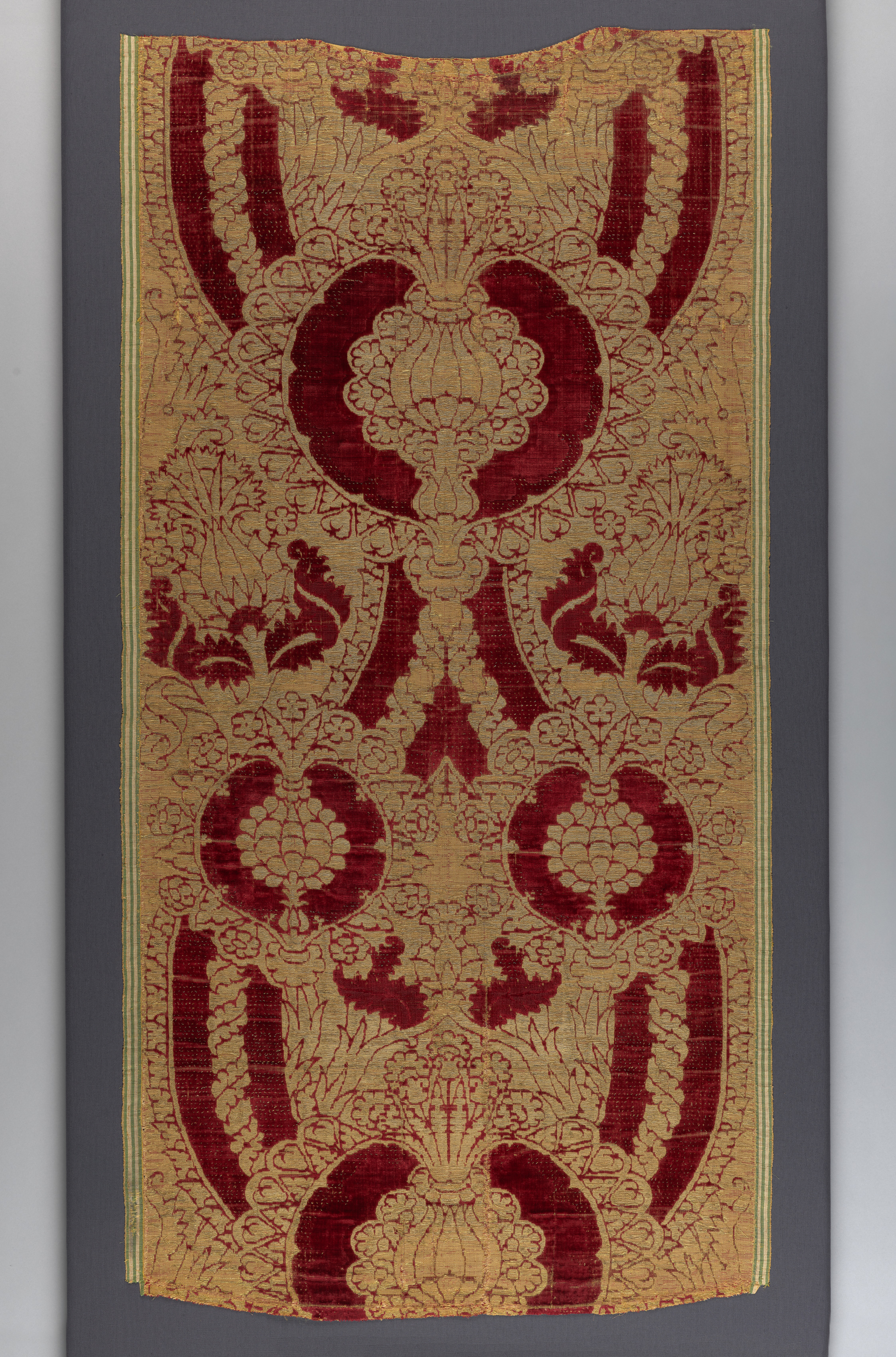
At Zoey Fashion Lab, we do not simply study historical textiles; we dissect them. We treat each thread as a sentence, each weave as a paragraph, and each pattern as a narrative waiting to be rewritten. The object of our current deconstruction is a rare specimen: a 15th-century silk velvet with gold, originating from the Florentine workshops of Italy. Its surface is a dense, luminous field of pomegranate motifs rendered in cut and uncut pile, interwoven with gold-thread loops. This is not a relic to be preserved under glass. It is a manifesto. By stripping this fabric of its historical context and re-examining it through an avant-garde lens, we uncover its radical potential—a blueprint for disrupting texture, light, and form in contemporary fashion.
Technical Dissection: The Grammar of Luxurious Disruption
The technical construction of this velvet is the first site of deconstruction. It is a complex, multi-layered system of silk and gold thread, employing cut pile in two heights, uncut pile loops, and gold-thread loops. This is not a flat surface; it is a topographical map of intentional contradiction.
The two heights of cut pile create a primary and secondary relief. The taller pile defines the pomegranate’s body, while the shorter pile articulates the surrounding leaves and stems. This is a deliberate manipulation of depth, a technique that forces the eye to travel across the fabric, never settling. In an avant-garde context, we see this as a precursor to three-dimensional textile construction—a way to build volume not through padding, but through the very structure of the weave. The uncut pile loops introduce a raw, tactile element. They are the unfinished sentence, the exposed seam of the fabric’s logic. They catch light differently, creating a matte, almost dusty texture against the slick sheen of the cut pile.
Most radical is the gold-thread loops. These are not flat, gilded lines. They are raised, metallic loops that physically protrude from the surface. They catch and scatter light in unpredictable, almost aggressive bursts. This is not the quiet shimmer of a gold brocade; it is a loud, sculptural statement. The gold is not a background or an accent; it is a structural element that disrupts the velvet’s inherent softness. This juxtaposition of plush silk and rigid, protruding metal creates a tactile dissonance—a core principle of avant-garde design. The fabric demands to be touched, but its surface is deliberately hostile to a single, smooth caress.
Pattern Analysis: The Pomegranate as a Symbol of Fracture
The pomegranate motif itself is rich with symbolic weight—fertility, abundance, and the cyclical nature of life and death. However, in our deconstruction, we strip it of this Renaissance humanist meaning. We see the pomegranate not as a symbol of unity, but as a symbol of fracture. Its many seeds are not a sign of wholeness, but of a core that has burst open, spilling its contents in a controlled, decorative explosion.
This pattern is rendered with a symmetry that is almost obsessive. The gold loops follow the contours of the fruit, outlining its split form. The two pile heights create a rhythmic pulse of dark and light, recess and projection. In an avant-garde reading, this is a visual stutter. The fabric repeats its motif, but each repetition is slightly different due to the interplay of light and texture. The pattern is not a static image; it is a performance of light, changing with every movement of the wearer. This aligns perfectly with the concept of Archive Resonance—the idea that a historical artifact does not speak to us from a fixed past, but resonates differently depending on the lens through which we view it. Here, the pomegranate’s “split leaf” is not a botanical detail; it is a formal device for breaking the plane of the fabric, creating a visual fissure that mirrors the physical fissures of the cut and uncut pile.
Avant-Garde Application: From Relic to Revolutionary Garment
How do we translate this 15th-century Florentine velvet into an avant-garde fashion statement? The answer lies in radical recontextualization.
1. Deformed Silhouette: The fabric’s weight and structural integrity are its primary assets. We would not drape it into a gown. Instead, we would use it to construct a piece that defies the body’s natural shape. Imagine a sculpted, asymmetrical bodice where the gold-thread loops are left exposed, not as embroidery, but as a raw, metallic fringe. The two pile heights would be used to create a gradient of texture, from smooth to rough, across a single, exaggerated shoulder. The pomegranate pattern would be cut and reassembled, its symmetry broken to follow the lines of a distorted, almost architectural silhouette.
2. Tactile Opposition: The core of the design would be the tactile dissonance. The velvet’s soft pile would be juxtaposed against hard, cold elements. For example, the gold-thread loops could be woven into a chainmail-like panel that sits over a sheer, fragile silk base. The cut pile would be used for a voluminous, cloud-like sleeve, while the uncut loops would form a raw, unfinished hem. The garment would be a conversation between the precious and the brutal, the soft and the sharp.
3. Light as a Material: The gold-thread loops are not just decorative; they are a mechanism for controlling light. In an avant-garde context, we would treat them as a living material. The garment would be designed to catch light in specific, dramatic ways—perhaps with a hood or collar that frames the face in a halo of gold loops, or with a train that drags on the ground, scattering light like a comet’s tail. The two pile heights would be used to create a moiré effect, where light and shadow dance across the surface in a hypnotic, disorienting pattern.
4. The Unfinished Garment: The uncut pile loops are a sign of the fabric’s potential, not its completion. We would lean into this by leaving edges raw, by allowing gold threads to fray, and by incorporating the loops as a deliberate, unfinished detail. The garment would look like a work in progress, a relic of a future that is still being woven. This aligns with the avant-garde’s love of the imperfect and the unresolved.
Conclusion: The Fabric as a Time-Bending Artifact
This 15th-century Florentine silk velvet is not a historical dead end. It is a starting point. Its technical complexity—the two pile heights, the uncut loops, the gold-thread loops—is a radical vocabulary for texture and light. Its pomegranate pattern is a symbol of fracture and release. When we deconstruct it through an avant-garde lens, we see not a relic of the past, but a blueprint for a future where fabric is not just worn, but inhabited. The garment we envision is a time-bending artifact: it carries the weight of its Florentine origin, but its form is entirely of the present. It is a mirror of silver and gold, a split leaf, a life story told in relief. It is, in essence, the Archive Resonance made tangible—a fabric that refuses to be silent.