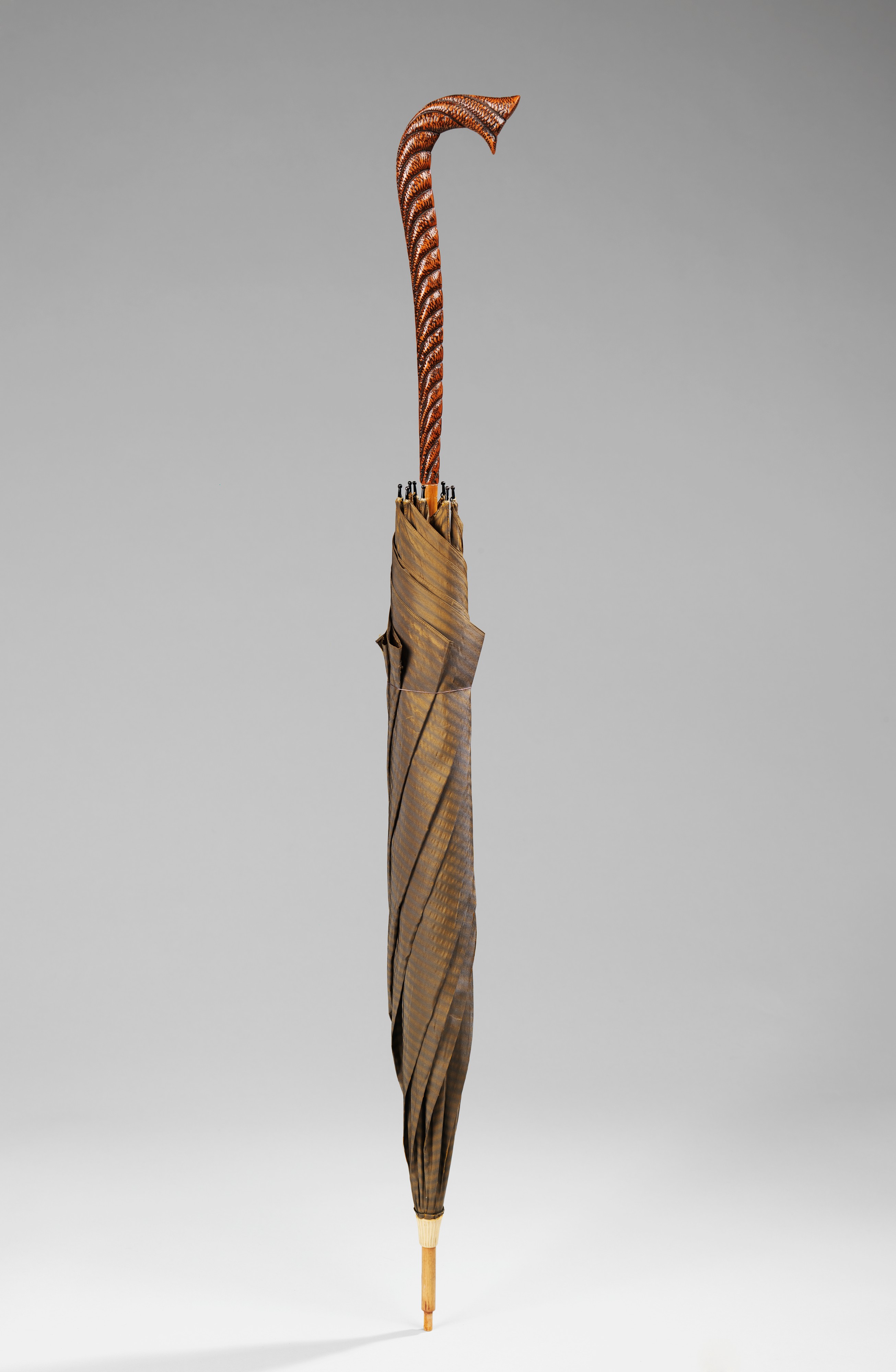
Deconstructing the Canopy: The Umbrella as a Structural Paradigm for SS26
Introduction: The Umbrella Beyond Utility
The umbrella, a quotidian object of American ingenuity repurposed from rain protection to sunshade, undergoes a radical metamorphosis in this SS26 avant-garde study for Zoey Fashion Laboratory. No longer a mere accessory, it is reimagined as a wearable architectural system—a dialogue between silk's fluidity, wood's skeletal strength, and metal's tensile precision. This analysis dissects the umbrella's potential to redefine futuristic silhouettes through deconstructive aesthetics, challenging the very notion of garment as shelter. The American origin of this object—historically tied to colonial innovation and later mass production—is subverted into a high-concept exploration of kinetic draping and structural asymmetry, where the canopy becomes a second skin for the post-human form.
Material Alchemy: Silk, Wood, and Metal in Dialogue
The triumvirate of materials—silk, wood, and metal—is not merely a palette but a tension system that drives the collection's avant-garde ethos. Silk, often associated with luxury and fluidity, is here treated as a programmable membrane. Through laser-cut perforations and heat-set pleating, it mimics the umbrella's radial folds, yet is engineered to collapse and expand in response to body movement. This is not drapery in the classical sense; it is dynamic architecture that adapts to the wearer's biomechanics.
Wood, sourced from American hardwoods like ash or maple, is carved into exoskeletal struts that articulate the silhouette. These are not hidden but exposed, forming a cage-like structure that echoes the umbrella's ribbing. The wood is treated with a matte lacquer to resist moisture, yet its grain remains visible, grounding the design in organic tactility. Metal—specifically, brushed aluminum or oxidized steel—is used for hinged joints and magnetic closures, allowing the garment to transition from a closed pod to an open canopy. The interplay of these materials creates a haptic hierarchy: silk yields, wood supports, metal locks.
Futuristic Silhouettes: The Canopy as Second Skin
The quintessential umbrella shape—a dome on a stick—is deconstructed into modular volumes that wrap the torso, extend as asymmetrical trains, or hover as detached headpieces. Three key silhouettes emerge for SS26:
1. The Radial Cocoon: A full-body garment where silk panels radiate from a central wooden spine at the nape, forming a cone that flares outward. The metal ribs are visible as external boning, creating a geodesic lattice that mimics an inverted umbrella. The silhouette is both protective and vulnerable—a shell that invites touch while repelling the elements.
2. The Asymmetrical Canopy Skirt: A hybrid of skirt and cape, where a single wooden strut extends from the hip, supporting a silk sail that drapes diagonally across the body. The metal joints allow the sail to be adjusted, creating a variable silhouette that shifts from a tight column to a dramatic train. This piece challenges the static nature of traditional couture, introducing kinetic draping as a core design principle.
3. The Detached Headpiece: A standalone canopy made of silk stretched over a wooden frame, suspended above the head via a metal armature. This piece divorces the umbrella from the body entirely, transforming it into a wearable sculpture that alters the wearer's aura. The headpiece is not a hat but a spatial intervention, creating a negative space around the face that distorts perception.
Structural Innovation: From Folding Mechanism to Kinetic Garment
The umbrella's folding mechanism is the crux of its structural innovation. In this collection, the parasol joint is reimagined as a ratcheting system that allows the garment to collapse into a compact form or expand into a full silhouette. The wooden struts are connected by metal hinges that click into place at 15-degree intervals, enabling the wearer to sculpt their own silhouette in real time. This is not passive fashion; it is interactive architecture that demands engagement.
Furthermore, the silk is treated with a thermochromic dye that shifts color with body heat, revealing hidden patterns—a map of the umbrella's original stitching—as the garment warms. The metal components double as conductive threads, allowing for subtle LED integration that pulses in response to ambient light. This fusion of biometric feedback and material intelligence positions the umbrella not as a relic but as a prosthetic for the future.
Deconstructive Aesthetics: The Unmaking of Form
Deconstruction in this context is not destruction but revelation. The umbrella's inner workings—the ribs, the runner, the ferrule—are exposed and exaggerated. Seams are left raw, silk edges are frayed, and wooden struts are notched to show their grain. This anti-finish aesthetic honors the object's utilitarian origins while elevating it to haute couture. The canopy is sliced open in strategic places, creating negative spaces that reveal the body beneath, challenging the umbrella's original purpose of concealment.
The American origin is acknowledged through industrial references: the metal joints are stamped with patent numbers, and the wood is sourced from sustainable American forests, tying the collection to a narrative of craft and commerce. Yet, the overall effect is futuristic—a garment that looks like it was salvaged from a post-apocalyptic weather station.
Conclusion: The Umbrella as a Manifesto for SS26
This avant-garde study positions the umbrella as a blueprint for wearable architecture. By deconstructing its form and reimagining its materials, Zoey Fashion Laboratory proposes a new paradigm for SS26: garments that are not static but responsive, kinetic, and deeply structural. The umbrella's American origin is not a limitation but a launchpad, infusing the collection with a spirit of industrial pragmatism tempered by poetic abstraction. In this vision, the umbrella is no longer a tool for shielding against rain; it is a canopy for the self, a shelter that the wearer can rebuild with every gesture. The future of couture lies not in draping fabric but in engineering possibility—and the umbrella, with its simple yet profound mechanics, is the perfect starting point.