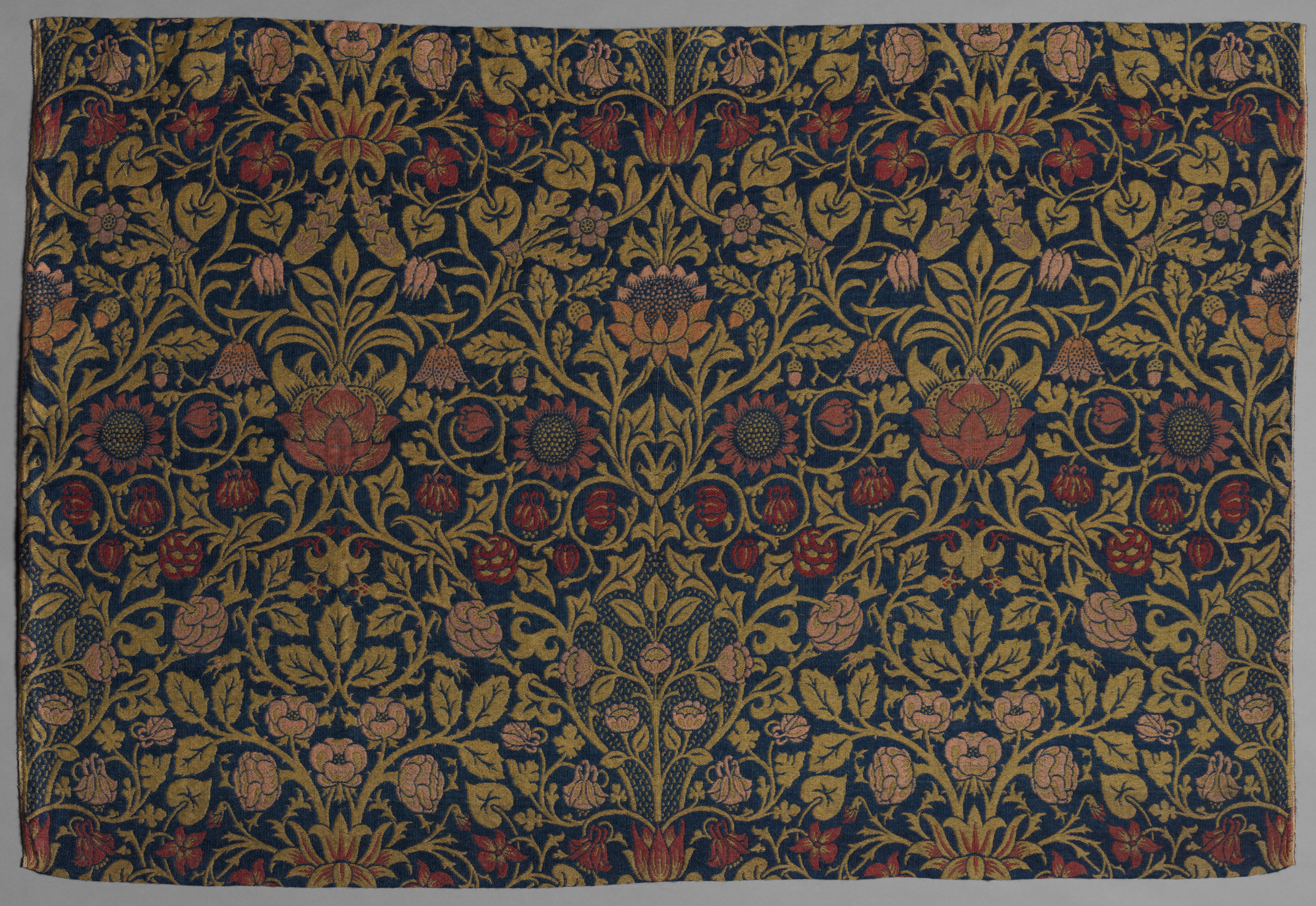
Deconstructing the Archive: Violet and Columbine at Zoey Fashion Lab
At Zoey Fashion Lab, our mission is to interrogate the material past to forge the aesthetic future. The textile designated Violet and Columbine, originating from the historic Merton Abbey in Surrey, England, presents a profound case study in this endeavor. This is not merely a fabric; it is a dense, woven document. Its technical specifications—a jacquard loom woven, weft-faced twill, double cloth construction in wool and mohair—speak to a specific moment of industrial artistry. Yet, its Archive Resonance, which evokes the cultural collisions and aesthetic fusions of the 16th and 17th centuries, propels it directly into the avant-garde. Our analysis will deconstruct this textile from three critical perspectives: its technical anatomy, its historical and cultural strata, and its potential for radical, forward-facing application.
Technical Anatomy: The Architecture of Weight and Light
The fabric’s construction is a masterclass in engineered complexity. The jacquard loom is the first key. Unlike simpler dobby looms, the jacquard mechanism allows for the independent control of each warp thread, enabling the creation of intricate, repeating patterns with seemingly infinite variation. For Violet and Columbine, this means the floral motifs—the violet and the columbine—are not printed or embroidered on the surface; they are structurally integral to the weave. This is a fabric that is its own pattern.
The designation weft-faced twill is equally critical. In a weft-faced weave, the weft (horizontal) threads dominate the surface, obscuring the warp (vertical) threads. This creates a fabric with exceptional drape and a pronounced, often lustrous, surface. The twill structure, characterized by its diagonal ribs, adds durability and a subtle, shifting texture. When combined with the weft-faced orientation, the result is a textile that catches and reflects light differently from every angle, creating a living, breathing surface.
The double cloth construction is the most technically audacious element. Double cloth is essentially two separate fabrics woven simultaneously, one on top of the other, and interconnected at specific points. This creates a fabric with two distinct faces, each potentially with a different color, pattern, or texture. For Violet and Columbine, this likely allows for a deep, saturated violet on one side and a contrasting, perhaps lighter, columbine-inspired hue on the reverse. The interplay between these two layers, and the points where they are bound together, generates a three-dimensional, almost sculptural quality.
The choice of fibers—wool and mohair—is a deliberate study in contrast. Wool provides structure, warmth, and a matte, grounded finish. Mohair, the lustrous fleece of the Angora goat, introduces a halo of light, a silky sheen, and a remarkable resilience. The mohair fibers, with their smooth scales, resist felting and add a crisp, springy hand. Together, wool and mohair create a fabric that is simultaneously substantial and ethereal, heavy yet luminous. This is a textile that demands to be felt, its weight and texture a tactile narrative of its own making.
Archive Resonance: The Echo of Cultural Collision
Our Archive Resonance reference situates this fabric within the tumultuous period of the 16th and 17th centuries—an era of global exploration, religious upheaval, and unprecedented cultural exchange. The Merton Abbey works, while a product of the 19th-century Arts and Crafts movement, drew deeply from these earlier wellsprings. The violet and columbine motifs are not merely decorative; they are loaded with symbolic meaning. The violet, in Renaissance emblem books, often represented humility, faithfulness, and the Virgin Mary. The columbine, with its distinctive spurred petals, was a symbol of melancholy, folly, or the Holy Spirit, depending on the context.
To weave these two flowers together is to create a visual dialogue between opposing forces: humility and folly, devotion and melancholy. This is the essence of the cultural collision the Archive Resonance evokes. The 16th and 17th centuries were a time when the known world was expanding, and old certainties were crumbling. The jacquard loom, centuries later, would democratize pattern, but the intellectual and emotional complexity of the motifs remains. Violet and Columbine is not a simple, pastoral idyll. It is a meditation on the tension between order and chaos, the sacred and the profane, the domestic and the exotic. This is a fabric that carries the weight of history, not as a burden, but as a source of creative friction.
Avant-Garde Application: Deconstruction and Re-Emergence
At Zoey Fashion Lab, our avant-garde ethos demands that we do not simply reproduce the past. We must deconstruct it to reveal its hidden potentials. For Violet and Columbine, this means exploiting its technical and symbolic contradictions to create garments that challenge conventional form and function.
The double cloth construction offers a direct path to deconstruction. We can separate the two layers, using the violet face for structured, architectural elements and the columbine face for softer, flowing panels. The points of interconnection become deliberate seams, visible scars that speak to the fabric’s inherent duality. We can also cut and reverse the fabric, allowing the internal warp threads to fray and create a deliberate, controlled unraveling. This is not destruction; it is a revelation of the fabric’s inner life.
The weft-faced twill and the mohair’s lustrous halo can be exploited through asymmetric draping and exaggerated volumes. A single, sweeping sleeve cut on the bias will catch the light differently than a structured bodice, creating a play of shadow and sheen that mirrors the fabric’s own internal dialogue. The weight of the wool and mohair can be used to create dramatic, sculptural folds that defy gravity, as if the garment is a frozen moment of motion.
Finally, the symbolic weight of the violet and columbine can be subverted. Instead of a literal floral pattern, we can magnify and abstract the motifs, using the jacquard’s capacity for scale to create a single, oversized columbine spur that wraps around the torso, or a violet blossom that blooms across the back. The garment becomes a wearable emblem, a contemporary coat of arms that speaks to the wearer’s own internal contradictions.
In conclusion, Violet and Columbine is not a relic. It is a catalyst. Its technical sophistication and historical resonance provide the raw material for a truly avant-garde intervention. By deconstructing its weave, interrogating its symbols, and re-engineering its form, Zoey Fashion Lab transforms this archival textile into a statement of radical, contemporary design. It is a fabric that remembers, but refuses to be trapped by, its past.