Deconstructing the Ilkhanid Velvet: A Study in Contradiction
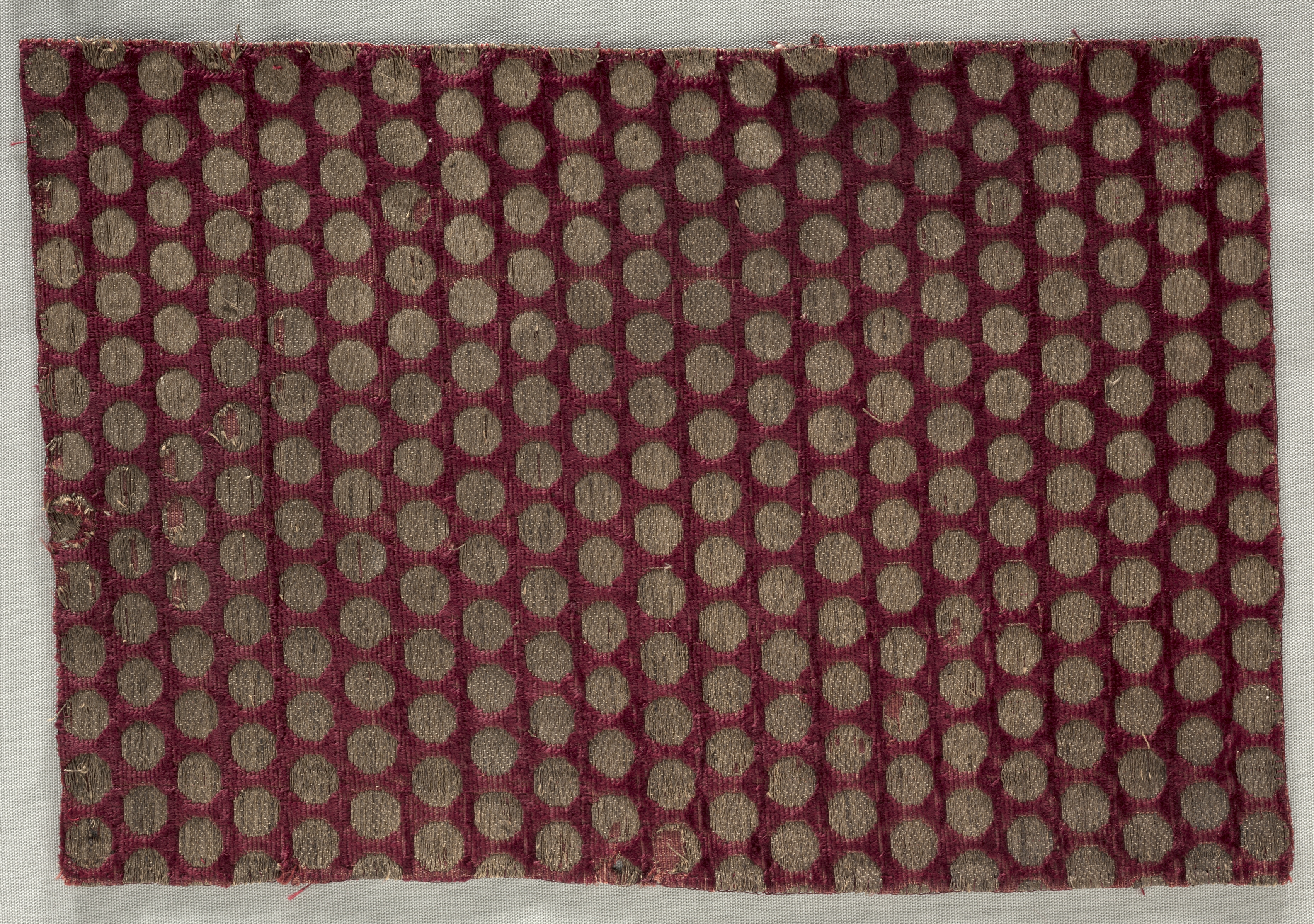
At Zoey Fashion Lab, we approach historical textiles not as artifacts to be preserved, but as living dialogues between past materiality and future form. The subject of this analysis—a fragment of silk and gilt-metal thread brocaded velvet from Ilkhanid Iran, likely Tabriz, circa 13th-14th century—presents a profound case study in deconstruction. This fabric, with its plush pile and embedded gold discs, embodies a paradox: it is both a surface of opulent stillness and a text of dynamic, conflicted energy. Our analysis will dissect its technical composition, symbolic resonance, and potential for avant-garde reinterpretation, guided by the juxtaposition of the "silver mirror with gold inlay" and the "stone sarcophagus with narrative relief" as referenced in the Archive Resonance.
Technical Deconstruction: The Anatomy of Opulence
Material Duality: The fabric's structure is a study in tension. The base weave is a silk velvet—a pile fabric created by cutting loops of silk threads, resulting in a dense, soft surface that absorbs and reflects light in a muted, sensual glow. This is the "cold stone" of the sarcophagus: a grounding, tactile depth that invites touch yet resists transparency. Interwoven into this pile are discontinuous brocaded elements: flat, gilt-metal threads (silver-gilt or gold-wrapped silk) that form geometric discs and stylized split-leaf arabesques. These metal components are the "silver mirror": hard, reflective, and alien against the velvet's organic softness. The gold discs, likely hammered into thin sheets and cut into circular forms, were applied or woven in a way that creates a raised, almost embossed effect, catching light in sharp, glittering points.
Structural Paradox: The brocading technique introduces a fundamental contradiction. While the velvet pile is uniform and continuous, the gold discs are isolated, discontinuous events. They do not form a continuous pattern but rather punctuate the surface like celestial bodies or scattered coins. This creates a rhythm of interruption: the eye moves across the velvet's smooth expanse, only to be arrested by a metallic flash. The split-leaf motifs, rendered in gilt thread, further complicate this—they are linear, flowing, and organic in design, yet rendered in a rigid, metallic material. This is where the "mirror" and "sarcophagus" collide: the gold leaf attempts to mimic the living, growing plant, but its materiality is fixed, cold, and reflective, like a memory embalmed in metal.
Symbolic Resonance: The Mirror and the Sarcophagus
The Mirror of Surface: The gold discs function as mirrors in the literal and metaphorical sense. In Ilkhanid court culture, mirrors were symbols of divine light, royal authority, and the transient nature of beauty. The discs, scattered across the velvet, create a fragmented, disorienting reflection. They do not offer a unified image but instead break the viewer's gaze into multiple, shimmering points. This aligns with the avant-garde concept of decentered subjectivity: the self is not a stable whole but a constellation of fragments. The velvet's pile, in contrast, absorbs light, creating a dark, velvety void—the "cold stone" of the sarcophagus. This void is the ground against which the gold discs assert their presence, a reminder that opulence is always framed by absence.
The Sarcophagus of Narrative: The split-leaf arabesques, rendered in gilt thread, are not mere decoration. In Ilkhanid art, such motifs often carried cosmological and funerary significance. The split leaf—a stylized palmette or half-palm—is a symbol of life cut short, of growth arrested. It is the "narrative relief" on the stone coffin: a story of vitality frozen in time. The gold discs, placed among these leaves, can be read as coins placed on the eyes of the dead, or as celestial bodies marking the passage of time. The velvet itself, with its deep pile, evokes the darkness of the tomb, while the gold discs are the jewels of the afterlife. This is not a fabric for the living; it is a fabric for the liminal space between existence and memory.
Avant-Garde Recontextualization: The Deconstruction of Luxury
Surface as Rupture: For Zoey Fashion Lab, this velvet is not a relic to be replicated but a provocation to rupture. The avant-garde designer would not seek to reproduce the brocading technique but to deconstruct its logic. Imagine a garment where the velvet is laser-cut into jagged, organic shapes, exposing the raw edges of the silk pile. The gold discs would be detached and reattached as asymmetrical, dangling ornaments—no longer embedded in the fabric but floating, like detached mirrors. The split-leaf motifs could be reimagined as digital prints that dissolve into glitchy, pixelated forms, challenging the notion of "authentic" craftsmanship.
Material Transgression: The velvet's plush surface can be treated as a site of erosion. Consider a process of selective abrasion: using sandblasting or chemical etching to remove the pile in specific areas, revealing the underlying weave. This would create a "worn" or "decayed" effect, transforming the opulent velvet into a text of decay and memory. The gold discs, instead of being polished, could be tarnished or patinated, their reflective surfaces dulled to a matte, oxidized finish. This would subvert the original function of gold as a symbol of eternal light, turning it into a metaphor for the passage of time and the inevitable tarnish of history.
Silhouette as Narrative: The garment itself should embody the tension between the mirror and the sarcophagus. A possible silhouette: a long, columnar dress that is tight at the torso and flares into a train—a form that evokes both a funerary shroud and a ceremonial robe. The bodice could be constructed from the deconstructed velvet, with gold discs sewn on in a chaotic, non-repeating pattern, mimicking the scattered coins on a grave. The train could be made of sheer, translucent silk organza, onto which the split-leaf motifs are digitally printed in silver and gold. This train would be the "stone relief"—a transparent, ghostly narrative that floats behind the wearer, never fully solid.
Conclusion: The Archive as Catalyst
This Ilkhanid velvet, with its gold discs and split-leaf motifs, is not a finished object but an archive of potential. Its technical contradictions—soft pile versus hard metal, organic form versus rigid material—are the very elements that fuel avant-garde experimentation. By deconstructing its surface, subverting its symbolic weight, and recontextualizing its materials, Zoey Fashion Lab can transform a relic of imperial luxury into a garment that speaks to the fragmented, transient, and deeply material nature of contemporary identity. The mirror and the sarcophagus are not opposites; they are two sides of the same fabric—a fabric that, in our hands, will be cut, burned, and reassembled into a new narrative of beauty and decay.