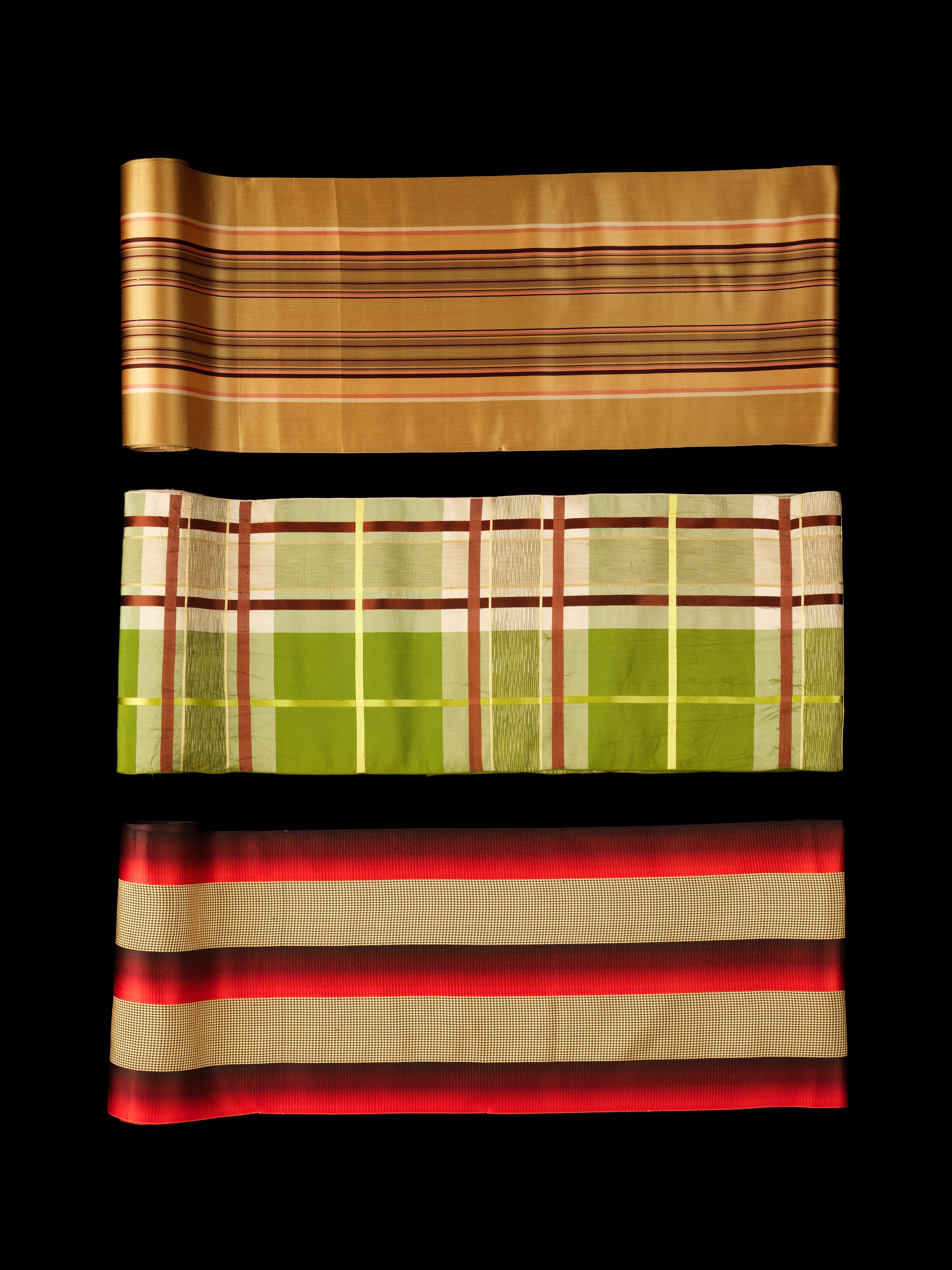
The Deconstruction of Line: Ribbon as Structural Architecture in Avant-Garde Couture
In the lexicon of avant-garde fashion, few materials possess the paradoxical duality of the French silk ribbon. At once a relic of aristocratic embellishment and a tool of radical structural innovation, the ribbon has historically been relegated to the periphery of garment construction—a decorative afterthought, a bow of closure, a trim of excess. For the SS26 season, Zoey Fashion Laboratory repositions the ribbon from ornament to ontology. This is not a study of nostalgia; it is a manifesto for the future of silhouette. The French silk ribbon, in its purest form, becomes the primary agent of garment architecture, challenging the very notion of fabric as a continuous plane and embracing a future where the garment is built, not draped.
The Material Grammar of French Silk Ribbon
To understand the avant-garde potential of the ribbon, one must first deconstruct its material identity. French silk ribbon, particularly from the historic weaving centers of Lyon and Saint-Étienne, possesses a tensile strength and a luminosity that synthetic equivalents cannot replicate. Its warp-faced weave creates a directional bias—a grain that dictates tension and release. In the context of SS26, this is not a limitation but a design parameter. The ribbon’s narrow width (ranging from 3mm to 15mm) forces the designer to think in terms of lines rather than surfaces. Each ribbon becomes a vector, a stroke of structural ink that can be tensioned, twisted, or layered to create a new kind of volume.
The silk itself, with its natural protein fibers, offers a unique thermal and textural response. Under stress, it compresses; when released, it returns to a subtle, organic form. This memory, combined with the ribbon’s inherent edge (the selvedge that prevents fraying), allows for precise architectural articulation. The avant-garde designer no longer cuts fabric; they compose with ribbons, treating each strand as a beam in a tensile structure. The result is a garment that breathes, moves, and holds its shape with the logic of a suspension bridge—light, strong, and defiantly linear.
Futuristic Silhouettes: The Ribbon as Exoskeletal Framework
The SS26 silhouette, as envisioned by Zoey Fashion Laboratory, rejects the organic, fluid draping of previous seasons in favor of a cybernetic, almost robotic elegance. The ribbon becomes the exoskeleton. Consider a gown where the bodice is constructed from a lattice of 5mm silk ribbons, tensioned in a hexagonal grid that mimics cellular structures or digital mesh. This is not a dress that clings; it is a dress that encloses space. The ribbons are stitched only at their intersections, creating a web of negative space through which the skin is visible, yet the form is rigidly defined. The waist is not cinched by a belt but is instead a zone of concentrated ribbon density, where multiple vectors converge to create a corset-like compression without the bulk of traditional boning.
The shoulders, in this paradigm, become structural cantilevers. A series of 10mm ribbons, treated with a micro-resin finish for added rigidity, extend outward from the collarbone, curving upward and backward to form a wing-like projection. These are not feathers; they are architectural fins, each ribbon a load-bearing element that redistributes the weight of the garment. The silhouette is simultaneously severe and ethereal—a nod to the biomechanical designs of H.R. Giger, but tempered by the soft, reflective sheen of French silk. The back of the garment, often ignored, becomes a symphony of tension. Ribbons are laced in a crisscross pattern, not to adjust fit but to create a dynamic, kinetic sculpture that shifts with every movement.
Structural Innovation: Tension, Compression, and the Void
The true innovation of ribbon-based couture lies in its manipulation of structural forces. Traditional garment construction relies on compression—fabric squeezed against the body. The ribbon, however, excels in tension. A dress can be suspended from a single point, such as a high collar or a shoulder yoke, with ribbons radiating downward like the cables of a suspension bridge. The body becomes the anchor, not the support. This creates a silhouette that appears to float, with the ribbons holding the garment open, away from the skin. The result is a volume that is not filled with air or padding but with potential—a void that the wearer inhabits.
In a separate construction, the ribbon can be used to create compression zones that mimic the logic of a tensegrity structure. A skirt, for example, might be formed by a series of concentric rings of ribbon, each connected by vertical tension lines. The rings are rigid (achieved through internal boning or layered ribbon lamination), while the vertical lines are elastic. The garment compresses and expands with the body’s movement, yet maintains a constant, futuristic shape—a cylinder that breathes. This is not a skirt of fabric; it is a skirt of engineered space.
The joining of ribbons is equally critical. Traditional stitching is replaced by micro-macramé, where ribbons are knotted or looped through one another. This method eliminates the need for a backing fabric, allowing the garment to be fully transparent in its construction. Every knot is a design element, every loop a structural node. The French silk’s natural luster catches light at each intersection, creating a moiré effect that shifts with the viewer’s angle. This is not decoration; it is the logic of the garment made visible.
Color and Light: The Chromatic Singularity of Silk Ribbon
In the SS26 collection, color is not applied but woven into the ribbon’s structural role. The French silk ribbon, dyed in the tradition of the Lyonnais ateliers, achieves a depth of hue that is almost holographic. A single ribbon can shift from deep indigo to electric violet under direct light, due to the silk’s natural prismatic refraction. The avant-garde designer exploits this by using ribbons of complementary colors that, when layered or twisted, create an optical blend. A bodice might be constructed from alternating ribbons of cyan and magenta, which, when viewed from a distance, appear as a solid, vibrating purple. Up close, the individual ribbons are distinct, creating a pointillist effect that is both structural and painterly.
Furthermore, the use of negative space—the gaps between ribbons—becomes a tool for controlling light. A garment can be designed to cast specific shadows on the skin, creating a secondary pattern of light and dark that changes with the wearer’s posture. This is a dynamic, living garment, one that is never the same from one moment to the next. The ribbon, in its linear, discrete form, becomes a brushstroke of light on the canvas of the body.
Conclusion: The Ribbon as a Manifesto for the Future
The French silk ribbon, in the hands of Zoey Fashion Laboratory, is no longer a decorative relic. It is a radical tool for reimagining the relationship between garment, body, and space. For SS26, the ribbon becomes a line of force, a vector of tension, a beam of light. The silhouettes are not draped but constructed, not softened but articulated. This is a future of fashion where the garment is an engineered environment, a wearable architecture that defines the body through the voids it creates. The ribbon, in its elegant, linear simplicity, offers a path forward—a return to the basics of line and tension, elevated to the highest form of avant-garde expression.