Deconstructing the Sacred: The Ceremonial Cross of Countess Gertrude as an Avant-Garde Blueprint
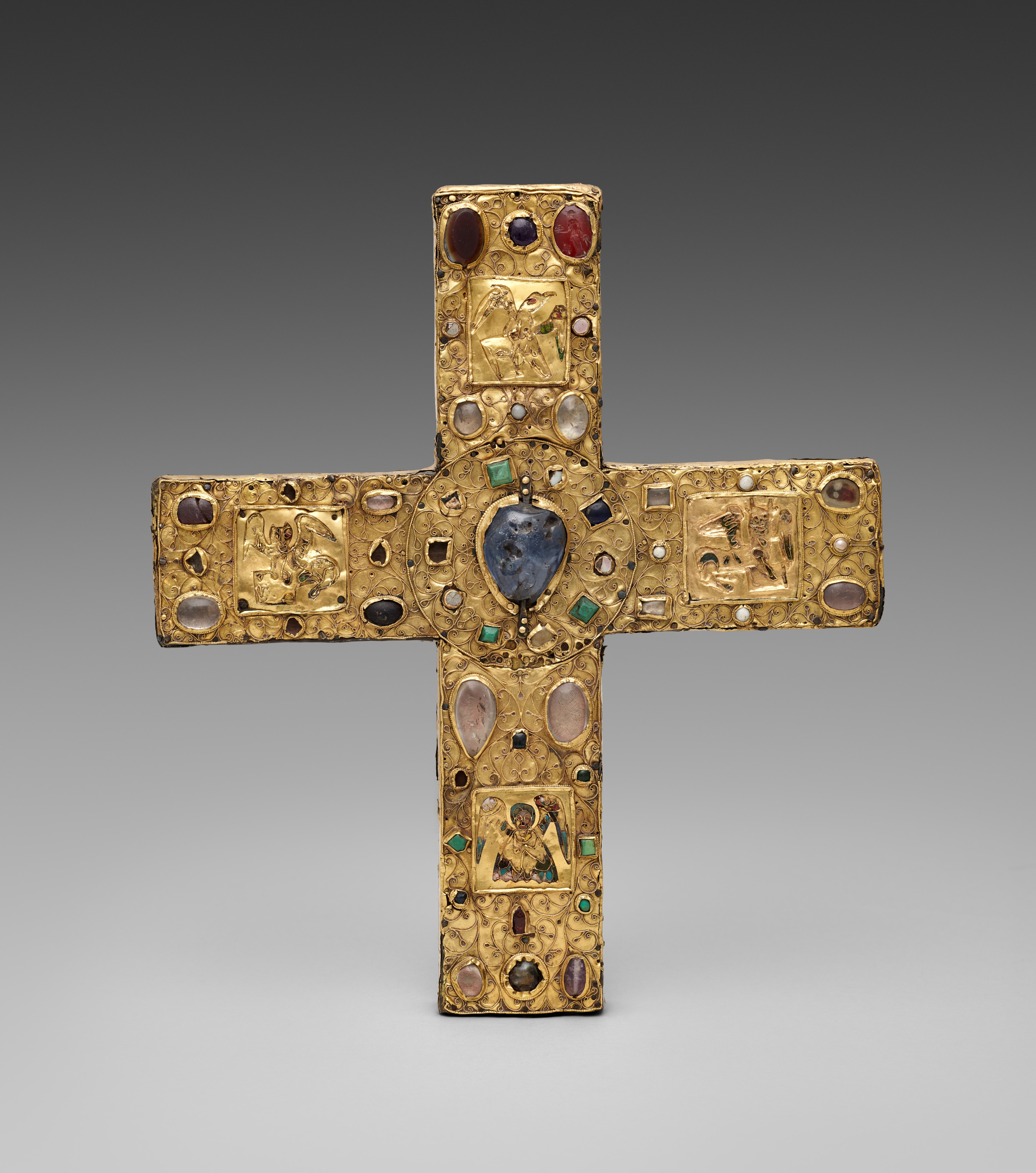
At Zoey Fashion Lab, our mission is to unearth the latent narratives within historical artifacts and translate them into radical, wearable structures. The Ceremonial Cross of Countess Gertrude, a masterwork of 11th-century Lower Saxony (or its environs), is not merely a relic of medieval piety. It is a complex, multi-layered text of power, faith, and material alchemy. For the avant-garde designer, this cross offers a profound lexicon of deconstruction: a dialogue between the sacred and the structural, the luminous and the grounded. Its technical composition—gold repoussé, cloisonné enamel, intaglio gems, pearls, and a wood core—forms the basis for a new kind of fashion narrative, one that resonates with the Archive Resonance principle of “一面是光洁银镜上以黄金镶嵌的纷繁棕叶纹,另一面是冰冷石棺板上以浮雕诉说的生命叙事” (one side is a smooth silver mirror inlaid with intricate gold palm leaf patterns, the other side is a life narrative told in relief on a cold sarcophagus slab).
I. The Dualistic Core: Mirror and Sarcophagus
The Archive Resonance quote is the key to unlocking the cross’s avant-garde potential. It presents a fundamental duality: the mirror versus the sarcophagus. The mirror, with its smooth silver surface and intricate gold palm leaf inlay, represents the surface, the reflective, the ornamental, and the eternal present. The sarcophagus, with its cold stone and relief-carved narrative, represents the depth, the historical, the mortal, and the sequential story. The Ceremonial Cross of Countess Gertrude embodies this very tension. Its front, gleaming with gold, enamel, and pearls, is the mirror—a dazzling display of earthly and heavenly glory. Its back, the wood core and the hidden structural skeleton, is the sarcophagus—the unseen, the foundational, the mortal core that supports the spectacle.
For Zoey Fashion Lab, this duality becomes a design manifesto. The avant-garde garment is no longer a single surface but a dialectical object. One side must be the “mirror”—a hyper-ornamented, reflective, and almost hallucinatory surface that denies depth. The other side must be the “sarcophagus”—a raw, structural, narrative-bearing interior that reveals the process of its own making. This is not about reversible clothing in the traditional sense, but about a garment that enacts a conceptual flip, where the wearer can choose to present the polished myth or the raw reality.
II. Material Alchemy: From Sacred Relic to Wearable Structure
Each material in the cross is a design directive for the avant-garde atelier.
Gold Repoussé and the Language of Surface Tension: The repoussé technique—hammering gold from the reverse side to create a relief pattern—is a process of controlled distortion. In fashion, this translates to structured draping and thermal manipulation of metallic fabrics. Imagine a jacket where the surface is not flat but is instead a topography of raised, hammered forms, created by heat-setting and layering metallic organza over a flexible armature. The “palm leaf” motif becomes a repeating structural pleat, not a print. The gold is not a color but a behavior of light—a surface that catches and deflects, creating a shimmering, unstable identity.
Cloisonné Enamel and the Fragmented Color Field: The enamel’s compartments of color, separated by thin gold wires, are a proto-pixelated system. For the avant-garde, this is a grid of interruption. We can translate this into laser-cut leather or acrylic panels that are stitched together with fine metallic thread, creating a mosaic of color that is both rigid and fluid. The enamel’s jewel tones—sapphire blue, emerald green, ruby red—are not used decoratively but as structural color blocks that define the silhouette. Each “cloison” becomes a separate, articulated panel that moves independently, fracturing the garment’s form as the wearer moves.
Intaglio Gems and the Negative Space Narrative: The carved intaglio gems are negative-space reliefs. In fashion, this suggests the use of cut-out, reverse-embroidery, or heat-shrink techniques that create recessed images within the fabric. A gemstone’s carved figure becomes a hollowed-out pocket or a transparent window in the garment, revealing a layer beneath. This is the “sarcophagus” side peeking through the “mirror” surface—the hidden story becoming visible through the void.
Pearls and the Organic, Unstable Element: Pearls are organic, irregular, and inherently mortal (they are a response to an irritant). They are the imperfect, the human, the transient. In an avant-garde context, pearls are not strung in neat rows but are randomly clustered, embedded in resin, or suspended on micro-chains to create a chaotic, cellular growth on the garment. They become the biological counterpoint to the rigid gold and enamel, representing the life that the cross was meant to sanctify and the decay it was meant to transcend.
Wood Core and the Hidden Skeleton: The wood core is the structural truth. It is the unseen support that allows the precious surfaces to exist. In fashion, this translates to the exoskeleton or the internal armature becoming visible. A garment might have a wooden or resin-based “core” that is partially exposed, with the gold and enamel surfaces attached as removable, sacrificial skins. This is the ultimate avant-garde gesture: the structure is the ornament. The “sarcophagus” is no longer hidden; it is the primary aesthetic.
III. The Avant-Garde Silhouette: A Cross in Motion
The cross form itself is a radical silhouette. It is not a natural body shape but a symbolic imposition. For Zoey Fashion Lab, we deconstruct this into a wearable architecture. The vertical beam becomes a long, asymmetrical train or a spine-like column that extends down the back. The horizontal beam becomes a projecting shoulder piece or a detachable collar that creates a cruciform shadow. The center, where the beams intersect, is the nexus point—the heart of the garment, where the mirror and sarcophagus meet. This is where the most intense material alchemy occurs: a dense cluster of repoussé gold, cloisonné panels, and a single, large intaglio gem that can be removed to reveal the wood core beneath.
IV. Narrative as Construction: The Life of Countess Gertrude
The cross is not abstract; it is a biographical object. Countess Gertrude’s life—her power, her piety, her mortality—is encoded in its materials. The avant-garde garment must also tell a story, but not a linear one. It must be a fragmented, multi-temporal narrative. The “palm leaf” motif (a symbol of martyrdom and victory) can be repeated in a distorted, almost chaotic pattern, suggesting a life that is both celebrated and broken. The intaglio gems can depict scenes from her life (or from the lives of saints) but rendered in a deconstructed, cubist manner—a face split across three panels, a hand reaching from a pocket. The garment becomes a portable reliquary, but one that questions the very idea of relic and memory.
V. Conclusion: The Cross as a Portal
The Ceremonial Cross of Countess Gertrude is not a historical costume. It is a time-traveling manifesto. Its technical complexity and symbolic density provide the avant-garde designer with a complete toolkit for creating garments that are not just worn but inhabited. The mirror side is the public performance of power; the sarcophagus side is the private meditation on mortality. By deconstructing this cross, Zoey Fashion Lab can create a collection that is both a homage to medieval craftsmanship and a radical critique of contemporary fashion’s obsession with surface. The final garment is a dialectical object: a mirror that reflects the self and a sarcophagus that contains the soul, all held together by a wood core that reminds us that every structure, no matter how gilded, has a mortal foundation. This is the avant-garde at its most resonant—not a rejection of history, but a re-animation of its deepest tensions.