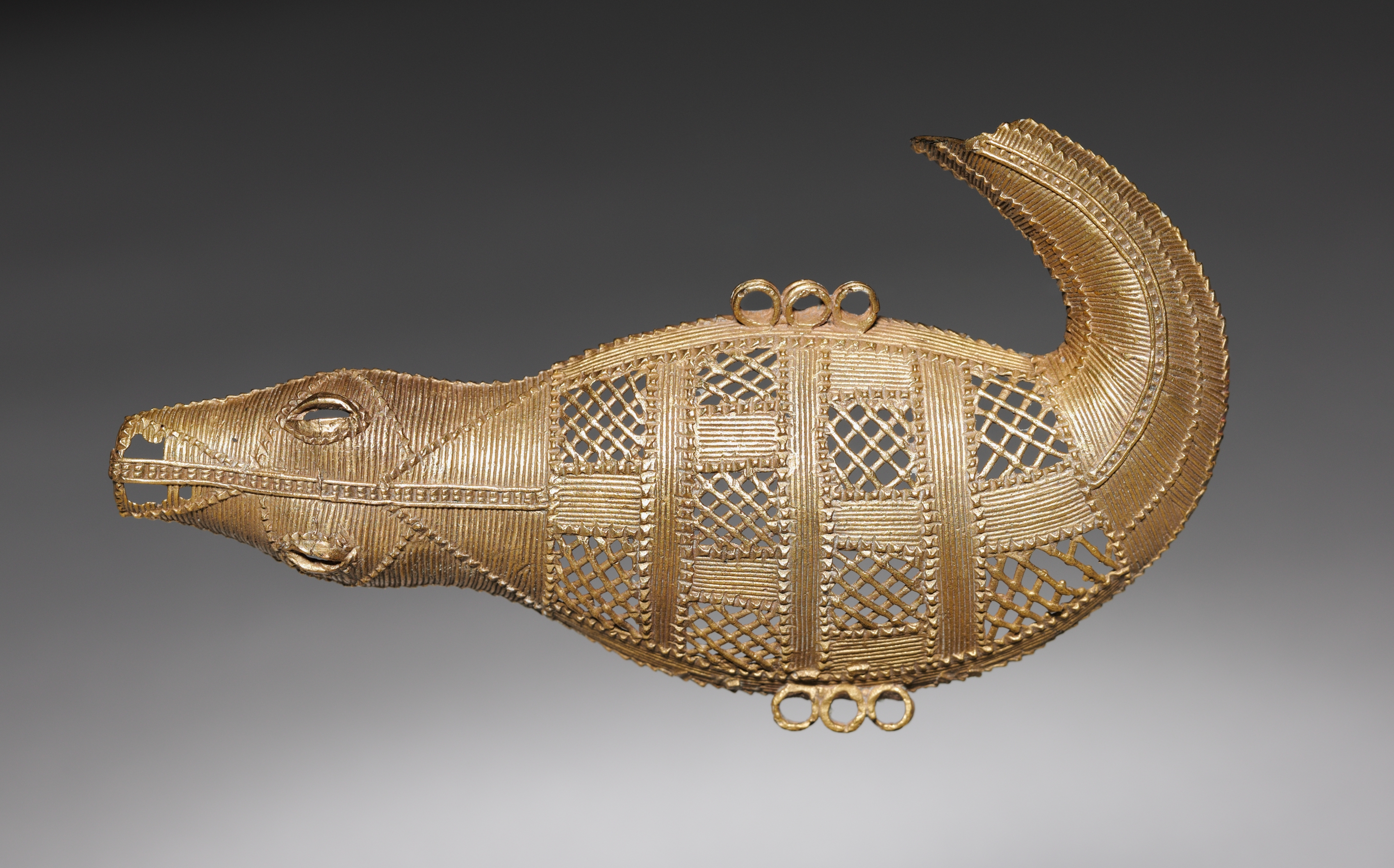
Deconstruction Analysis: The Baule Crocodile Pendant in an Avant-Garde Context
At Zoey Fashion Lab, the role of the Chief Fabric Deconstructionist extends beyond textiles to encompass the symbolic and material narratives embedded within adornment. The subject of this analysis—a gold pendant depicting a crocodile, originating from the Baule goldsmith tradition of Côte d'Ivoire, West Africa—presents a profound opportunity to examine how an ancient artifact can be recontextualized within an avant-garde framework. This piece, referenced through the Archive Resonance of a mirror with split-leaf palm motifs and a stone coffin’s life narrative, challenges conventional notions of luxury, identity, and temporality. The pendant is not merely a decorative object; it is a dense archive of cultural memory, technical mastery, and symbolic power, demanding a deconstruction that bridges the sacred and the subversive.
Material and Technical Analysis: The Alchemy of Gold
The pendant is crafted from gold, a material that carries immense weight in both African and global contexts. In Baule culture, gold is not merely a precious metal but a medium of spiritual and political communication. The Baule, part of the Akan cultural complex, historically used gold dust as currency and created elaborate goldweights and ornaments to signify status, lineage, and connection to the ancestral world. The technical execution of this pendant—likely achieved through lost-wax casting, a method perfected by Baule goldsmiths—demonstrates a sophisticated understanding of metallurgy and aesthetics. The crocodile’s scales, jaws, and tail are rendered with precision, yet the piece retains a tactile, almost organic quality. The gold’s surface is not uniformly polished; instead, it shows subtle variations in texture, suggesting a deliberate interplay of light and shadow. This technical choice aligns with the avant-garde sensibility of rejecting industrial perfection in favor of handcrafted imperfection, which speaks to a deeper authenticity.
From a deconstructionist perspective, the gold material itself becomes a site of tension. The pendant’s value is both intrinsic (as a precious metal) and symbolic (as a marker of cultural capital). Yet, in the avant-garde context, this value is deliberately destabilized. The pendant is not displayed as a mere commodity but as a relic that questions the very nature of worth. The Archive Resonance reference to a mirror with split-leaf palm motifs suggests a reflective surface that fragments identity, while the stone coffin’s life narrative implies a burial of meaning. Here, the gold pendant acts as a bridge between these opposites: it is both a mirror (reflecting cultural pride) and a coffin (containing the weight of colonial extraction and diaspora). The material, therefore, is not neutral; it is a charged substance that demands a critical reading of its provenance and circulation.
Symbolic Deconstruction: The Crocodile as Liminal Being
The crocodile is a potent symbol in West African cosmology, particularly among the Baule and neighboring groups. It embodies duality: it is a creature of both water and land, a predator and a guardian, a symbol of fertility and danger. In Baule mythology, the crocodile is often associated with the spirit world, serving as a messenger between the living and the dead. The pendant’s form—a crocodile poised in a dynamic, almost coiled stance—captures this liminality. The animal’s open jaws and textured back suggest a readiness to strike, yet its stillness implies a meditative presence. This duality resonates with the avant-garde interest in the uncanny and the hybrid. The pendant is not a literal representation but a symbolic abstraction, inviting the wearer to inhabit a state of in-betweenness.
The Archive Resonance further deepens this symbolism. The “mirror with split-leaf palm” evokes the idea of fragmentation—a reflection that is never whole. The crocodile, as a pendant worn against the body, becomes a mirror of the self, but one that is fractured by history. The “stone coffin” introduces the theme of death and preservation. The pendant, like a coffin, encases a story that is both personal and collective. The crocodile’s narrative is one of survival and adaptation, mirroring the resilience of African cultures in the face of colonial disruption. In the avant-garde framework, this pendant becomes a tool for reclaiming agency—a wearable artifact that challenges the viewer to confront the violence embedded in beauty. The crocodile’s predatory nature is not softened; instead, it is amplified as a symbol of resistance.
Contextual Resonance: From Baule Goldsmith to Avant-Garde Fashion
The pendant’s origin in Côte d'Ivoire, specifically within the Baule tradition, places it within a history of artistic excellence that predates colonial contact. Baule goldsmiths were revered for their ability to transform raw material into objects of spiritual and political power. However, the global journey of such artifacts—often through colonial extraction, museum collections, or luxury markets—complicates their meaning. In the context of Zoey Fashion Lab, this pendant is not a static relic but a dynamic agent of cultural dialogue. The avant-garde style, with its emphasis on deconstruction, recontextualization, and the blurring of boundaries, allows this piece to transcend its original function. It is no longer solely a symbol of Baule royalty or a commodity for trade; it becomes a statement on the politics of adornment.
The reference to the Archive Resonance—a mirror and a coffin—is particularly instructive. The mirror suggests a self-reflexive gaze, where the wearer and viewer are forced to examine their own positionality. The coffin, conversely, suggests burial and memory. Together, they create a dialectic that is central to avant-garde practice: the simultaneous celebration and critique of history. The crocodile pendant, when worn in a contemporary fashion context, performs this dialectic. It is a beautiful object that also carries the weight of colonial violence, cultural appropriation, and the ongoing struggle for repatriation. The avant-garde designer or wearer who chooses this piece must be aware of this complexity, using it to provoke thought rather than merely to accessorize.
Technical and Aesthetic Innovations: Bridging Past and Future
From a technical standpoint, the pendant’s construction offers lessons for contemporary fashion and jewelry design. The Baule goldsmith’s use of lost-wax casting is a labor-intensive process that demands patience and skill. In an era of mass production, this pendant stands as a testament to the value of slow fashion and artisanal craftsmanship. The avant-garde interpretation of this technique might involve combining it with non-traditional materials—such as resin, recycled metals, or digital fabrication—to create hybrid objects that honor tradition while pushing boundaries. The pendant’s scale and weight also suggest a deliberate ergonomic design: it is meant to be worn close to the body, perhaps over the heart or at the solar plexus, where its symbolic energy can resonate with the wearer’s breath and movement.
The aesthetic of the pendant—its bold silhouette, textured surface, and symbolic density—aligns with the avant-garde preference for the monumental and the intimate. The crocodile is both a miniature sculpture and a talisman, inviting close inspection while commanding presence from a distance. This duality is a hallmark of avant-garde fashion, which often plays with scale and perspective to disrupt expectations. The pendant’s gold material, traditionally associated with wealth and permanence, is here reimagined as a vehicle for storytelling. The split-leaf palm motif from the Archive Resonance suggests a pattern of branching and fragmentation, which can be read as a metaphor for the diaspora—a culture that is split yet connected through shared symbols. The crocodile, as a guardian of water and land, becomes a unifying figure in this narrative.
Conclusion: The Pendant as Archive and Provocation
In conclusion, the Baule crocodile pendant is far more than a piece of jewelry; it is a compressed archive of cultural, technical, and symbolic knowledge. Through the lens of Zoey Fashion Lab’s avant-garde methodology, this pendant is deconstructed to reveal its multiple layers: the material politics of gold, the liminal symbolism of the crocodile, the historical weight of West African artistry, and the contemporary imperative to engage with these narratives critically. The Archive Resonance of the mirror and coffin serves as a guiding metaphor, reminding us that adornment is both reflective and memorial. The pendant invites the wearer to look into the mirror of history while carrying the coffin of memory—a dual act that defines the avant-garde’s relationship with the past.
For Zoey Fashion Lab, this analysis underscores the importance of ethical curation and cultural deconstruction. The crocodile pendant, when integrated into an avant-garde collection, becomes a site of dialogue between tradition and innovation, luxury and critique, beauty and trauma. It challenges the fashion industry to move beyond superficial appropriation and toward a deeper engagement with the stories embedded in the objects we wear. As a Chief Fabric Deconstructionist, I recommend that this pendant be presented not as a standalone artifact but as part of a broader narrative—one that includes the voices of Baule goldsmiths, the history of African gold trade, and the ongoing relevance of these symbols in a globalized world. Only then can the pendant fulfill its potential as a transformative piece of avant-garde adornment.