Deconstructing the Sacred: The Sutra Cover as Avant-Garde Architectural Textile
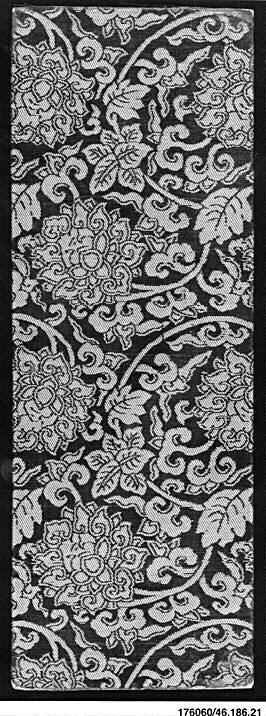
In the rarefied air of haute couture, the boundary between artifact and garment is perpetually dissolving. For Zoey Fashion Laboratory’s SS26 collection, we turn our gaze to an unexpected muse: a Chinese Sutra Cover, circa 18th century, executed in plain weave silk with supplementary weft patterning. This is not a mere historical reference; it is a radical source code for a new sartorial language. The Sutra Cover, originally a protective and devotional object, is reimagined as a blueprint for structural innovation, a dialogue between sacred geometry and the deconstructive ethos of the avant-garde. Here, the floral scroll is not decoration but a dynamic force—a generative algorithm for futuristic silhouettes that challenge volume, movement, and the very nature of textile as architecture.
The Textile as Algorithm: From Supplementary Weft to Structural Lattice
The technical foundation of this analysis lies in the plain weave silk with supplementary weft patterning. In traditional Chinese weaving, this technique introduces an extra weft thread—often in contrasting color or metallic thread—to create intricate, raised motifs against a flat ground. For SS26, we extrapolate this principle into a three-dimensional garment construction. The supplementary weft is no longer a decorative afterthought; it becomes a structural rib, a load-bearing element that dictates the garment’s silhouette. Imagine a cocoon-like jacket where the base weave forms a translucent, weightless shell, while the supplementary wefts are woven in a high-modulus, heat-set synthetic fiber—perhaps a bio-engineered silk-nylon hybrid. These wefts are programmed to contract upon exposure to body heat, creating a dynamic, self-adjusting lattice that cinches and releases in response to the wearer’s movement. The floral scroll, then, is not merely a pattern but a parametric system: each petal and stem is a node in a network of tension and release, generating a silhouette that is simultaneously organic and cybernetic.
Floral Scroll as Futuristic Silhouette: The Deconstructed Lotus
The floral scroll motif—a continuous, undulating vine of lotuses and peonies—is deconstructed into its atomic components. We reject the literal reproduction of blossoms in favor of a morphogenetic approach. The scroll’s spiral and S-curves become the generative lines for a series of modular, interlocking panels. Consider a floor-length gown where the bodice is a single, continuous spiral of silk, laser-cut to mimic the scroll’s tendrils. These tendrils are then heat-pressed into rigid, petal-like scales that articulate with every step. The skirt, conversely, is a cascade of thousands of these scales, each attached to a micro-hinge of stainless steel or recycled polymer. The result is a silhouette that oscillates between a second skin and an exoskeleton—a futuristic armor that references the protective function of the original Sutra Cover. The structural innovation lies in the absence of traditional seams: the garment is assembled through a system of interlocking tabs and slots, a nod to joinery techniques in Chinese furniture, but rendered in a lightweight, semi-transparent silk. The floral scroll is thus transformed into a kinetic topography, where the garment’s surface is alive with movement, reflecting light and shadow as the wearer navigates space.
Structural Innovation: The Bio-Mimetic Weft and Zero-Waste Geometry
The avant-garde imperative demands not only aesthetic disruption but also material and ethical innovation. The supplementary weft technique offers a pathway to zero-waste construction when paired with computational design. We propose a digital jacquard loom that weaves the entire garment as a single, continuous piece, with the pattern of the floral scroll determining the garment’s shape. The weft threads—some in silk, others in a biodegradable, algae-based polymer—are programmed to vary in density, creating zones of opacity, transparency, and structural rigidity. The floral scroll’s negative space becomes the armholes, neckline, and waist; the positive space forms the body. This is not a pattern cut from fabric; it is a fabric grown into a pattern. The result is a hyper-efficient silhouette that eliminates textile waste entirely. For SS26, we envision a series of modular tops and skirts that can be reconfigured through a system of magnetic or snap-fit weft threads. The wearer becomes a co-creator, adjusting the garment’s silhouette from a sculptural, closed form to a flowing, open one—a direct translation of the Sutra Cover’s dual role as a protective cover and a vehicle for sacred text.
Deconstructive Aesthetics: The Unraveled Scroll and the Incomplete Garment
The deconstructive aesthetic is central to Zoey Fashion Laboratory’s identity. We honor the Sutra Cover’s original function—to preserve and sanctify—by deliberately subverting it. The floral scroll is not presented as a finished motif; it is unraveled, frayed, and interrupted. Imagine a jacket where the supplementary wefts are left loose at the hem, trailing like calligraphic brushstrokes. These loose threads are not flaws but intentional design elements, creating a sense of unfinished dynamism. The garment appears to be in a state of becoming, as if the floral scroll is actively growing or decaying. This tension between order and chaos is amplified by the use of asymmetrical draping: one shoulder is a precise, architectural structure of folded silk, while the other is a cascade of raw, unbound wefts. The silhouette is deliberately incomplete, challenging the viewer to complete the pattern in their mind. This deconstructive approach also extends to the garment’s lining, which is left exposed in strategic areas, revealing the reverse side of the weave—a subtle commentary on the hidden labor and structure that underpins all couture.
SS26 Context: The Sutra Cover as a Portal to the Post-Human
In the context of SS26, the Sutra Cover transcends its historical origins to become a portal to a post-human aesthetic. The floral scroll, with its connotations of rebirth and enlightenment, is reimagined as a biometric interface. We propose integrating flexible, textile-based sensors into the supplementary wefts, allowing the garment to respond to the wearer’s pulse, temperature, and even emotional state. The floral scroll would glow in response to calm, or stiffen into a protective shield when the wearer is anxious. This is not science fiction; it is the logical evolution of the supplementary weft as a structural and communicative element. The silhouette becomes a second nervous system, a wearable architecture that blurs the line between the organic and the technological. The Sutra Cover, once a repository for sacred knowledge, now becomes a repository for personal data and adaptive behavior. The floral scroll is no longer a static image but a living, breathing algorithm that shapes the garment in real time.
Conclusion: The Sacred as Structural Imperative
The Chinese Sutra Cover with floral scroll is not a relic to be copied but a catalyst for radical innovation. By deconstructing its weave, pattern, and function, Zoey Fashion Laboratory proposes a new paradigm for SS26: a garment that is at once a protective shell, a kinetic sculpture, and a responsive interface. The plain weave silk with supplementary weft patterning becomes a metaphor for the avant-garde itself—a tension between the foundational and the emergent, the sacred and the speculative. The floral scroll, in its infinite recurrence, offers a blueprint for endless structural variation, a language of volume and line that is both ancient and futuristic. This is not fashion as decoration; it is fashion as architecture, as code, as living text. The Sutra Cover is reborn, not as a cover for a book, but as a cover for the human form in an age of unprecedented transformation.