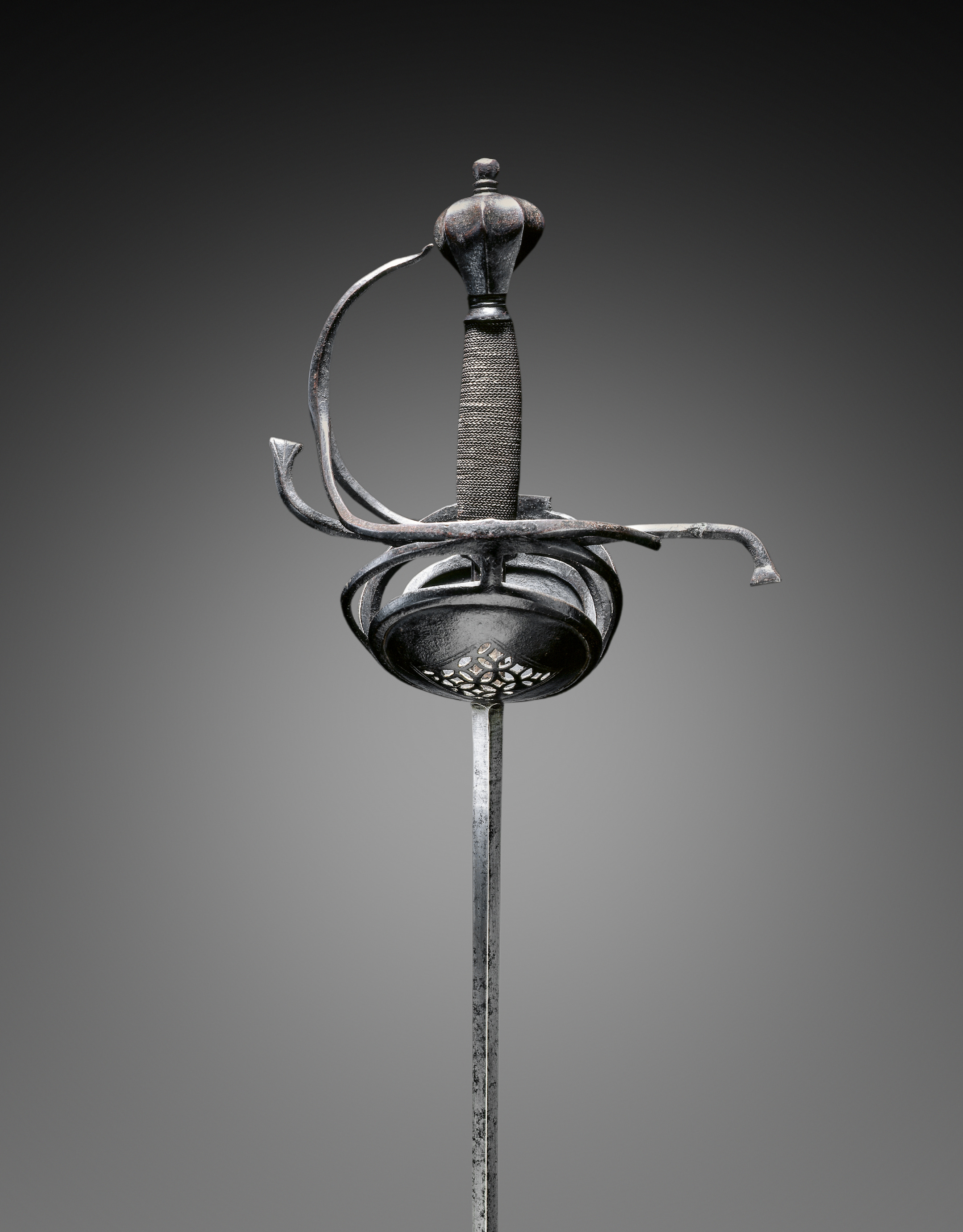
Deconstructing the Rapier: A Metallurgical and Morphological Analysis for Zoey Fashion Lab
As Chief Fabric Deconstructionist for Zoey Fashion Lab, my mandate is to interrogate the material and symbolic DNA of objects, not merely to describe them, but to extract their latent kinetic and structural possibilities. The subject of this analysis—a steel rapier from Milan, Italy, with a russeted hilt and wire grip—presents a uniquely compelling case. It is not a garment, yet its architecture, its balance, and its historical weight are profoundly sartorial. The rapier is a New DNA Strand, a thread of pure Avant-garde potential that can be woven into a new lexicon of wearable form. This analysis will deconstruct the rapier into three core material systems: the blade (steel), the hilt (russeted iron), and the grip (wire), before synthesizing these findings into a design thesis for Zoey Fashion Lab.
I. The Blade: Steel as Structural Line and Kinetic Memory
The rapier’s blade is forged from high-carbon steel, a material defined by its tensile strength and its capacity for extreme elongation before failure. In the context of Avant-garde fashion, steel is not merely a metal; it is a frozen line of force. The blade’s geometry—long, slender, and triangular or diamond in cross-section—is a study in directed energy. It is designed to puncture, to pierce, to create a single, devastating point of contact. For Zoey Fashion Lab, this translates into a design principle: the linear, unyielding silhouette.
Consider the blade’s flexibility. A rapier is not a rigid bar; it is a spring. When thrust, it bends, stores kinetic energy, and then returns to true. This is a crucial morphological lesson. In garment construction, we can replicate this behavior through structural boning or composite panels that are pre-stressed. Imagine a jacket sleeve that, when the arm is raised, creates a deliberate, controlled curve—a "blade line"—before snapping back to a sharp, vertical drape. The steel’s reflective surface, when polished, creates a mirror of light and shadow. For a fabric, we might translate this into liquid metallic finishes on rigid, woven substrates like a double-faced satin or a bonded lamé, creating a surface that is both hard and fluid. The blade’s edge, though not sharp in the rapier’s primary use, suggests a cutting line in a garment—a sharp lapel, a precise hem, a geometric neckline that slices the body’s architecture.
II. The Hilt: Russeted Iron as Textural Patina and Structural Anchor
The hilt, crafted from iron and given a russeted finish, introduces a radically different material vocabulary. Russeting is a controlled oxidation process that creates a dark, matte, and deeply textured surface. It is the antithesis of polished steel. It is a surface that records time, touch, and atmosphere. In fashion terms, this is the patina of the avant-garde—a deliberate embrace of imperfection, wear, and age.
The hilt’s form—the quillons, the pommel, the ricasso—is a complex, three-dimensional puzzle. It is the counterbalance to the blade’s linear thrust. The quillons, projecting horizontally, create a cross-guard that is both protective and expressive. In a garment, this translates to architectural shoulder structures or asymmetrical collar forms that project outward, creating negative space around the body. The pommel, a weighted sphere at the base, is the point of mass. In fashion, this suggests a weighted hemline or a dramatic, heavy closure—a metal ring, a large-scale toggle, or a sculpted button that anchors the garment’s flow.
The russeted surface is not smooth. It is granular, porous, and tactile. For Zoey Fashion Lab, this texture can be replicated through bonded metallic powders on leather or heavy canvas, or through burn-out velvet techniques that create a raised, oxidized pattern. The hilt’s dark, matte finish absorbs light, creating a sense of depth and mystery. This is a perfect counterpoint to the blade’s reflectivity. In a collection, this duality can be expressed through layering: a glossy, blade-like outer shell over a matte, textured underlayer, or a garment that transitions from polished to patinated across its surface.
III. The Grip: Wire as Tension, Restraint, and Kinetic Connection
The wire grip, typically made of twisted brass or steel wire wound tightly around the core of the handle, is the point of human interface. It is where the weapon becomes an extension of the hand. The wire is tension personified. It is a series of parallel, spiraling lines that create a textured, non-slip surface. In fashion, this translates directly into wrapping, lacing, and binding techniques.
The wire grip’s geometry is a helix. It suggests continuous, linear motion that encircles a form. For Zoey Fashion Lab, this can be interpreted as corset lacing that is not hidden but exposed, or as structural wire-work embedded in a garment’s seams. Imagine a dress where the bodice is constructed from a network of twisted metal wires, creating a cage-like structure that is both rigid and breathable. The grip’s texture—rough, tactile, and slightly abrasive—can be translated into fringed or knotted surfaces using metallic yarns or leather thongs. The wire’s function is to bind the hand to the object. In fashion, this becomes a design for attachment and detachment: a glove that is wired to a sleeve, a collar that is laced to a bodice, creating a sense of controlled restraint.
IV. Synthesis: The Rapier as a New DNA Strand for Avant-Garde Fashion
The rapier is not a single object; it is a system of opposing forces. The blade’s linear, reflective, thrusting energy is countered by the hilt’s textured, weighty, anchoring mass, and connected by the grip’s spiraling, binding tension. This is the New DNA Strand for Zoey Fashion Lab. The design thesis emerges as follows:
1. The Blade Line as Silhouette: The primary structural principle is the long, unbroken vertical line. Garments should be designed with a single, dominant axis—a long coat, a floor-length dress, a jumpsuit that extends the body’s line. This line must be precise and unyielding, achieved through sharp tailoring, bonded seams, and internal boning that mimics the blade’s stiffness. The surface should be reflective and fluid, using liquid metals, high-shine satins, or metallic-coated organza.
2. The Hilt as Anchoring Architecture: The garment’s focal points—shoulders, hips, cuffs, collars—should be treated as hilt-like structures. They should be dark, matte, and heavily textured. Use russeted metal finishes on leather, or create sculptural forms using heavy canvas or molded neoprene. These elements should project outward, creating negative space and a sense of protective armor. The weight of these elements should be deliberately placed to counterbalance the garment’s flow, much like the pommel balances the blade.
3. The Wire Grip as Kinetic Binding: The points of connection—waists, wrists, necklines—should be treated as grip zones. Use exposed lacing, twisted metal cords, or knotted leather straps to create a sense of tension. These bindings should be functional, allowing the wearer to adjust the garment’s fit, but also decorative and structural. The wire’s spiral pattern can be echoed in twisted seams, coiled embroidery, or spiral-cut panels that wrap the body.
Conclusion: The Milanese rapier is not a historical artifact to be replicated, but a morphological blueprint for a new way of dressing. It teaches us that a garment can be both a weapon and a sculpture, both rigid and fluid, both reflective and matte. For Zoey Fashion Lab, this is the Avant-garde imperative: to deconstruct the object, extract its material logic, and rebuild it as a living, breathing, wearable form. The rapier’s DNA is now ours to encode. The collection will be called “Line, Mass, and Tension.”