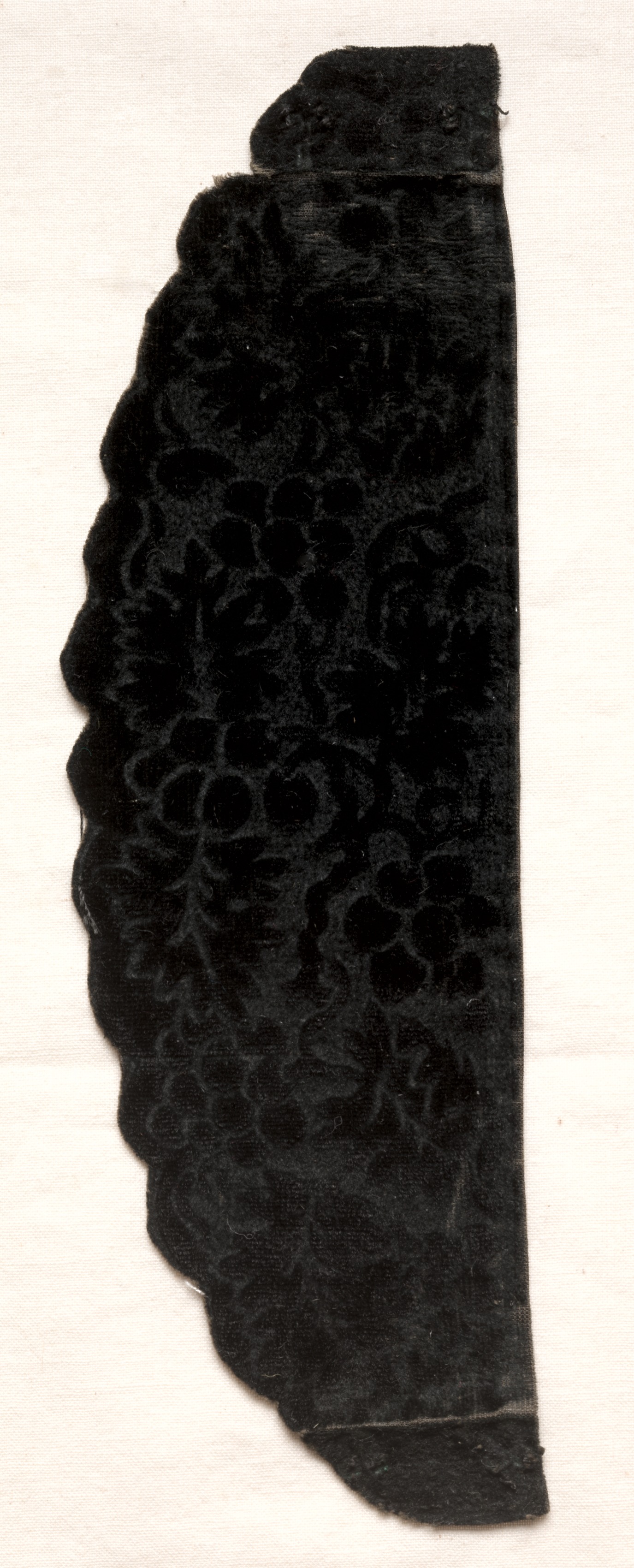
Deconstructing the Velvet Cuff: A Zoey Fashion Lab Analysis
At Zoey Fashion Lab, we approach every artifact as a living document of material culture. The subject of this analysis—a pair of velvet cuffs from 19th-century France—represents a paradox: an object of rigid social formality crafted from a fabric of profound tactile sensuality. Our mission is to deconstruct this artifact not merely as a historical curiosity but as a New DNA Strand—a genetic blueprint for avant-garde design. By stripping the cuff of its original context, we can re-engineer its core principles into a radical, contemporary language of fashion.
Material Origins: The Velvet Paradox
Velvet, in its 19th-century French production, was a material of extreme technical complexity. Woven on a drawloom, it required a secondary warp to create its characteristic pile—a labor-intensive process that rendered it a luxury fiber accessible only to the aristocracy and burgeoning bourgeoisie. The cuffs in question, likely silk velvet, exhibit a deep, absorbent black that swallows light, a color signifying both mourning and power. For the avant-garde designer, this velvet is not a symbol of restraint but a subversive medium. Its pile can be crushed, sheared, or chemically distressed to create textures that defy its original pristine finish. The very weight of the fabric—its dense, gravitational pull—becomes a tool. We can imagine deconstructing the cuff’s velvet into irregular, frayed strips, then re-weaving them into a lattice that exposes the skin beneath, challenging the fabric’s historical role as a concealer of flesh.
Structural Analysis: The Cuff as a Contradiction
The 19th-century French cuff was a device of control. It framed the hand, restricted wrist movement, and signaled adherence to strict social codes. Its structure—typically a rigid, cylindrical form fastened with buttons or a small clasp—was designed to project an image of disciplined elegance. Yet, the velvet material introduces a fundamental contradiction: softness constrained by form. This tension is the New DNA Strand we seek to exploit. In our deconstruction, we propose a “dysfunctional” cuff that honors the original silhouette but subverts its function. Imagine a cuff that is asymmetrically elongated, trailing into a train of velvet that brushes the floor, or one that is split open along its seam, revealing a lining of mirrored glass or exposed wiring. The cuff’s closure mechanism—once a symbol of propriety—can be exaggerated into a grotesque, oversized clasp that becomes the focal point of the garment, or removed entirely, leaving the cuff to hang loosely as a decorative appendage.
Historical Context: The Cuff as a Social Signal
In 19th-century France, the cuff was a microcosm of the wearer’s identity. Men’s cuffs were often starched and white, signaling cleanliness and status, while women’s velvet cuffs, frequently paired with lace or fur, denoted femininity and wealth. The velvet cuff, in particular, was a seasonal marker—worn in colder months to suggest warmth and luxury. For the avant-garde, this historical baggage is raw material. We can re-contextualize the cuff as a wearable sculpture that comments on class, gender, and temporality. For instance, a collection might feature cuffs crafted from recycled velvet garments—each piece bearing the stains, wear, and repairs of its previous life—stitched together into a patchwork that tells a story of labor and decay. Alternatively, the cuff could be exaggerated to an absurd scale, covering the entire forearm and hand, transforming the wearer into a hybrid creature that questions the boundary between human and object.
The New DNA Strand: Avant-Garde Re-Engineering
Our reference to the cuff as a New DNA Strand implies a process of genetic recombination. We are not replicating the original; we are extracting its core genetic code—the relationship between softness and structure, the interplay of light and shadow, the tension between function and ornament—and splicing it with contemporary materials and technologies. Consider the following avant-garde applications:
- Biometric Integration: Embedding sensors within the velvet pile that respond to the wearer’s pulse or temperature, causing the cuff to change color or pulse with light. The historical cuff’s role as a static status symbol is replaced by a dynamic, living interface.
- Deconstructive Layering: Using laser-cutting to remove sections of the velvet, revealing a substructure of carbon fiber or recycled plastic. The cuff becomes a ruin—a fragment of the past exposed to a brutalist future.
- Textural Anarchy: Applying chemical treatments to selectively dissolve the velvet’s pile, creating patterns of bare warp and weft that resemble topographical maps. The cuff is no longer a uniform surface but a landscape of erosion and growth.
Conclusion: From Artifact to Action
The 19th-century French velvet cuff is not a relic to be preserved in a glass case. At Zoey Fashion Lab, we see it as a catalyst for rebellion. Its velvet speaks of luxury, but we can make it speak of labor. Its structure speaks of control, but we can make it speak of liberation. By deconstructing its form, history, and materiality, we unlock a New DNA Strand that informs an avant-garde aesthetic rooted in contradiction, transformation, and critical engagement. The cuff becomes a wearable question: What does it mean to adorn the body with a piece of the past, twisted into a shape that has never been seen before? The answer lies not in the object itself, but in the hands of the designer who dares to unmake it.