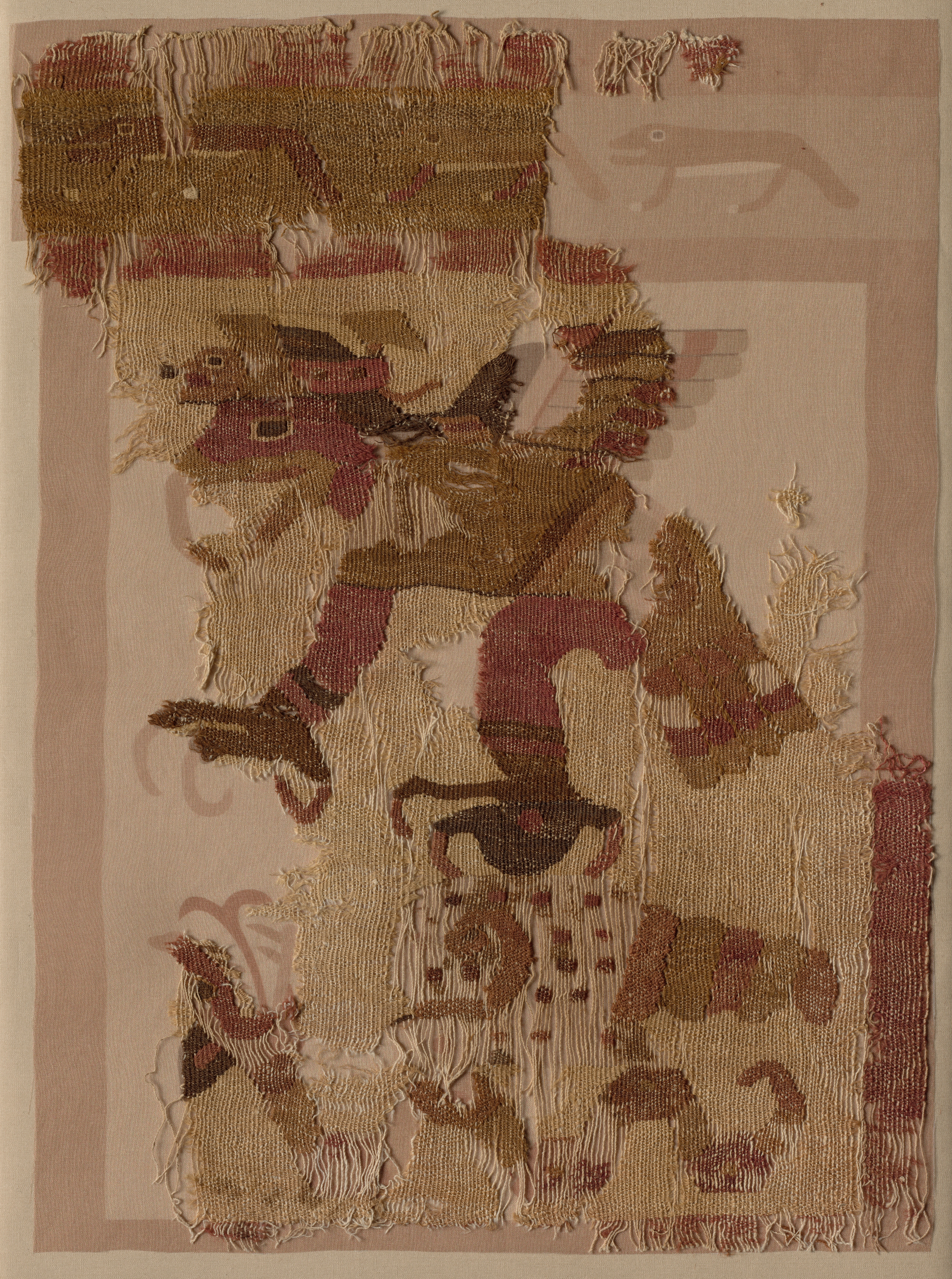
Deconstructing the Moche Fragment: An Avant-Garde Analysis for Zoey Fashion Lab
In the pursuit of avant-garde fashion, the past is not a relic but a raw material—a source of structural, textural, and narrative tension. The textile fragment from the Moche culture of Peru’s north coast, composed of cotton and camelid fiber, offers Zoey Fashion Lab a profound opportunity to deconstruct and reimagine the boundaries between ancient craft and futuristic design. This analysis, framed by the concept of Archive Resonance—the silent testimony of cultural collision and aesthetic fusion—will explore how this fragment’s technical, symbolic, and material properties can be liberated from historical context to inform a cutting-edge fashion narrative.
Technical Composition: The Dialectic of Fibers
The fragment’s dual-fiber construction—cotton and camelid fiber—establishes a foundational tension that resonates with avant-garde principles. Cotton, a plant-based fiber native to the Americas, offers a crisp, breathable structure with a matte finish. In contrast, camelid fiber (likely from llama, alpaca, or vicuña) introduces a protein-based, thermoregulating, and lustrous element. This combination is not merely functional but dialectical: the soft, warm, and elastic camelid fiber opposes the cool, stiff, and absorbent cotton. For Zoey Fashion Lab, this binary can be exploited through deconstructive tailoring—allowing the fibers to remain visually distinct, perhaps through raw, unstitched edges or exposed warp and weft. The fragment’s weave, likely a plain or tapestry structure, can be reinterpreted as a grid of resistance, where each thread becomes a line of tension in a garment that defies conventional draping. The Moche weavers’ mastery of tension and density—visible in the fragment’s surviving integrity—offers a blueprint for creating garments that are both structurally sound and provocatively fragmented.
Materiality and Texture: From Archaeological Relic to Sensory Provocation
The physical condition of the fragment—its faded colors, frayed edges, and subtle deformations—is not a sign of decay but a palimpsest of time. The cotton has likely yellowed, while the camelid fiber retains a muted, earthy palette of browns, creams, and rusts. For an avant-garde collection, these textures can be amplified rather than restored. Consider a garment where the cotton sections are chemically distressed to mimic archaeological wear, while the camelid fiber is left pristine, creating a jarring juxtaposition of decay and preservation. The fragment’s tactility—the softness of camelid hair against the coarser cotton—can be translated into a layered sensory experience: a coat with a camelid fiber lining that brushes the skin, while the outer cotton shell is treated with a resin or metallic finish, evoking the Moche’s use of mineral pigments. The Archive Resonance here is not about replication but about re-contextualization—allowing the material’s history to speak through its imperfections, much like a 16th-century painting’s craquelure becomes a feature in contemporary art.
Symbolic and Cultural Resonance: The Moche as Proto-Avant-Garde
The Moche civilization (c. 100–800 CE) was itself a culture of radical innovation in textile arts. Their use of iconography—deities, warriors, and ritual scenes—was not merely decorative but narratively charged. The fragment, likely part of a larger garment or funerary textile, carries the weight of spiritual and social meaning. For Zoey Fashion Lab, this symbolism can be abstracted rather than directly appropriated. The Moche’s preoccupation with the human figure, for instance, can be translated into anatomical deconstruction: seams that follow the lines of a skeleton, or panels that evoke the shape of a mummy bundle. The fragment’s pattern, if any remains, can be reduced to geometric fragments—a broken zigzag or stepped diamond—that are then laser-cut into modern synthetics or leather. This approach respects the original culture’s complexity while avoiding cultural appropriation through conceptual distance. The Archive Resonance of 16th-17th century global trade, as referenced in the prompt, mirrors the Moche’s own networks of exchange; the fragment is a node in a web of Andean, Amazonian, and coastal influences. An avant-garde collection could echo this by collaging fibers from disparate sources—Peruvian cotton, Mongolian cashmere, Japanese silk—creating a new, dissonant harmony.
Structural Innovation: Deconstructing the Weave
The Moche fragment’s weave structure—likely a warp-faced plain weave or a discontinuous weft for patterns—offers a template for rethinking garment construction. The warp and weft can be separated and recombined: warp threads become vertical seams or fringed hems, while weft threads are woven into transparent, net-like panels. This technique, known as fabric deconstruction, allows the garment to exist in a state of perpetual becoming, where the construction process is visible and celebrated. For example, a dress could have a woven bodice that dissolves into loose, floating warp threads at the hem, mimicking the fragment’s frayed edges. The camelid fiber’s natural elasticity can be used to create tension points—gathered sections that pull the cotton into sculptural folds, reminiscent of Moche ceramic vessels. The color palette should remain earthy (indigo, ochre, charcoal) but punctuated with metallic threads or iridescent coatings, referencing the Moche’s use of gold and silver ornaments. The result is a garment that is both archaeological and futuristic—a time-traveling artifact.
Avant-Garde Application: The Zoey Fashion Lab Collection
For a hypothetical collection titled "Warp of the Ancestors," this fragment would inform three key pieces: a deconstructed coat, a fragmented dress, and a sculptural accessory. The deconstructed coat would feature a cotton shell with raw, unhemmed edges, lined with camelid fiber in a patchwork of natural shades. The fragmented dress would use laser-cut panels that mimic the fragment’s missing sections, with camelid fiber straps that crisscross the body like Moche funerary bindings. The sculptural accessory—a belt or collar—would be woven from cotton and camelid fiber in a tensioned grid, with metal grommets at each intersection, evoking the Moche’s use of shell and stone beads. Each piece would be accompanied by a narrative tag that explains the fragment’s origin and the deconstruction process, transforming the garment into a mobile archive. The Archive Resonance is thus not static but performative: the wearer becomes a vessel for cultural memory, reanimated through avant-garde design.
Conclusion: The Fragment as Future
The Moche textile fragment is not a historical curiosity but a provocation for the avant-garde. Its technical duality, material decay, and symbolic depth offer Zoey Fashion Lab a rich lexicon for deconstruction, recontextualization, and innovation. By treating the fragment as a living document—one that speaks to the collision of cultures and the fusion of aesthetics—the lab can create garments that are not merely fashionable but conceptually rigorous. The Archive Resonance of this fragment, echoing through centuries of Andean and global exchange, finds its ultimate expression in the avant-garde: a form that respects the past by breaking it apart and reassembling it as a new, dissonant whole. For Zoey Fashion Lab, the Moche fragment is not a source of nostalgia but a blueprint for liberation, where every thread is a line of inquiry, and every seam a site of cultural dialogue.