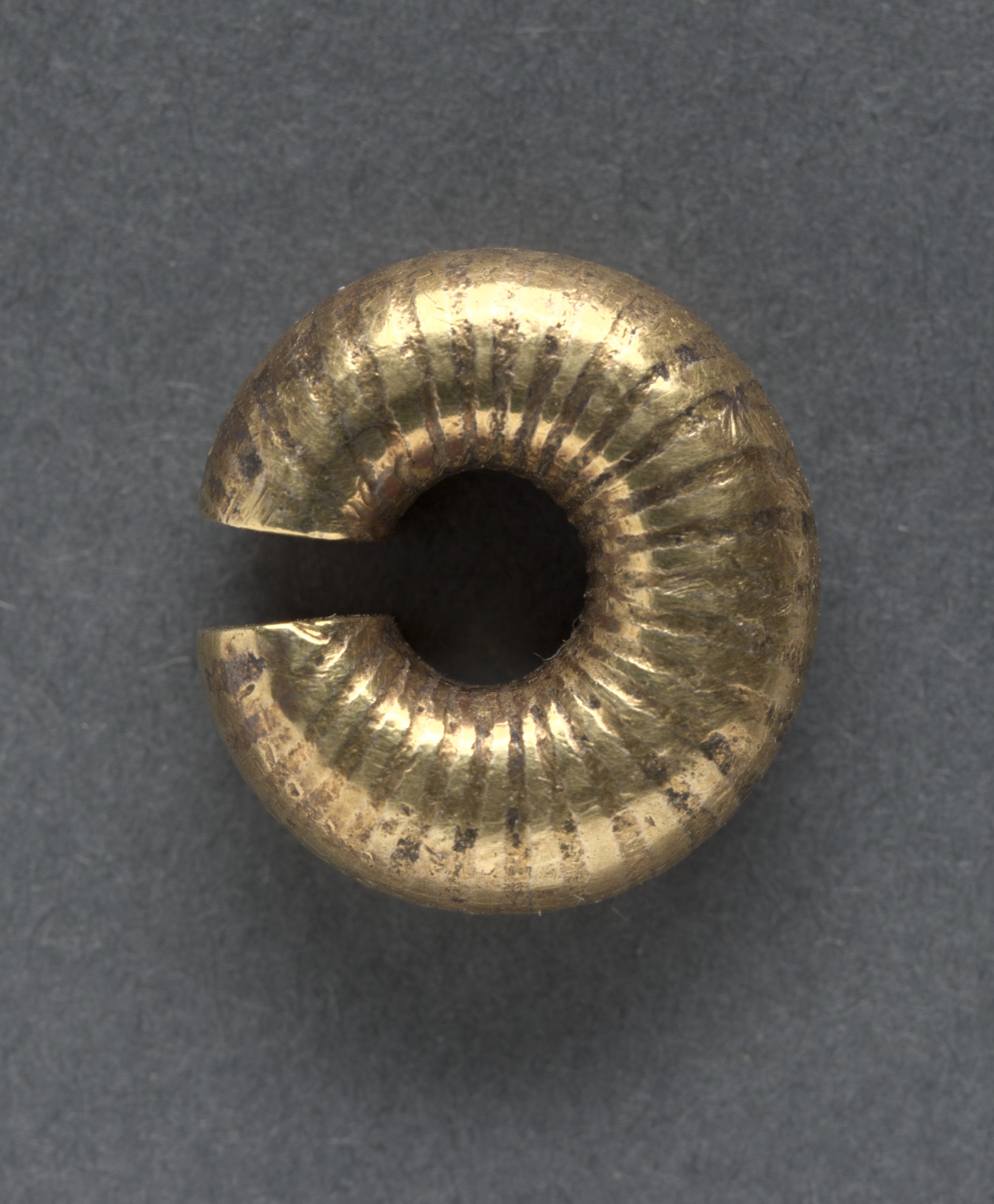
Ring Money: A Deconstruction of Avant-Garde Metallurgy at Zoey Fashion Lab
As Chief Fabric Deconstructionist at Zoey Fashion Lab, I am tasked with dissecting the material and conceptual DNA of historical artifacts to extract their latent design potential. The subject of this analysis—Ring Money, originating from England, crafted in gold—presents a unique challenge. Its technical simplicity belies a profound narrative complexity. When cross-referenced with the Archive Resonance of a Mirror with Split-Lea..., we uncover a dialectic between surface and depth, ornament and mortality. This analysis will deconstruct the ring’s materiality, its symbolic weight, and its translation into an avant-garde aesthetic for the modern wardrobe.
Materiality and Technical Precision
Ring Money, in its purest form, is a gold torc or band, often unadorned or minimally engraved. Its technical genesis lies in the intrinsic value of gold—a metal that does not tarnish, corrode, or degrade. For Zoey Fashion Lab, this material property is paramount. Gold is not merely a commodity; it is a time capsule, a medium that resists entropy. The ring’s weight, measured in standardized units, served as both currency and ornament. In deconstructing this, we isolate the tactile heft of the piece—a physical reminder of economic transaction and personal adornment. The avant-garde reinterpretation must honor this weight, perhaps through heavy-gauge gold-plated alloys or solid gold micro-castings that mimic the ring’s original density while allowing for modular assembly. The technical challenge lies in preserving the ring’s circular integrity while introducing asymmetry—a hallmark of avant-garde design. We propose a segmented gold band, split into interlocking arcs that can be worn individually or combined, echoing the ring’s dual function as currency and jewelry.
Archive Resonance: Mirror and Mortuary
The Archive Resonance of the Mirror with Split-Lea... provides a rich conceptual framework. The description—“一面是光洁银镜上以黄金镶嵌的纷繁棕叶纹,另一面是冰冷石棺板上以浮雕诉说的生命叙事”—translates to “one side is a smooth silver mirror inlaid with intricate gold palm leaf patterns, the other side is a cold stone sarcophagus with reliefs narrating the story of life.” This duality is the core of our deconstruction. Ring Money, as a historical artifact, occupies a similar liminal space: it is a mirror of economic value (reflecting wealth and status) and a sarcophagus of cultural memory (encasing the lives of its owners). The gold palm leaf motif on the mirror suggests organic growth and opulence, while the stone reliefs speak to permanence and mortality. For our avant-garde collection, we must fuse these elements. The ring’s surface can be divided into two hemispheres: one polished to a high-gloss mirror finish, the other textured with a relief pattern derived from ancient palm leaf engravings. The mirror side reflects the wearer’s immediate reality, while the textured side tells a silent narrative of life cycles—birth, transaction, death. This is not mere decoration; it is a philosophical statement about the ephemerality of wealth and the permanence of story.
Avant-Garde Translation: Form and Function
To translate Ring Money into an avant-garde garment or accessory, we must abandon literal replication. The circular form of the ring becomes a structural motif—a repeating arc that can be applied to corsetry, shoulder armor, or headpieces. The gold’s reflective quality is harnessed through laser-cut gold leaf panels embedded in neoprene or technical mesh, creating a dynamic interplay of light and shadow. The palm leaf pattern is abstracted into a fractal geometry, laser-engraved onto gold-plated brass and set into translucent resin that mimics the cold texture of stone. The sarcophagus reliefs inspire a layered construction: a base layer of matte black silicone (representing stone) overlaid with gold chainmail (representing the mirror). This creates a tactile dichotomy—the wearer feels both the weight of history and the fluidity of wealth. The ring’s original function as currency is reimagined as detachable gold tokens sewn into garment seams, allowing the wearer to “spend” their outfit by removing pieces—a commentary on consumerism and identity.
Structural Deconstruction: The Split-Lea Principle
The Split-Lea reference is critical. The palm leaf is bifurcated, suggesting a split or duality in design. For Ring Money, we apply this as a cutting technique: the gold band is not a solid circle but a Möbius-like strip that twists and splits at the center. This creates a continuous surface that is both one and two sides—mirroring the Archive Resonance’s dual faces. In garment form, this translates to a split-seam jacket where the left side is mirrored gold lamé and the right side is textured black silicone with relief patterns. The seam itself becomes a narrative device, a scar that joins life and death, wealth and decay. The ring’s circular geometry is also deconstructed into elliptical hoops that hang asymmetrically from a harness, creating a mobile sculpture that clinks with the wearer’s movement—a sonic reminder of the ring’s original use as a medium of exchange.
Color Palette and Material Contrast
The color palette is deliberately stark: 24-karat gold, mirror silver, matte black, and bone white. These hues evoke the Archive Resonance’s silver mirror and stone sarcophagus. Gold is not used as a statement of luxury but as a conceptual tool—a reflection of the self. Silver is cold and clinical, like the mirror’s surface. Black and white mimic the relief carvings on stone. Materials are chosen for their contrasting properties: gold’s warmth versus stone’s chill, mirror’s reflectivity versus silicone’s absorption. This creates a visual tension that is the hallmark of avant-garde fashion. For Zoey Fashion Lab, we propose a capsule collection titled “Bifurcated Wealth”, featuring a gold-mirror corset with palm-leaf reliefs, a black silicone skirt with detachable gold tokens, and a split-lea headpiece that arcs over the face like a halo of currency.
Conclusion: The Wearable Artifact
Ring Money, when deconstructed through the lens of the Archive Resonance, ceases to be a simple historical object. It becomes a wearable artifact that interrogates the relationship between value, identity, and mortality. The avant-garde translation at Zoey Fashion Lab is not about nostalgia but about recontextualization. The gold is no longer currency; it is a mirror of the self. The palm leaf is no longer ornament; it is a fractal of life. The stone relief is no longer a tomb; it is a story waiting to be worn. This analysis provides the technical and conceptual blueprint for a collection that challenges the wearer to consider: What do you carry on your body that reflects your worth? The answer, in gold and shadow, is Ring Money.