Technical Deconstruction & Historical DNA
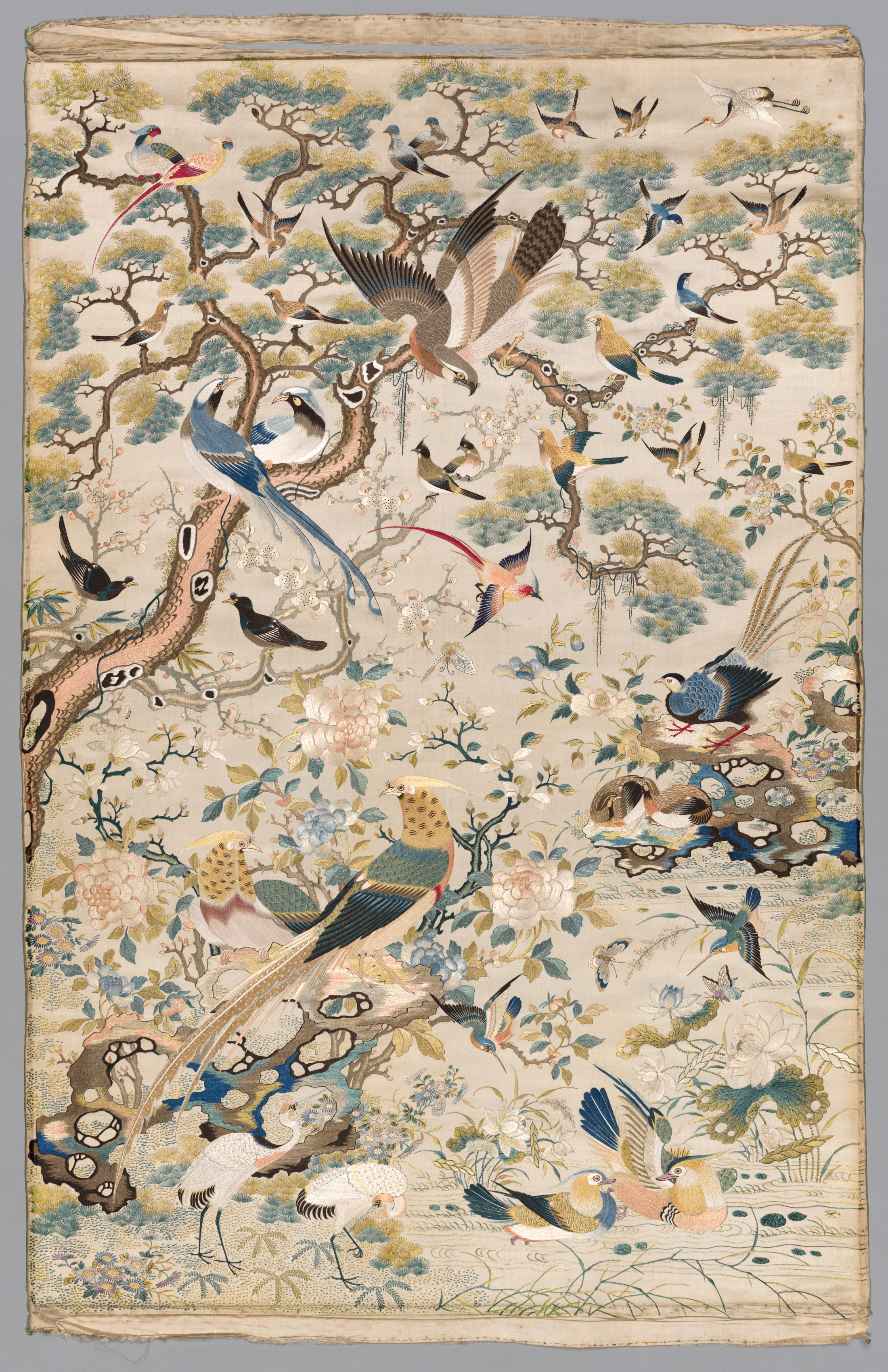
The artifact, a Qing dynasty (1644-1911) silk satin embroidered with a myriad of birds, presents not merely as a textile but as a complex data storage device of aesthetic and technical intelligence. Our analysis begins at the molecular level. The foundation is satin weave silk, a choice of profound intentionality. The long, unbroken floats of the satin weave create a luminous, almost liquid surface, a perfect canvas designed to capture and reflect light. This is not a passive background; it is an engineered optical field, a precursor to modern technical fabrics that manipulate light reflection. The polychrome silk embroidery, executed with staggering precision, operates as a coded language. Each stitch—a potential node; each color transition—a data point. The subject, "a myriad of birds," is a traditional symbol of harmony and imperial auspiciousness, but its true function here is as a non-linear database of form, movement, and ecological interaction.
Pattern Recognition: From Flock to Algorithm
The avian motif is a masterclass in controlled complexity. It is not a static portrait but a simulation of emergent behavior. Each bird, while unique in its plumage coloration and posture, relates to the whole through principles of asymmetry, balance, and implied flight paths. The composition avoids rigid symmetry, instead creating a dynamic equilibrium that the eye perceives as naturally chaotic yet artistically ordered. This is a visual algorithm for organic systems. For the Lab, this translates into a design philosophy where individual garment components (panels, sleeves, inserts) are unique yet governed by a core set of parametric rules, creating collections that are cohesive but never repetitive.
Furthermore, the embroidery technique itself—likely employing forbidden stitch (Kesi) and fine chain stitches—represents a high-level material programming. The layering of threads to create dimensionality and shadow is a manual, analog version of 3D rendering. The direction of the stitches maps the topography of feathers and wings, providing a blueprint for how flat, flexible materials can be engineered to suggest volume and kinetic energy through texture alone.
Recombinant Synthesis: Building the New DNA Strand
The reference to a "New DNA Strand" is our core directive. We do not replicate; we recombine. The historical artifact provides the base pairs—the fundamental code. Our avant-garde execution is the mutation and splicing that creates a new, viable, and provocative organism.
Strand 1: Material Transmutation
The satin silk base is reimagined. We preserve its luminous quality but alter its substance and behavior. Proposals include: a bi-phase satin, woven with alternating strands of recycled silk and optical fiber, creating a fabric that shifts from matte to luminous under different light sources; or a liquid satin made from thermoplastic polymers, where the satin weave is heat-molded to retain permanent, three-dimensional crumples and folds, echoing the implied movement of the birds. The embroidery is translated into laser-etched gradients on coated technical fabrics, or conductive ink prints that form interactive circuits, with "feathers" that respond to touch or environmental data.
Strand 2: Structural Avian Morphology
The bird forms escape the two-dimensional plane. Garment architecture will derive directly from avian anatomy and flock mechanics. Imagine a coat where the shoulder line extends into a articulated, wing-like cape, using memory alloy wires within seams to allow the wearer to "fold" or "extend" the silhouette. A gown's train could be composed of thousands of laser-cut silk "feathers" attached to a flexible netting, creating a dynamic, flowing mass that rustles and moves with avian realism. Jackets may feature asymmetric, layered lapels that mimic the overlapping plumage of a bird's breast, each layer a different, iridescent fabric cut on a unique bias.
Strand 3: The Myriad as a System
The "myriad" is key. This is not a single bird motif applied repetitively. Our collection will embody the concept of the flock. This means creating a capsule system where no single piece is identical, yet all communicate. A series of tops, each with a unique, abstracted bird-form embroidered or constructed from fabric shards, designed to be layered so the forms interact and create new composite images. It is wearable generative art. The color palette moves beyond Qing polychrome into hyper-natural and digital gradients—shifts from mineral green to electric blue, or iridescent hues that change from raven black to peacock green based on viewpoint.
Avant-Garde Manifesto: The Zoey Fashion Lab Proposition
The final output of this analysis is a collection entitled "Murmuration: The Qing Codex." It is avant-garde not for the sake of shock, but as a necessary evolution. It posits that the future of fashion lies in a deep, analytical dialogue with the past, treating historical artifacts as open-source code.
This collection will be defined by intelligent silhouettes that are modular and transformable, reflecting the adaptability of birds. It will utilize hybrid materials that blend the sublime touch of ancient silk with the performative properties of modern synthetics. Most importantly, it will carry a narrative of recombinant heritage—a visual and tactile statement that beauty and innovation are not linear progressions, but a continuous loop of deconstruction and synthesis.
The Qing embroidery was a map of a harmonious natural world. Our collection is a map of a harmonious techno-natural world, where the logic of the flock meets the logic of the algorithm, and where the silent, embroidered birds of the past take flight in a startling, new, and utterly contemporary form.