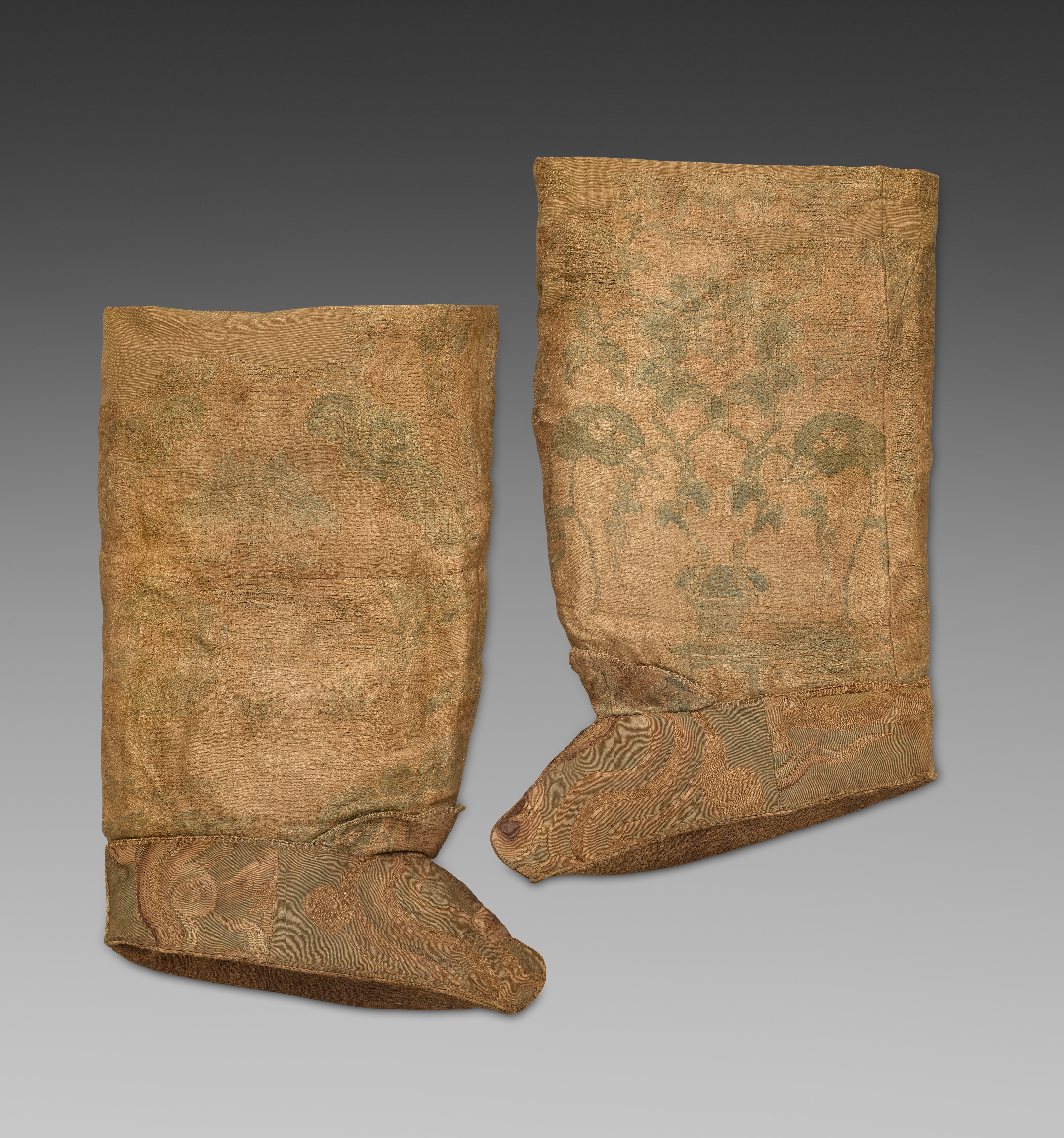
Deconstruction Analysis: Liao Dynasty Boots – A DNA Strand for Avant-Garde Footwear
As the Chief Fabric Deconstructionist for Zoey Fashion Lab, my role is to dissect historical artifacts not merely as relics, but as living blueprints for forward-thinking design. The subject of this analysis is a pair of boots originating from the Northern Liao dynasty (907-1125), a period of cultural fusion between nomadic Khitan and sedentary Chinese traditions. These boots, constructed from a complex matrix of silk compound twill, silk and gold tapestry, silk tabby, gauze, batting, and leather, represent a sophisticated technical achievement. For the Zoey Fashion Lab, this artifact is not a museum piece; it is a new DNA strand—a genetic code for an avant-garde collection that merges historical luxury with radical deconstruction.
Technical Deconstruction: The Material Genome
The boots’ construction reveals a multi-layered approach to materiality, each element serving both structural and symbolic functions. The silk compound twill forms the primary surface, its diagonal ribbing providing a subtle, directional texture that catches light differently depending on the angle. This is not a static fabric; it is a dynamic surface that suggests movement, even in stillness. The silk and gold tapestry inserts, likely woven with metallic threads, introduce a reflective, almost armor-like quality. These panels are not merely decorative; they act as focal points, drawing the eye to areas of stress—the ankle, the instep—where the boot flexes. The silk tabby and gauze layers, used for lining and inner structure, offer breathability and flexibility, while the batting (a padded layer) provides insulation and cushioning. Finally, the leather sole and heel ground the boot in practicality, offering durability against the terrain of the Mongolian steppe.
For Zoey Fashion Lab, this material genome is a call to re-engineer luxury. The compound twill can be reinterpreted using recycled silk fibers, creating a textural gradient that mimics the original’s depth. The gold tapestry can be replaced with conductive threads, embedding a subtle, interactive element—perhaps a touch-sensitive panel that changes color or emits a soft light. The batting, traditionally wool or cotton, can be substituted with aerogel-infused padding, offering unprecedented thermal regulation without bulk. The leather sole can be reimagined as a 3D-printed lattice, reducing weight while maintaining structural integrity. This is not about copying; it is about extracting the functional DNA and mutating it into a new species of footwear.
Cultural Context: Nomadic Luxury as Avant-Garde Provocation
The Liao dynasty was a crucible of cultural exchange. The Khitan elite adopted Chinese silk-weaving techniques while retaining their nomadic identity, creating a hybrid aesthetic that defied categorization. These boots, with their gold threads and padded construction, were not just footwear; they were signifiers of power, mobility, and wealth. For an avant-garde designer, this historical context offers a provocative narrative: luxury as a tool for transgression. The boots’ opulence is not conservative; it is aggressive, a statement of dominance over both nature and culture.
Zoey Fashion Lab can channel this by inverting the boots’ original function. Where the Liao boots were designed for horseback riding and steppe travel, an avant-garde reinterpretation might focus on urban navigation—a boot that adapts to concrete, glass, and digital interfaces. The gold tapestry, once a symbol of imperial status, can become a metaphor for digital wealth: woven with fiber-optic threads that pulse with data, turning the wearer into a walking interface. The batting, originally for warmth, can be replaced with phase-change materials that respond to the wearer’s body heat, altering the boot’s shape and color in real-time. This is luxury as dynamic performance, not static decoration.
Structural Innovation: The Boot as Architecture
The Liao boots’ construction is remarkably advanced for their time. The use of multiple fabric layers—twill, tapestry, tabby, gauze, batting—creates a composite structure that distributes stress, insulates, and allows articulation. For Zoey Fashion Lab, this is a blueprint for modular design. Each layer can be separated and reimagined as an independent component, allowing the wearer to customize the boot’s performance. The outer twill shell could be a detachable exoskeleton, printed with geometric patterns that reference the original’s weave. The gold tapestry inserts could be magnetic, allowing the wearer to swap them for different textures or colors. The batting layer could be a replaceable insole made from biodegradable foam, while the leather sole could be a snap-on traction system for different surfaces.
This modularity is inherently avant-garde, rejecting the idea of a finished product in favor of a living, evolving artifact. The boot becomes a platform for personal expression, much like the Liao dynasty’s own hybrid identity. The gauze layer, originally used for breathability, can be reimagined as a mesh that integrates with smart textiles, monitoring the wearer’s gait and adjusting the boot’s stiffness in response. The tabby weave, a simple plain weave, can be used as a base for biodegradable embroidery, allowing the boot to “grow” patterns over time as the wearer interacts with their environment.
Avant-Garde Application: The New DNA Strand in Practice
For Zoey Fashion Lab, the Liao boots are not a reference; they are a genetic template. The following are specific design directions based on the deconstruction:
1. The "Nomadic Interface" Boot
- Use silk compound twill woven with recycled polyester to create a durable, lightweight shell.
- Embed gold tapestry panels with micro-LEDs that respond to pressure, creating a dynamic light show with each step.
- Replace batting with a gel-like phase-change material that molds to the foot, offering personalized comfort.
- The leather sole is replaced with a 3D-printed lattice of recycled rubber, with a hexagonal pattern that references the original’s weave structure.
2. The "Deconstructed Steppe" Boot
- Separate the layers into a detachable system: an outer twill exoskeleton, a gold tapestry mid-layer, a gauze inner sock, and a leather base.
- The exoskeleton is laser-cut with patterns inspired by Liao dynasty cloud motifs, but with asymmetrical, jagged edges to evoke a sense of decay.
- The gold tapestry is hand-embroidered with conductive thread, allowing the wearer to control a connected device (e.g., a phone) by tapping the boot.
- The inner sock is made from biodegradable silk, designed to be replaced every season, emphasizing impermanence and renewal.
3. The "Hybrid Armor" Boot
- Use silk compound twill as a base, but treat it with a hydrophobic coating for urban wear.
- The gold tapestry is replaced with a metallic mesh that can be heated via a low-voltage battery, offering warmth in cold climates.
- The batting is replaced with aramid fiber padding, providing cut resistance without sacrificing flexibility.
- The leather sole is fused with a carbon-fiber plate for energy return, turning each step into a spring-loaded motion.
Conclusion: From Artifact to Catalyst
The Liao dynasty boots are more than a historical curiosity; they are a catalyst for radical design. Their material complexity, cultural hybridity, and structural ingenuity offer a rich vocabulary for avant-garde footwear. At Zoey Fashion Lab, we do not preserve the past; we mutate it. By treating this artifact as a new DNA strand, we can design boots that are not just worn, but experienced—pieces that challenge the boundary between fashion, technology, and art. The result is a collection that honors the nomadic spirit of the Liao dynasty while propelling fashion into an uncertain, exhilarating future.