Deconstructing the Avant-Garde: The Conte Gold Pectoral as a Blueprint for Zoey Fashion Lab
Introduction: The Archive as a Catalyst
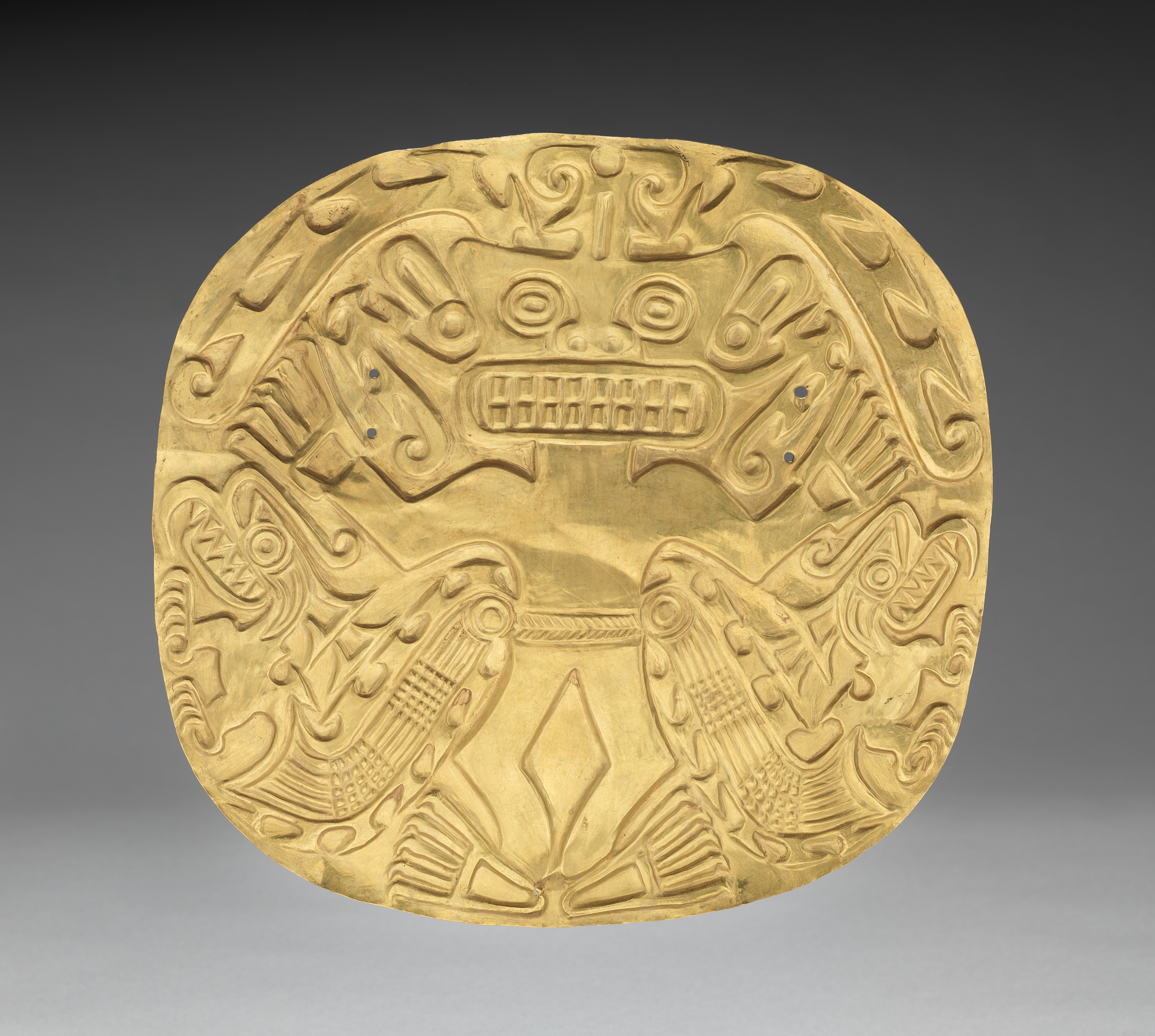
The artifact before us—a gold alloy pectoral from the Intermediate Region of Panama, dating to the 5th-10th Century and executed in the Conte style—is not merely a historical ornament. For Zoey Fashion Lab, it is a resonant archive, a blueprint for deconstructing the boundaries between the organic and the structural, the sacred and the profane. The archival reference, Archive Resonance: 一面是光洁银镜上以黄金镶嵌的纷繁棕叶纹,另一面是冰冷石棺板上以浮雕诉说的生命叙事, provides a critical lens. It juxtaposes a polished silver mirror inlaid with intricate gold palm-leaf patterns against a cold stone sarcophagus whose reliefs narrate a life story. This duality—reflective surface versus narrative depth, organic leaf versus rigid stone—is the core of our avant-garde analysis. We will dissect this pectoral not as a finished object, but as a deconstructive protocol for fashion design.
Materiality as a Deconstructive Act
The pectoral’s primary material, a gold alloy, is traditionally associated with permanence, status, and the divine. In the Conte style, gold is often worked with a lost-wax technique, creating forms that are simultaneously fluid and rigid. For Zoey Fashion Lab, this materiality is a challenge. We deconstruct the gold’s symbolic weight by treating it as a textile—a malleable, drapable surface. The alloy’s color, a warm, slightly greenish hue due to copper content, becomes a palette for chromatic deconstruction. We extract this specific gold tone and translate it into metallic-threaded organza, laminated leather, and heat-set vinyl. The pectoral’s surface, often textured with repoussé or filigree, is reimagined as a fabric relief. We apply silicone-based appliqués that mimic the raised palm-leaf motifs, creating a tactile experience that blurs the line between jewelry and garment. The mirror aspect of the archive reference—the polished silver with gold inlay—is translated into high-gloss, laser-cut acrylic panels embedded within sheer mesh. These panels reflect the wearer’s body, fragmenting and multiplying it, just as the pectoral once fragmented the light of the Panamanian sun.
Structural Deconstruction: From Plaque to Garment System
The pectoral’s form—a rigid, convex plaque designed to sit on the chest—is a structural constraint. Zoey Fashion Lab deconstructs this constraint by fracturing the plaque into modular components. We dissect the pectoral’s geometric and organic motifs: the central disc, the radiating palm leaves, the border of stylized human or animal figures. These become individual pattern pieces. The central disc is reimagined as a collar, a circular yoke that anchors the garment. The palm leaves become asymmetrical shoulder panels, extending beyond the natural shoulder line to create a silhouette that is both protective and aggressive. The border figures are translated into dart-like inserts at the waist and hips, creating a corseted effect without the rigidity of boning. The result is a garment that is architectural yet fluid, a wearable ruin of the original plaque. The stone sarcophagus reference informs the garment’s internal structure. We use a base of stiff, blackened cotton canvas—like the stone—upon which the gold-toned elements are layered. This creates a visual tension between the “cold” foundation and the “warm” surface narrative.
Narrative Deconstruction: The Life Story as Seam
The archive reference speaks of a life narrative told in relief on a sarcophagus. The Conte pectoral, too, often depicts cosmological narratives—shamans, jaguars, and celestial bodies. Zoey Fashion Lab deconstructs this narrative by treating the garment’s seams as storytelling devices. Each seam becomes a line of text, a visual hieroglyph. We use exposed, decorative stitching in gold thread to trace the path of the original pectoral’s motifs. The seams are not hidden; they are emphasized, creating a map of the artifact’s construction. The split-leaf motif mentioned in the archive is particularly potent. We interpret this as a deconstructive cut—a deliberate tear or slit in the fabric that reveals the underlying structure. These cuts are placed at the collarbone, the sternum, and the diaphragm, echoing the pectoral’s original placement. The cuts are not random; they follow the energy lines of the human body, creating a garment that breathes with the wearer. The narrative is not linear but fragmented, allowing the wearer to construct their own story through movement and interaction.
Avant-Garde Application: The Zoey Fashion Lab Collection
This deconstruction informs a specific avant-garde collection. The centerpiece is a jacket constructed from the fractured pectoral components. The back is a single, unbroken panel of blackened canvas, referencing the sarcophagus. The front is a collage of gold-toned elements: a circular yoke, asymmetrical shoulder leaves, and hip inserts. The seams are stitched with gold thread in a pattern that mimics the original filigree. The jacket is worn over a sheer, silver-mesh bodysuit—the mirror—that reflects the wearer’s skin. The bodysuit is inlaid with laser-cut acrylic “palm leaves” that catch light and create a shimmering, fragmented effect. The collection also includes a deconstructed skirt that mimics the pectoral’s border figures. The skirt is composed of multiple, overlapping panels of gold-lamé and black canvas, each panel cut in the shape of a stylized human figure. The panels are connected by visible, gold-clasped chains, referencing the pectoral’s original suspension system. The overall silhouette is asymmetrical and powerful, a wearable echo of a shamanic artifact.
Conclusion: The Pectoral as a Living Archive
The Conte gold pectoral, when deconstructed through the lens of Zoey Fashion Lab, is no longer a static artifact. It becomes a living archive—a set of protocols for material, structural, and narrative innovation. The resonance between the polished mirror and the cold sarcophagus, the organic leaf and the rigid stone, is the generative tension that drives our avant-garde practice. We do not replicate the pectoral; we re-animate it, allowing its forms to fracture, its narratives to fragment, and its materials to transform. The result is fashion that is not merely wearable but ritualistic, a contemporary engagement with the sacred and the structural. For Zoey Fashion Lab, the archive is not a tomb; it is a womb, birthing new forms from the gold of the past. The pectoral’s deconstruction is an act of creative archaeology, unearthing the avant-garde potential within the ancient.