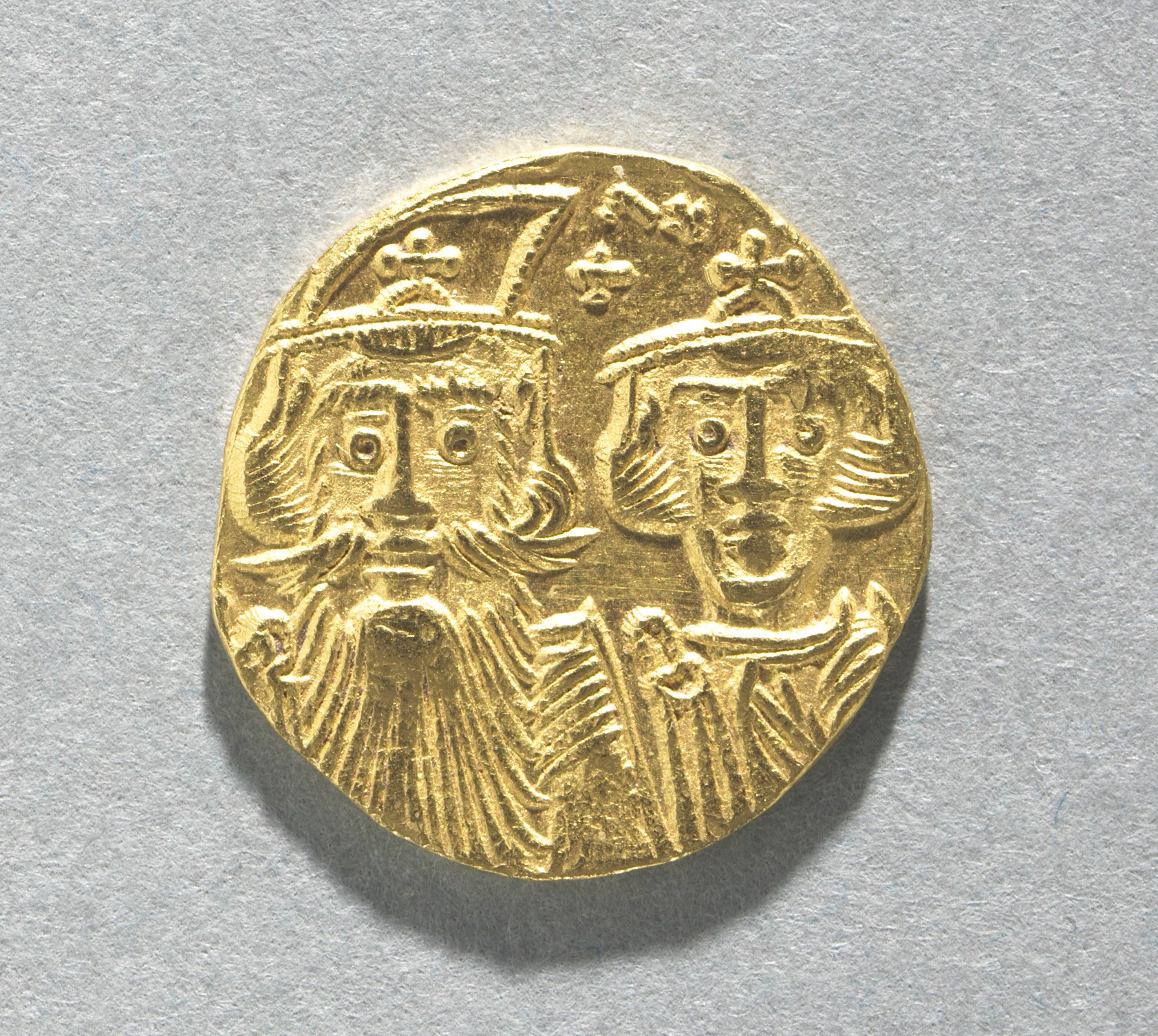
Deconstructing the Imperial Gaze: An Avant-Garde Analysis of the Solidus with Busts of Constans II and Constantine IV
At Zoey Fashion Lab, we do not merely observe historical artifacts; we interrogate them. We strip them of their chronological armor and re-contextualize their material and symbolic DNA within the contemporary avant-garde. The subject of this analysis—a gold solidus from Byzantium, obverse featuring the busts of Constans II and Constantine IV—is not simply a coin. It is a compressed narrative of power, succession, and metallurgical authority. When we read this object through the lens of Archive Resonance—specifically the poetic tension between a "mirror with split-leaf" and a "cold stone sarcophagus"—we uncover a profound dialogue between surface brilliance and subterranean mortality. This analysis will deconstruct the solidus as a wearable, conceptual artifact, reimagining its formal properties for the radical fashion system of Zoey Fashion Lab.
1. The Metallurgical Paradox: Gold as Both Shield and Shroud
The solidus is forged from gold, a material that in the Byzantine context signified divine light, imperial eternity, and untouchable sovereignty. Yet, within the avant-garde framework, gold is not merely a symbol of wealth; it is a material of contradiction. It is both reflective and absorptive, a surface that captures the eye while denying entry. The obverse presents two busts—Constans II, the senior emperor, and Constantine IV, his son—locked in a hierarchical gaze. Their faces are rendered with a stylized, almost mask-like precision. This is not portraiture in the humanist sense; it is a political icon, a frozen performance of dynastic stability.
For Zoey Fashion Lab, this gold surface becomes a mirror with split-leaf—a reflective plane that is fractured, organic, and alive. The "split-leaf" motif suggests a botanical rupture, a growth that is both beautiful and violent. In our deconstruction, the solidus is not a flat coin but a three-dimensional talisman that oscillates between a polished shield (projecting imperial power) and a shroud (concealing the decay of that power). The gold is not eternal; it is a temporal membrane that separates the living from the dead. The busts of Constans II and Constantine IV are not just rulers; they are ghosts etched into a precious metal, their authority preserved but also entombed.
2. The Obverse as a Stage: Hierarchical Composition and the Avant-Garde Silhouette
The obverse composition is rigorously hierarchical. Constans II is depicted larger, with a more prominent crown and a longer beard, while Constantine IV is smaller, positioned slightly behind, with a youthful, beardless face. This is a visual grammar of succession, a diagram of power transfer. The drapery of their garments is stylized into repetitive folds, creating a rhythm that echoes the architectural friezes of Byzantine churches. The inscription, typically encircling the busts, reinforces their names and titles, locking them into a textual cage of legitimacy.
From an avant-garde fashion perspective, this composition translates into a layered, asymmetrical silhouette. The larger bust of Constans II becomes a structural shoulder pad, a rigid, geometric form that dominates the garment's profile. The smaller bust of Constantine IV is a secondary appendage, perhaps a detachable sleeve or a trailing panel that suggests dependency and future growth. The drapery folds are reinterpreted as pleated, metallic fabric—gold lamé or hammered metal mesh—that catches light in sharp, angular planes. The inscription is not text but embroidery, a border of gold thread that constrains the garment's edges, reminding the wearer that they are bound by history.
The "cold stone sarcophagus" reference from Archive Resonance is crucial here. The obverse, despite its gold, is a funerary relief. The busts are not alive; they are carved, frozen, memorialized. In our design, the garment's surface is scored with shallow, parallel lines—like chisel marks on stone—that disrupt the gold's reflective sheen. This creates a tactile tension between the smooth, mirror-like areas (the "mirror with split-leaf") and the roughened, sarcophagal zones. The wearer becomes a living monument, a body that carries the weight of imperial history while simultaneously breaking it apart.
3. The Archive Resonance: From Mirror to Sarcophagus
The provided Archive Resonance text—"一面是光洁银镜上以黄金镶嵌的纷繁棕叶纹,另一面是冰冷石棺板上以浮雕诉说的生命叙事"—offers a dualistic framework. The "smooth silver mirror inlaid with gold and complex palm leaf patterns" evokes a surface of pure reflection and organic growth. The "cold stone sarcophagus with reliefs narrating life stories" evokes a surface of memory and burial. The solidus, as a single object, contains both. Its obverse is the sarcophagus relief, telling the story of imperial lineage. Its reverse (not analyzed here, but implied) would be the mirror, a polished field that reflects the viewer's own gaze back upon them.
For Zoey Fashion Lab, this duality is the core of the avant-garde statement. We design a two-faced garment: one side is a mirror of gold and silver, a highly polished, almost liquid surface that reflects the environment and the wearer's own image. This side is adorned with appliquéd palm leaves in gold wire, representing the "split-leaf" motif—a symbol of organic, chaotic growth that disrupts the rigid geometry of the coin. The other side is a textured, matte surface of oxidized metal or blackened leather, carved with low-relief busts of Constans II and Constantine IV. This side is the sarcophagus, a cold, tactile narrative that the wearer carries on their back or as an inner lining.
The garment becomes a portable archive, a wearable artifact that forces the viewer to confront the temporality of power. The mirror side is the present, the living, the reflective. The sarcophagus side is the past, the dead, the narrated. The wearer is the fulcrum, the living body that bridges these two states. This is not costume; it is critical re-embodiment.
4. Deconstructing the Imperial Gaze: The Avant-Garde as Counter-Narrative
The solidus was designed to be seen, to circulate, to assert authority. Its obverse is a propaganda tool, a fixed image of power that demands recognition. The avant-garde fashion system, however, subverts this gaze. By fragmenting, layering, and re-contextualizing the solidus's imagery, we transform it from a tool of imperial control into a site of critical interrogation.
Consider the hierarchical composition of the busts. In our design, the larger bust of Constans II is not a dominant center but a dislocated fragment, perhaps placed off-shoulder or as a detachable collar. The smaller bust of Constantine IV becomes a floating appliqué that can be repositioned, suggesting that succession is not fixed but contingent. The gold is not polished to a high shine but oxidized, patinated, and distressed, revealing the material's vulnerability. The "palm leaf" patterns are not decorative but surgical, cutting into the gold surface like scars.
This deconstruction aligns with the avant-garde ethos of de-familiarization. The wearer is not a passive receiver of imperial history but an active agent who re-orders its symbols. The solidus becomes a tool for questioning the very nature of representation, power, and memory. The "mirror with split-leaf" is not a perfect reflection but a fractured one, showing the cracks in the imperial facade. The "cold stone sarcophagus" is not a final resting place but a generative surface from which new narratives can be carved.
5. Conclusion: The Wearable Solidus as Avant-Garde Artifact
The solidus with busts of Constans II and Constantine IV is not a relic to be preserved in a museum vitrine. It is a resonant archive that speaks to the contemporary condition of power, materiality, and embodiment. Through the lens of Zoey Fashion Lab, we have deconstructed its obverse as a dialectical surface—part mirror, part sarcophagus—that can be re-imagined as a wearable, critical garment. The gold is not just wealth; it is a temporal membrane that separates the living from the dead. The busts are not just emperors; they are ghosts in the machine of fashion.
In the avant-garde collection, this solidus becomes a jacket with a mirror-front and a sarcophagus-back, a skirt with pleated, metallic folds that mimic drapery, or a headpiece that frames the face like a coin's obverse. The wearer is not a subject of the empire but a deconstructor of its image. The Archive Resonance of the "mirror with split-leaf" and the "cold stone sarcophagus" is not a binary opposition but a continuous oscillation, a rhythm that the garment embodies. This is the future of fashion: not as adornment, but as critical archaeology.