Deconstructing the Brescian Flintlock: A New DNA Strand for Zoey Fashion Lab
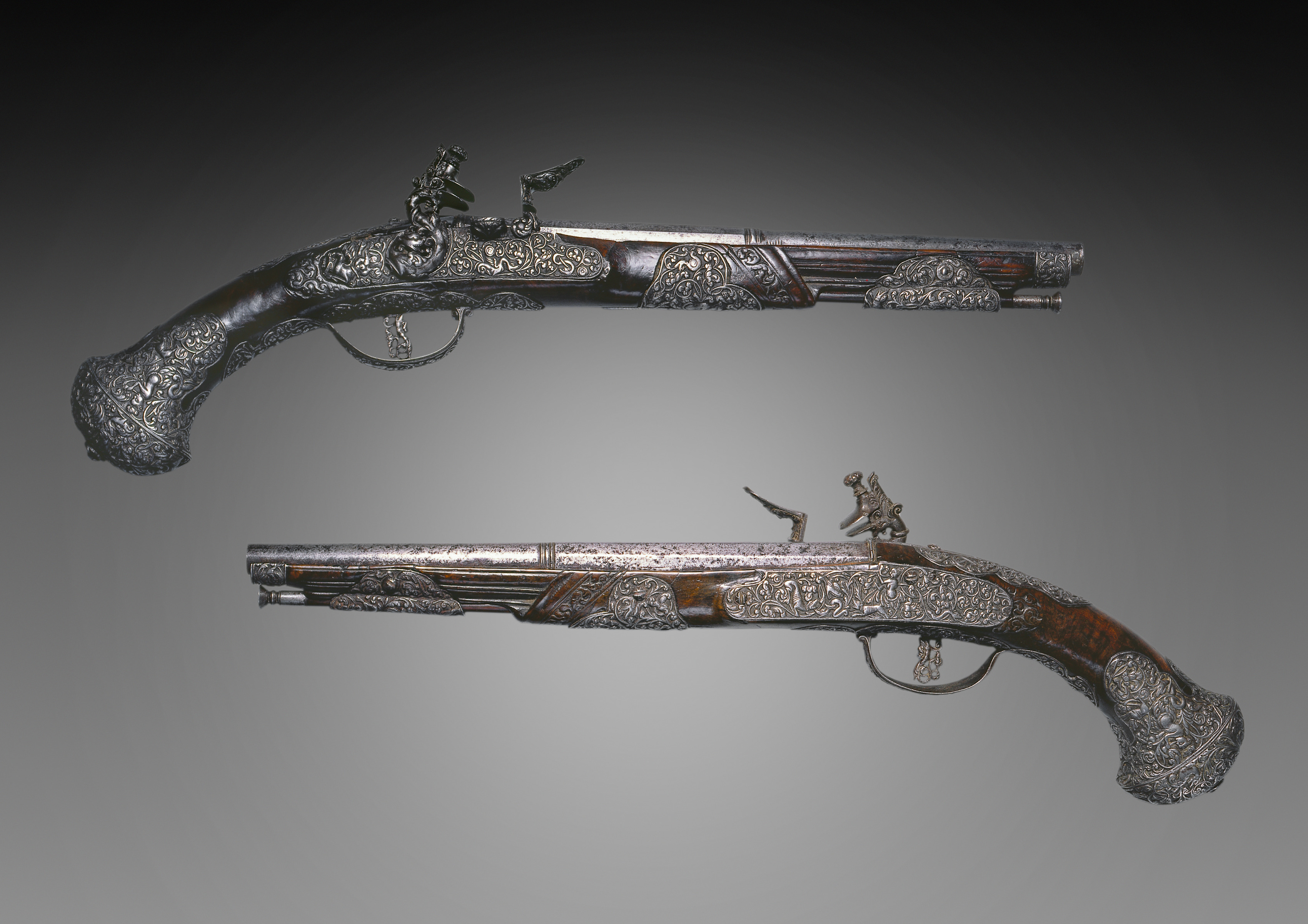
As Chief Fabric Deconstructionist for Zoey Fashion Lab, my role is to dissect historical artifacts not as relics, but as blueprints for future materiality. The subject of this analysis—a pair of 17th-century flintlock pistols from Brescia, Italy—presents an extraordinary challenge. These are not mere weapons; they are sculptural objects, precision instruments, and expressions of power. Their components—chiseled steel, walnut stock, and the mechanics of ignition—constitute a New DNA Strand for avant-garde fashion. This strand is not about literal replication, but about translating the artifact’s core principles into wearable, kinetic, and textural experiences. Our analysis will decode three primary genetic markers: Structural Tension, Ornamental Violence, and Kinetic Provocation.
Genetic Marker 1: Structural Tension – The Steel and Walnut Dialogue
The most immediate dialogue in these pistols is between the chiseled steel and the walnut stock. Steel, cold and unyielding, is carved with intricate, almost floral, patterns—a paradox of hardness and delicacy. Walnut, warm and organic, is shaped to fit the hand, its grain a quiet counterpoint to the metal’s brilliance. In fashion, this is a conversation between rigid structure and fluid form.
For Zoey Fashion Lab, this translates into a deconstructed corset or exoskeletal jacket. Imagine a garment where laser-cut, steel-gray polymer panels (simulating the chiseled steel) are not sewn but mechanically hinged onto a base of hand-sculpted, dark walnut-dyed leather. The panels would be arranged to mimic the pistol’s barrel and lock plate, but their placement would be asymmetrical, creating a tension between the body’s natural movement and the armor-like shell. The walnut stock’s ergonomic curve becomes the jacket’s shoulder line, while the steel’s floral motifs are reinterpreted as negative-space cutouts revealing a layer of raw silk beneath. The result is a garment that breathes, creaks, and resists—a living artifact of structural tension.
Genetic Marker 2: Ornamental Violence – The Chiseled Decoration
The Brescian pistols are renowned for their chiseled decoration, where steel is not simply polished but deeply carved with scrollwork, acanthus leaves, and mythological figures. This is not decoration for decoration’s sake; it is ornamental violence—beauty carved into a tool of lethality. The steel’s surface becomes a battlefield between function and art.
In our avant-garde collection, this translates into embellished surfaces that challenge perception. We can achieve this through 3D-printed metal appliqués attached to sheer, high-tension fabrics like nylon organza or carbon-fiber mesh. These appliqués would replicate the chiseled patterns but in a fractured, deconstructed manner—a scrollwork motif that appears to be peeling away from the fabric, or a mythological figure that is half-formed, dissolving into the textile. The violence is not literal but visual: the decoration cuts into the fabric, creating tears, rips, and suspended threads that mimic the process of chiseling. This is a garment that tells a story of creation through destruction, where the embellishment is not added but excavated from the material itself.
Genetic Marker 3: Kinetic Provocation – The Flintlock Mechanism
The flintlock’s genius lies in its kinetic chain: the trigger releases a spring-loaded hammer that strikes a flint, creating sparks that ignite the powder. This is a sequence of latent energy, sudden release, and transformation. For fashion, this is the most potent DNA strand—a call to design garments that are not static but performative.
Zoey Fashion Lab can engineer a kinetic garment system inspired by this mechanism. Consider a dress or coat with integrated, wearable mechanisms—small, spring-loaded elements that are triggered by body movement. For instance, a sleeve could contain a series of flint-and-steel-inspired components that release a shower of biodegradable, non-toxic sparkles (simulating the flint’s sparks) when the wearer raises their arm. The “trigger” could be a subtle pressure point in the garment’s lining, activated by a gesture as simple as a hand clasp. The walnut stock’s ergonomics inform the placement of these triggers—at the hip, the shoulder, or the wrist—areas where the body naturally applies pressure.
More provocatively, the garment could feature transformable panels that change color or texture upon kinetic activation. A layer of thermochromic fabric (sensitive to friction or heat) could shift from deep walnut brown to gunmetal gray when the wearer moves, mimicking the flash of ignition. The chiseled steel patterns would be printed in a conductive ink that, when connected by the wearer’s touch, triggers a low-voltage LED sequence along the garment’s seams—a visual echo of the flintlock’s spark trail. This is not costume; it is wearable performance art that demands interaction.
Synthesis: The New DNA Strand in Practice
The deconstruction of these Brescian flintlocks yields a New DNA Strand for Zoey Fashion Lab: a design language that marries precision engineering with ornate brutality. The strand is characterized by:
- Material Contradictions: Rigid, metallic elements fused with organic, flowing textiles.
- Surface Narrative: Decoration that is not applied but carved, torn, or excavated from the fabric.
- Kinetic Agency: Garments that respond to the wearer’s body, transforming through movement or touch.
To realize this, our lab must collaborate with industrial designers, metalworkers, and textile engineers. The walnut stock’s warmth can be replicated through laser-cut, wood-veneered leather. The chiseled steel becomes etched stainless steel mesh or 3D-printed titanium lace. The flintlock’s mechanism inspires miniaturized pneumatic or spring-loaded systems embedded in seams. The final collection will not merely reference the 17th century; it will reanimate it through the lens of avant-garde fashion, creating pieces that are as much about process as they are about form.
In conclusion, these pistols are not weapons of the past but blueprints for future garments. Their DNA—structural tension, ornamental violence, and kinetic provocation—offers a radical departure from conventional fashion. Zoey Fashion Lab will not replicate the flintlock; it will wear its spirit, chiseled into every seam, every trigger, every spark. The result is fashion that is not worn but activated—a living, breathing artifact of history reimagined.