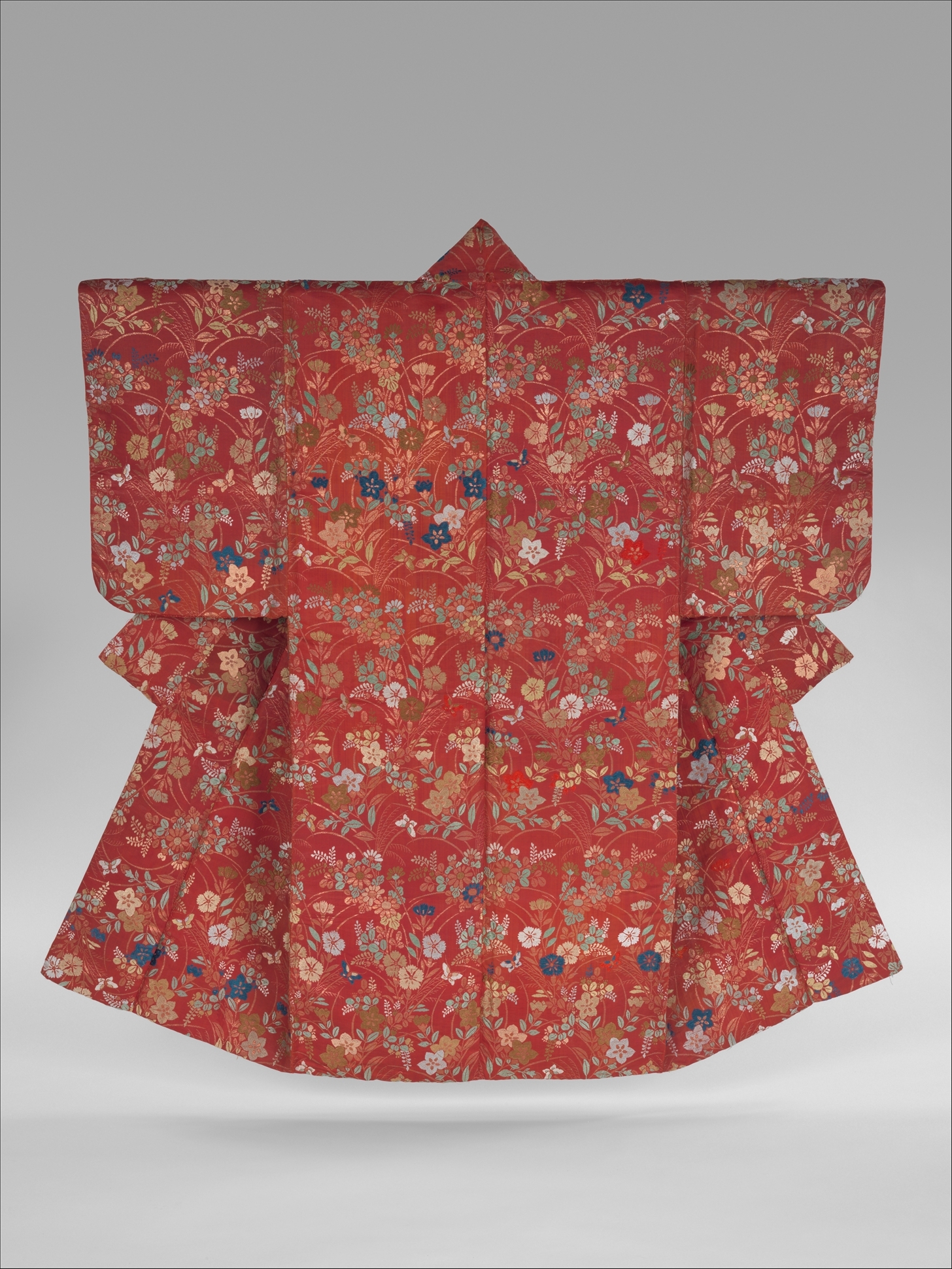
The Karaori Deconstructed: Temporal Architecture for SS26
The Noh robe, specifically the Karaori of the Muromachi period, is not a garment of passive history. It is a manifesto of controlled decay, a system of structural tension that prefigures the most radical deconstructive fashion of the 21st century. For Zoey Fashion Laboratory's SS26 proposition, this 16th-century artifact—woven in twill silk with brocaded autumn grasses and butterflies—becomes a blueprint for a new temporal silhouette. We are not reviving a tradition; we are extracting its latent futurity.
The Karaori’s primary innovation, for the avant-garde eye, lies in its asymmetric weight distribution. The dense brocading of metallic thread, concentrated in the lower hem and sleeves, creates a gravitational pull that the silk twill must resist. This is not a static garment. It is a system of tensile equilibrium. For SS26, we translate this into a silhouette that appears to be in a state of perpetual, slow-motion collapse. The shoulder line, traditionally rigid in Western tailoring, is replaced by a floating cantilever—a structural element that extends from the back, mimicking the suspended tension of the butterfly’s wings as they alight upon the autumn grass.
Deconstructing the Motif: Autumn Grasses as Structural Webbing
The autumn grasses—susuki, kikyo, and hagi—are not merely decorative. In the Karaori, they function as a cartographic network of the garment’s internal logic. The supplementary weft patterning, executed in silk and metallic thread, creates a raised topography that dictates how light falls and where the fabric will drape. For SS26, we propose a parametric grass weave—a digital translation of this hand-loomed technique. Using a custom algorithm that reads the original pattern’s density, we generate a series of 3D-printed structural nodes that are embedded within a base of liquid-silk organza. These nodes act as the garment’s exoskeleton, creating a silhouette that is both rigid and fluid, a paradox that defines the futuristic aesthetic.
The butterfly motif is the key to the garment’s kinetic architecture. In the original Karaori, butterflies are depicted in mid-flight, their wings a blur of gold and silver thread. For Zoey’s SS26 interpretation, we deconstruct this motion into a series of hinged panels. The sleeves are not attached to the body; they are suspended from the shoulder by a system of micro-cables and rotating joints, allowing them to flutter independently with the wearer’s movement. This is not mere ornament. It is a functional articulation that redefines the relationship between garment and body, transforming the wearer into a living kinetic sculpture.
Material Alchemy: Silk, Metal, and the Future of Textile
The original Karaori’s materiality—twill-weave silk with brocading in silk and metallic thread—is a study in incompatible densities. The silk twill provides a soft, pliable base, while the metallic threads create rigid, reflective zones. This dichotomy is the foundation for our SS26 material strategy. We propose a hybrid textile that combines traditional hand-loomed silk with a new generation of shape-memory alloys. The metallic threads are replaced by a nickel-titanium filament that can be programmed to recall a specific shape when heated by body temperature or ambient light. The autumn grasses, originally static, will slowly unfurl as the wearer moves, creating a living, breathing surface that evolves throughout the day.
The brocading technique itself is reinterpreted as a tactical layering system. The supplementary weft patterning is not woven in but applied as a laser-cut appliqué of recycled metallic film. This film is then bonded to the silk using a ultrasonic welding process, eliminating the need for thread and creating a seam that is both stronger and more flexible than traditional stitching. The result is a garment that retains the visual complexity of the original but with a zero-waste construction—a critical innovation for the sustainable avant-garde.
Silhouette as Temporal Narrative: The SS26 Proposition
The final silhouette for SS26 is not a single shape but a temporal sequence. The garment begins as a near-replica of the Karaori’s broad, rectangular form—a reference to the traditional Noh stage. However, as the wearer assumes poses from Noh theater—the surihashi sliding step, the kamae stance—the shape-memory alloys activate, and the garment deconstructs itself into a series of floating, asymmetrical planes. The back panel, originally a solid expanse of brocaded silk, splits along the lines of the autumn grass pattern, revealing a second skin of iridescent micro-fiber that shimmers with the colors of the original butterflies.
The sleeves, as mentioned, become independent kinetic elements. But the innovation extends to the hem. The traditional trailing hem of the Karaori, which sweeps the stage floor, is reimagined as a detachable train of segmented, laser-cut panels. Each panel is hinged with a miniature bearing, allowing it to fold and unfold like a fan. The wearer can choose to leave the train trailing for a dramatic entrance, then fold it into a compact, architectural bustle for movement. This is transformative couture—a garment that is not a fixed object but a system of possibilities.
Conclusion: The Karaori as a Proto-Futurist Artifact
The Noh robe is not a relic. It is a prototype for a future fashion that values structural intelligence over passive decoration. By deconstructing its motifs, material logic, and kinetic potential, Zoey Fashion Laboratory presents a collection for SS26 that is not inspired by the past but constructed from its latent futures. The autumn grasses become a network of structural nodes. The butterflies become a system of kinetic articulation. The silk and metal become a living, responsive surface. This is not a costume. This is a wearable architecture of time—a garment that exists not in a single moment but in the space between tradition and innovation, between the stage and the street, between the 16th century and the 22nd.