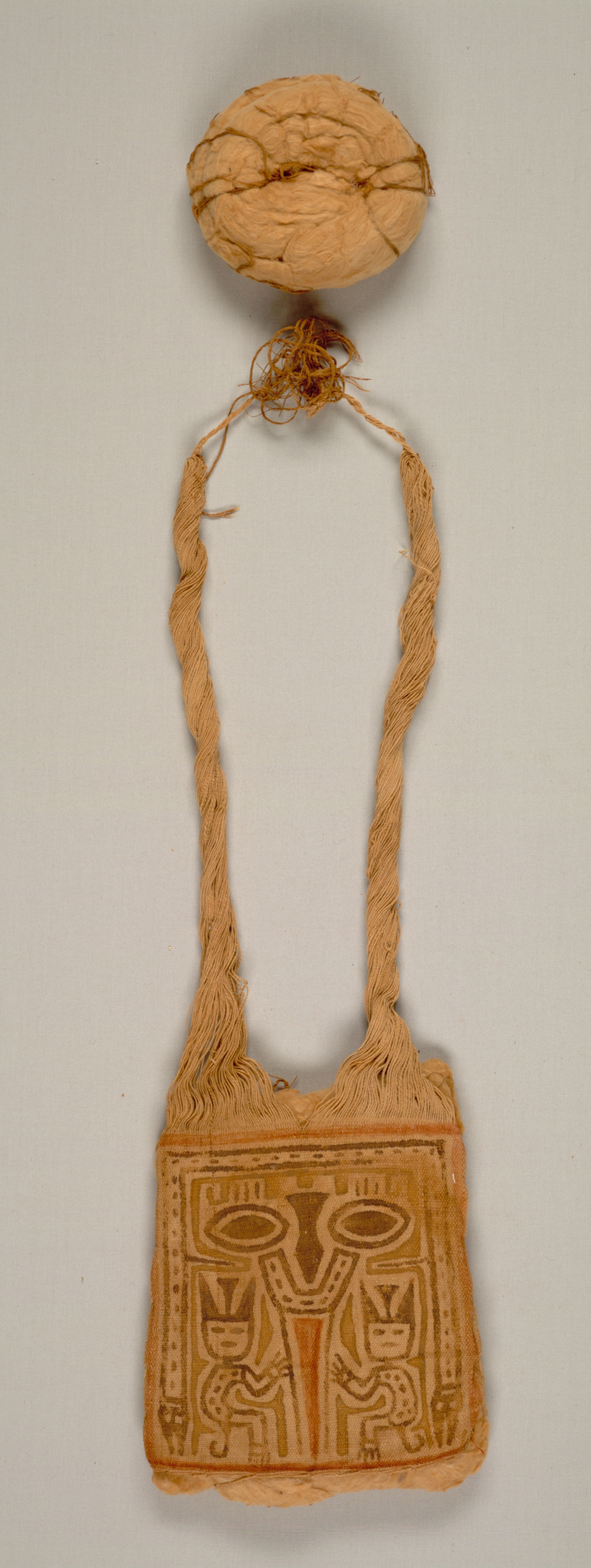
Deconstruction Analysis: The Mummy Bundle "Mask" as Proto-Avant-Garde Textile
As Chief Fabric Deconstructionist for Zoey Fashion Lab, I have undertaken a detailed technical and conceptual analysis of the Mummy Bundle "Mask" from the Paracas style, originating from the Ocucaje site in the Ica Valley, Peru, South Coast. This artifact, composed of cotton and pigment in a plain weave, presents a unique opportunity to bridge ancient Andean textile traditions with the principles of avant-garde fashion. The reference to "Archive Resonance" — specifically the notion of objects from the 16th to 17th centuries as silent witnesses to cultural collision and aesthetic fusion — serves as a critical lens. This analysis will deconstruct the mask’s materiality, its structural language, and its potential to inform a radical, contemporary design vocabulary.
Materiality and Deconstruction: Cotton and Pigment
The substrate of this mask is plain-weave cotton, a fabric of remarkable simplicity yet profound cultural significance. In the Paracas context, cotton was not merely a utilitarian fiber; it was a domesticated resource central to social and ritual life. The plain weave itself, the most basic interlacing of warp and weft, is a foundational grammar. For the avant-garde designer, this simplicity is a virtue. It presents a zero-degree of textile construction, a blank slate upon which complex interventions can be applied. The deconstructionist sees not a finished object, but a matrix of potential. The weave’s inherent porosity and flexibility, contrasted with the rigidity of the pigment application, creates a primary tension — a dialogue between the soft, pliable body of the fabric and the hard, pictorial surface of the mask.
The pigments used are not merely decorative; they are archaeological evidence of a technological and aesthetic system. Paracas artists were masters of mineral and organic dyes, achieving a chromatic range from deep indigos to vibrant cinnabar reds. In the context of the mask, these pigments are applied in a manner that is both painterly and structural. They do not simply sit on the surface; they penetrate the fibers, creating a composite material. This is a crucial point for the avant-garde: the pigment acts as a third element that transforms the cotton from a textile into a hybrid object. It is neither purely fabric nor purely painting. This hybridity is a core tenet of avant-garde practice, which seeks to dissolve boundaries between art, craft, and fashion. The mask’s surface, now a painted textile, challenges the hierarchy of materials, suggesting that the body’s covering can be a site for complex, layered expression.
Structural Language: The Mask as Architectural Fragment
The mask form itself is a powerful architectural element. In Paracas funerary practice, these bundles were not mere shrouds; they were three-dimensional constructs that redefined the human form. The face, often rendered in stylized, geometric motifs, becomes a portable facade. For the avant-garde, this is a direct precursor to the concept of wearable architecture. The mask is not a representation of a face; it is an abstraction of identity. The geometric patterns — stepped diamonds, zigzags, and stylized animal forms — are not naturalistic; they are signifiers of a coded visual language. This resonates with the avant-garde’s interest in semiotics and abstraction in fashion, where a garment or accessory becomes a sign system rather than a mere covering.
The deconstruction of this mask reveals a fragmented, layered composition. The plain weave cotton provides the ground, but the pigment creates a new, superimposed structure. The mask’s edges are often irregular, suggesting a cutting or tearing from a larger textile. This is not a seamless, finished object; it is a fragment of a larger narrative. This incompleteness is a powerful tool. In the hands of a deconstructionist, the mask becomes a template for disassembly. The geometric motifs can be isolated, the pigment layers can be analyzed as distinct strata, and the cotton substrate can be considered as a support system that can be manipulated — stretched, slashed, or woven into new configurations. The mask’s original function as a funerary object, meant to be seen in a specific ritual context, is now recontextualized as a source of formal and conceptual inspiration for a living body.
Archive Resonance: Cultural Collision and Avant-Garde Fusion
The reference to "Archive Resonance" — the period of 16th to 17th centuries as a time of cultural collision — is directly applicable to the Paracas mask. While this mask predates the Spanish conquest, the Paracas culture itself was a product of regional interaction and exchange. The Ocucaje site, in the Ica Valley, was a crossroads of Andean traditions. The mask’s style, with its bold, graphic quality, reflects a convergence of textile and ceramic traditions. This internal cultural collision is a precursor to the globalized collisions of the early modern period. For the avant-garde, this is a model for hybridity. The mask is not a pure artifact; it is a synthesis of influences — a proto-avant-garde object that already embodies the principle of fusion.
The concept of resonance is key. The mask does not simply exist in the past; it vibrates through time, offering a frequency that can be tuned into by contemporary designers. The "silent witness" of the archive is now speaking to us through its material presence. The avant-garde designer must become a translator, decoding the mask’s visual and tactile language and recoding it into new forms. The mask’s pigment, for example, can be seen as a proto-print, a direct application of color to fabric that predates mechanized printing. This suggests a return to artisanal, hand-driven processes in fashion — a reaction against mass production. The mask’s geometric abstraction can be reinterpreted as a modular system, where motifs can be repeated, scaled, and rotated to create new patterns. The irregular edges of the mask can be a design feature, celebrating the raw, unfinished quality that is a hallmark of deconstructionist fashion.
Implications for Zoey Fashion Lab: A New Avant-Garde Vocabulary
From this analysis, Zoey Fashion Lab can extract a radical design methodology. The Mummy Bundle "Mask" is not a costume to be copied, but a conceptual framework. The following principles emerge:
1. Material Hybridity: The mask demonstrates that a textile can be a composite surface. Zoey Fashion Lab should explore the use of painted or printed textiles that are then treated as sculptural elements. The pigment becomes a structural component, not just a decorative layer. This could involve using stiffening agents, resin, or even embedding pigments into the weave itself to create textile-paint hybrids.
2. Geometric Abstraction as Code: The mask’s geometric motifs are a visual language. The lab should develop a library of abstract shapes derived from the mask’s patterns, then use them in disrupted, asymmetrical compositions. The goal is not to represent the original, but to generate new meanings through recombination. This aligns with the avant-garde’s interest in deconstruction and reconstruction.
3. Fragment and Assemblage: The mask’s status as a fragment is a design opportunity. Zoey Fashion Lab can create garments that are inherently incomplete — pieces that are meant to be assembled, draped, or layered by the wearer. This challenges the conventional notion of a finished garment. The mask suggests a modular system where components can be added or removed, echoing the Paracas practice of wrapping and layering in funerary bundles.
4. Cultural Resonance as Process: The "Archive Resonance" concept should be integrated into the design process itself. The lab can archive its own materials — swatches, sketches, and prototypes — and treat them as fragments of a larger narrative. This creates a self-referential system where each collection is a layer in an ongoing dialogue with the past. The mask’s silent witness becomes a design partner.
In conclusion, the Mummy Bundle "Mask" from Paracas is not a historical relic to be preserved in a glass case. It is a living document of material intelligence, geometric mastery, and cultural synthesis. For Zoey Fashion Lab, it offers a proto-avant-garde template that can be deconstructed, analyzed, and reimagined. The plain weave cotton and pigment are not limitations; they are starting points for radical innovation. By embracing the mask’s hybridity, its fragmentary nature, and its coded abstraction, the lab can create a fashion that is archaeologically informed yet aggressively contemporary — a true resonance of the archive in the avant-garde now.