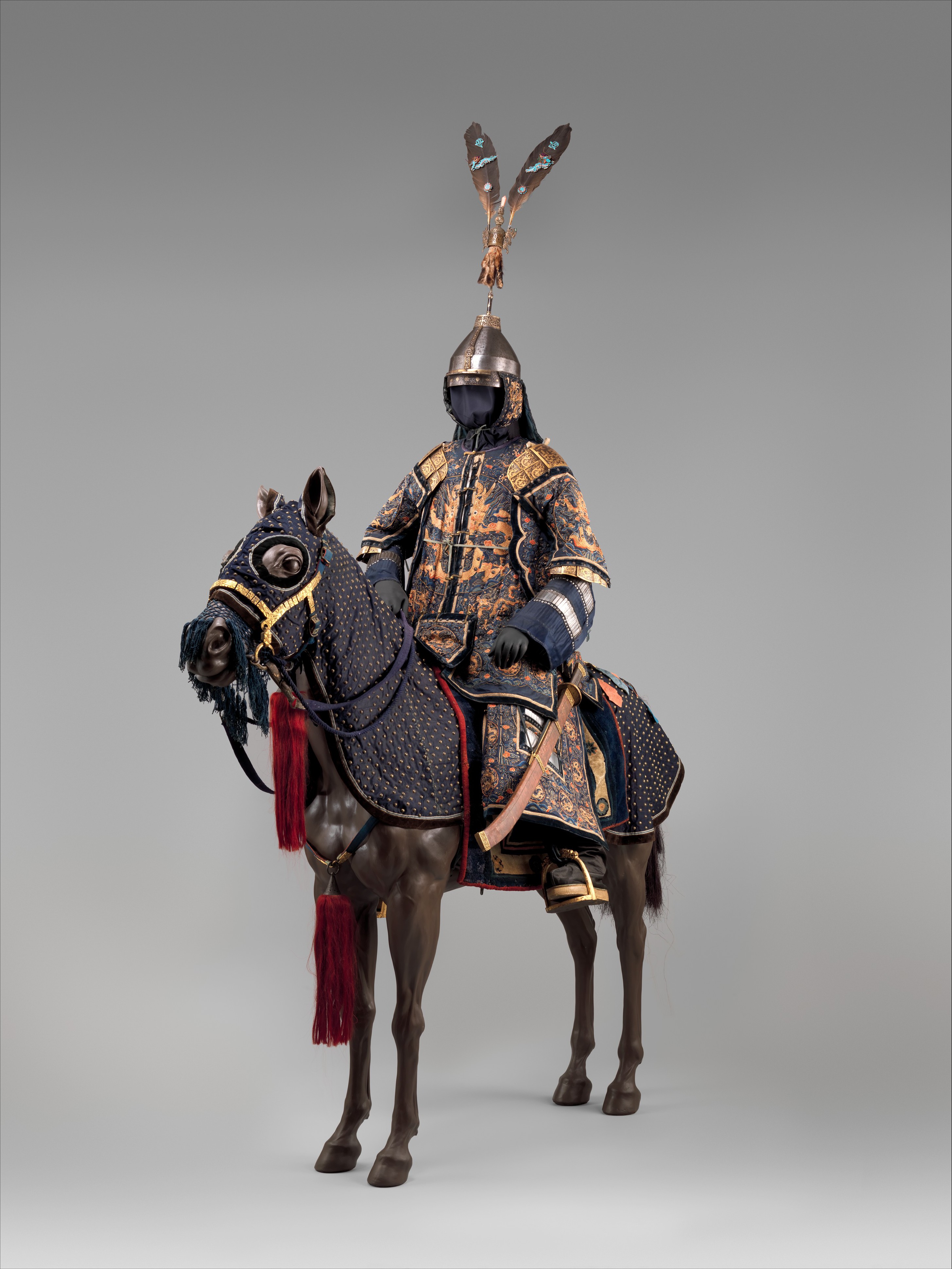
Deconstructing the Panoply: From Battlefield Rigidity to Kinetic Sculpture
The ceremonial armors of China's Dingjia tradition represent not merely protective gear, but a profound architectural statement on the body as a site of power, ritual, and symbolic order. For Zoey Fashion Laboratory's SS26 inquiry, we transcend historical reenactment to engage in a radical deconstruction. We interrogate the core principles of armor—modularity, hierarchy, and intimidation—and re-engineer them for a future where ceremony is personal, fluid, and dynamically defined. The rigid steel plates are not replicated; their principle of articulated segmentation becomes the genesis for a wearable, kinetic exoskeleton. Imagine lamellar scales, not of iron, but of hand-lacquered bio-resin or featherweight, anodized titanium, connected by tensile silk-cord ligaments and precision brass hinges. This foundational shift from static carapace to responsive architecture is the cornerstone of our avant-garde proposition.
Material Alchemy: The Molecular Re-Imagination of Opulence
The provided material palette is a lexicon of symbolic weight. Our laboratory's task is to perform a molecular-level translation, preserving the narrative of each substance while revolutionizing its application and tactile language. Steel, iron, and brass are not materials but states of being: they manifest as memory-wire embedded within silk organza, creating self-structuring silhouettes that respond to body heat and movement. Gold and silver are dematerialized into conductive Lurex threads woven into circuit-board jacquards, or as nano-coatings that shift hue under specific light spectra, creating a modern, interactive kingfisher feather effect.
Velvet and satin are subjected to processes of fusion and erosion: laminated with translucent lacquer to achieve a glacial, armored sheen, or laser-etched to reveal perforated, breathable maps of underlying circuitry. Coral, malachite, and turquoise are pulverized and suspended within resinous "gemstone gels," molded into organic, armor-like protrusions that appear to grow from the garment itself. The martin fur and cotton speak to insulation and liner; we reinterpret them as thermo-regulating phase-change textiles and quilted, channeled padding that defines volume from within, creating hollow, aerodynamic chambers in the silhouette. Paper, the most humble and profound, is engineered into structured, lacquer-hardened origami forms or shredded and reconstituted into a delicate, lace-like metallic felt.
Structural Innovations: The Bio-Mechanical Silhouette of SS26
SS26 for Zoey Fashion Laboratory proposes the "Bio-Mechanical Silhouette," a dialectic between the organic flow of the human form and the precise, intentional geometry of protective architecture. This is not clothing worn; it is architecture deployed.
Exo-Frame Harnessing & Dynamic Volume
Inspired by the horse armor (mǎ jiǎ) as much as the human form, we introduce external frame structures. These are not corsets, but lightweight, carbon-fiber "exo-harnesses" that strap over the body, creating points of anchor from which fabrics drape, stretch, or are tensioned. They define negative space, creating cavernous openings at the torso or along the spine, while concentrating intricate, jewel-like assemblies at the shoulders and collar—modern pauldrons and neck guards. Volume is dynamic: inflatable bladders of silk (echoing padded under-armor) can be modulated by the wearer, transforming a sleek, streamlined coat into a monumental, shoulder-arching silhouette within moments, a direct metaphor for the psychological assumption of ceremonial power.
Modularity & Ceremonial Layering Systems
The traditional lamellar system is the ultimate modular fashion. Our SS26 collection develops this into a user-configurable layering system. A base layer of thermo-regulating cotton-silk blend, printed with bioluminescent patterns (the "inner lining"), is overlaid with articulated, hard-resin panels attached via magnetic silicone docks. The wearer can choose the placement and density of these panels, personalizing their ceremonial "armor." A final, translucent layer of lacquered organza or etched velvet can be drawn over the entire construction, blurring the hard/soft dichotomy. This represents a futuristic ritual: the act of dressing becomes a conscious, creative assembly of one's ceremonial identity.
The Futuristic Ceremony: A Conceptual Armature for Existence
This collection posits that the contemporary and future ceremony is not a public spectacle but a private, fortified state of being. The ceremonial armor for SS26 is designed for the psychological battles and personal milestones of a fragmented, digital age. It is armor for the launch of a visionary enterprise, for a decisive negotiation, for a moment of profound self-declaration. The materials—once denoting imperial rank and martial prowess—now signal technological literacy, material innovation, and a conscious engagement with personal history and future potential.
The horse, as an extension of the warrior's body, finds its analogy in the extended silhouette. Protrusions, train-like extensions, and armature that flows from the body into the surrounding space create a kinetic aura, a personal territory. Feathers become laser-cut Mylar fronds that vibrate with movement; pearls are replaced with spherical, silicone-encapsulated LEDs that pulse with a soft, biometric glow. The final form is neither strictly masculine nor feminine but post-human—an architectured entity ready for the ceremonies of tomorrow. For Zoey Fashion Laboratory, this study is a definitive step towards a couture that does not dress the body, but builds its possibility space, forging ceremonial armors for the abstract, yet intensely personal, battles of the 21st century and beyond.