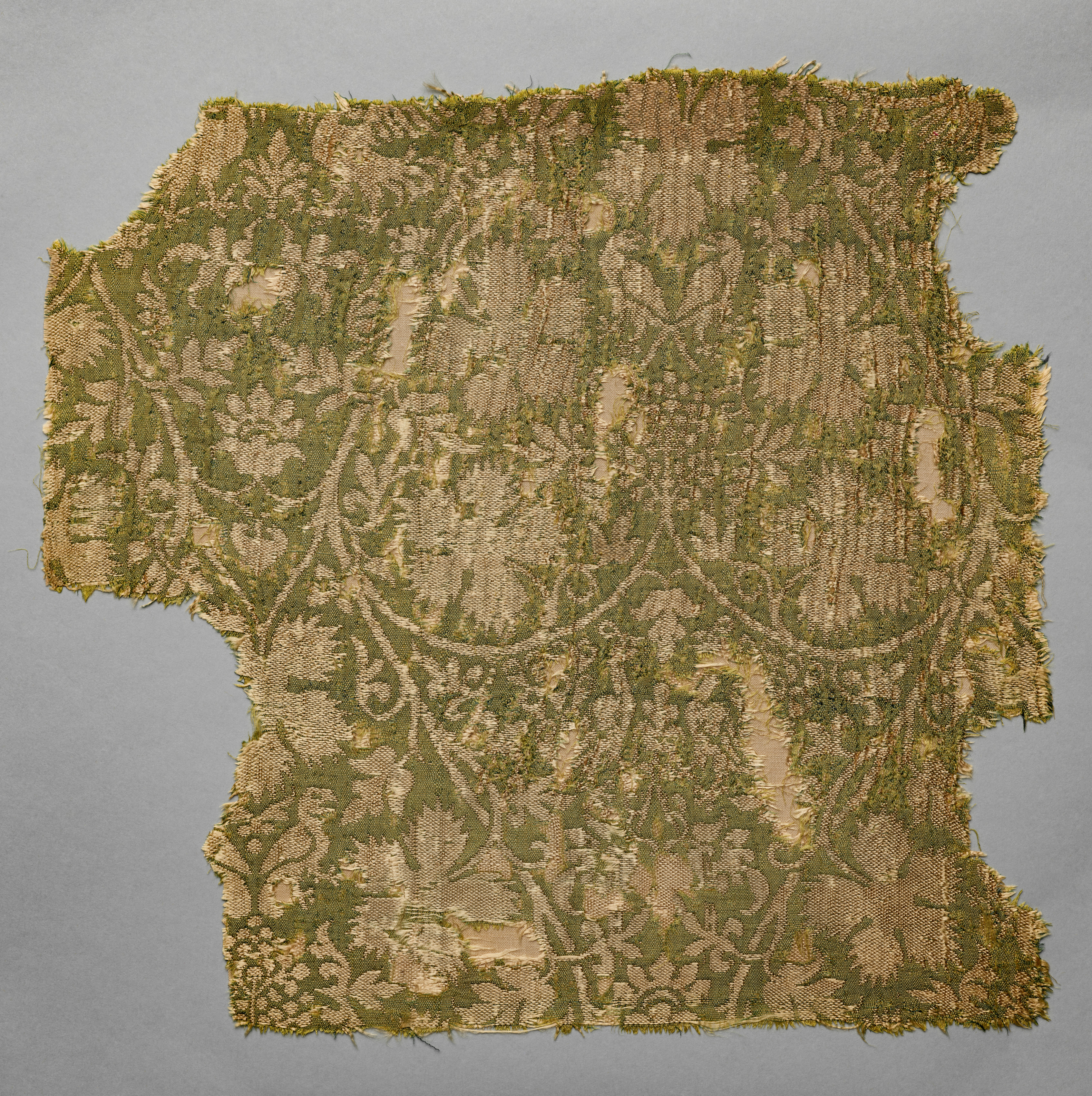
Deconstructing the Avant-Garde: A Technical and Cultural Analysis of a 16th-17th Century Italian Silk Fragment
Introduction: The Fragment as a Living Document
As the Chief Fabric Deconstructionist for Zoey Fashion Lab, I approach this Italian silk fragment not merely as a historical artifact, but as a living document of cultural synthesis. Dated to the 16th-17th century, this lampas-woven silk—adorned with scrolling vines, grape leaves, grapes, and birds—represents a pivotal moment when Eastern motifs, European craftsmanship, and emerging avant-garde sensibilities converged. The fragment’s technical sophistication and symbolic density offer a blueprint for contemporary design innovation, challenging us to reimagine tradition through a disruptive lens.
This analysis will dissect the fragment’s weave structure, iconography, and historical context, then extrapolate how its core principles can inform Zoey Fashion Lab’s avant-garde ethos. The goal is to unlock the fragment’s resonance—its ability to speak across centuries—and translate its language into modern textile narratives.
Technical Mastery: The Lampas Weave as a Medium of Complexity
The lampas weave, a sophisticated technique originating in the Byzantine and Islamic worlds, reached its zenith in Renaissance Italy. It involves two or more warp and weft systems, creating a compound structure where a ground weave supports a pattern weave. In this fragment, the ground is likely a plain or twill weave, while the pattern—scrolling vines, grape leaves, grapes, and birds—is executed in a supplementary weft, often in contrasting colors or metallic threads.
This technical choice is not merely decorative; it is a statement of structural and visual hierarchy. The lampas weave allows for intricate, flowing designs without compromising fabric integrity, making it ideal for liturgical vestments, courtly garments, and luxury furnishings. The fragment’s surviving details—the sinuous curves of the vines, the delicate veining of grape leaves, the stylized birds—demonstrate the weaver’s mastery of tension and color transitions. The use of silk, a material prized for its luster and dye affinity, amplifies the design’s depth, catching light to create a sense of movement.
For Zoey Fashion Lab, this technical complexity is a call to embrace multi-layered construction. The lampas weave’s dual-system logic can inspire contemporary jacquard or digital weaving techniques, where ground and pattern interact dynamically. By deconstructing this weave, we can explore how structural layering—whether through laser-cut overlays, bonded fabrics, or 3D-printed textures—can produce garments that are both visually and physically complex.
Iconography: The Language of Nature and Power
The fragment’s imagery—scrolling vines, grape leaves, grapes, and birds—is rich with symbolism. In Renaissance Italy, such motifs were not arbitrary; they were encoded with cultural and religious meaning. The grapevine, a symbol of Christ’s blood and the Eucharist, also referenced Bacchus, the Roman god of wine, linking the sacred with the secular. Grapes and grape leaves evoked fertility, abundance, and the cycles of nature. Birds, often depicted in flight or perched among the vines, represented the soul’s ascent or the freedom of the spirit.
However, the scrolling, almost arabesque quality of the vines hints at Eastern influences—specifically from Persian and Ottoman textiles, which were imported into Italy via trade routes. This hybridization reflects the cultural fluidity of the 16th-17th centuries, when Venice and Florence were hubs of cross-continental exchange. The birds, too, may draw from Chinese or Mughal motifs, where they symbolized longevity and harmony.
For the avant-garde designer, this iconography offers a playground for reinterpretation. The scrolling vines can be abstracted into fluid, biomorphic forms; the grapes can be rendered as exaggerated, three-dimensional embellishments; the birds can be fragmented into geometric shapes. The key is to maintain the motif’s narrative power while stripping it of its original context. Zoey Fashion Lab can use this as a case study in symbolic decontextualization: taking a familiar image and re-presenting it in a way that challenges perception.
Cultural Resonance: The Archive as a Catalyst for Innovation
As noted in the reference, “器物与绘画不仅是时代技艺的结晶,更是文化碰撞与美学交融的无声见证” (objects and paintings are not only the crystallization of era-specific techniques but also silent witnesses to cultural collision and aesthetic fusion). This fragment is a testament to that fusion: it embodies the dialogue between East and West, between sacred and profane, between craft and art. The 16th-17th centuries were a period of intense globalization, where silk, spices, and ideas traveled along the Silk Road. Italian weavers did not simply copy Eastern designs; they reinterpreted them through a Western lens, creating a new visual language.
This process of creative appropriation is central to the avant-garde ethos. The fragment challenges us to ask: How can we honor tradition while breaking its rules? How can we use historical techniques to critique contemporary consumption? For Zoey Fashion Lab, the answer lies in resonance—the ability of a design to evoke multiple meanings across time. By studying this fragment, we can develop a methodology for archival reanimation, where historical artifacts are not preserved but transformed.
Avant-Garde Applications: From Fragment to Future
To translate this analysis into actionable design, Zoey Fashion Lab can explore three avant-garde strategies:
1. Deconstructed Weave Structures: Deconstruct the lampas technique by separating its warp and weft systems. For example, create a garment where the ground weave is a sheer, laser-cut silk, while the pattern weave is a heavy, metallic embroidery applied in a non-linear, chaotic pattern. This juxtaposition of lightness and weight, order and disorder, echoes the fragment’s original tension.
2. Motif Fragmentation and Scale Play: Take the grape leaves and birds and enlarge them to an abstract, almost unrecognizable scale. Use digital printing to distort the scrolling vines into digital glitches, or hand-embroider the grapes as oversized, tactile clusters. The goal is to disrupt the familiar, forcing the viewer to see the motif anew.
3. Symbolic Recontextualization: Reinterpret the fragment’s sacred/secular duality for a modern context. Replace the grapevine with a QR code pattern that links to a digital archive, or use the birds as a motif for sustainability—birds as symbols of freedom from fast fashion. The historical resonance becomes a tool for commentary.
Conclusion: The Fragment as a Blueprint for Disruption
This Italian silk fragment is more than a beautiful object; it is a catalyst for avant-garde thinking. Its lampas weave teaches us about structural complexity; its iconography reminds us of the power of symbols; its history urges us to embrace cultural fusion. As the Chief Fabric Deconstructionist, I see this fragment as a starting point for a new design language—one that honors the past while boldly reimagining the future.
Zoey Fashion Lab’s mission is to deconstruct, not destroy. By dissecting this fragment’s technical and cultural DNA, we can create textiles that are both intellectually rigorous and visually arresting. The scrolling vines, grape leaves, grapes, and birds are not relics; they are invitations to innovate. Let us accept that invitation.