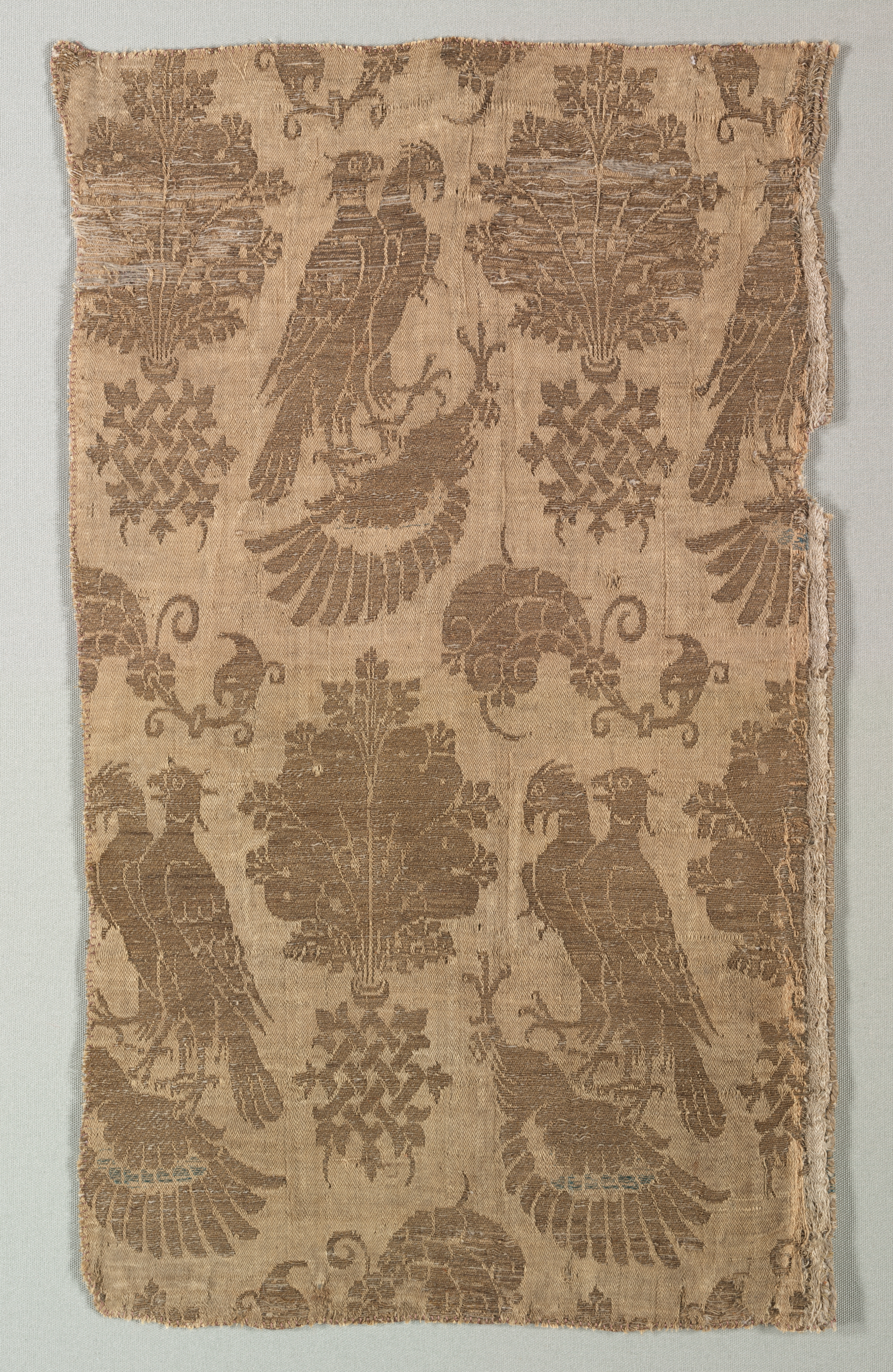
Deconstructing the Medieval Avant-Garde: An Analysis of 14th-Century Italian Gold-Patterned Silk
At Zoey Fashion Lab, we approach historical textiles not as relics to be preserved in amber, but as dynamic DNA strands that can be re-sequenced into avant-garde expression. The subject of this analysis—a gold-patterned silk woven in Italy during the last third of the 14th century, featuring falcons and heraldic motifs, and constructed via a sophisticated lampas technique—represents a pivotal moment in textile history. Its technical complexity, symbolic density, and material opulence offer a rich lexicon for contemporary deconstruction and reinvention. This report dissects the fabric’s core components—weave, motif, and cultural context—to extract actionable design principles for a forward-thinking collection.
Technical Foundation: The Lampas Weave as Structural Innovation
The lampas weave, a combination of two distinct interlacements, is the fabric’s foundational technology. Unlike simpler compound weaves, lampas employs a primary warp and weft for the ground cloth and a secondary, often metallic, warp and weft for the pattern. In this 14th-century example, the ground is a fine silk, likely a twill or tabby, providing a lustrous, drapeable base. The pattern is created by a supplementary gold thread—typically a gilded silver strip wrapped around a silk core—that floats across the surface, binding to the ground only where necessary. This creates a raised, almost sculptural effect, where the gold appears to hover above the silk.
For the avant-garde designer, this dual-structure principle is a call to deconstruct layering. The lampas technique is not a single surface but a dialogue between two systems. We can reimagine this by separating the ground and pattern into physically distinct garments or panels. Imagine a sheer, liquid-silk base dress, its drape mimicking the ground weave, over which a separate, laser-cut gold leather or metallic mesh “pattern” is suspended, echoing the floating gold. The structural integrity of the lampas—where the pattern is locked into the ground at specific points—can be translated into strategic, non-functional seams or deconstructive stitching that connects two independent layers, allowing them to move independently while remaining visually unified.
Motif Analysis: Falcons and Heraldry as Avant-Garde Symbols
The iconography of this silk is a potent blend of natural power and human artifice. The falcon, a bird of prey, symbolizes nobility, speed, and a predatory gaze. In 14th-century Italy, falconry was a pastime of the elite, a display of control over nature. The heraldic devices—likely stylized shields, geometric partitions, or abstracted beasts—represent the codified identity of a specific family or city-state. These motifs are not decorative; they are signifiers of authority, lineage, and territorial claim.
To translate these into an avant-garde language, we must strip them of their literal heraldic meaning and extract their formal and symbolic essence. The falcon’s form—its sharp beak, curved wing, and piercing eye—can be abstracted into angular, asymmetric cuts and darting silhouettes. A jacket’s lapel might mimic a falcon’s wing in mid-sweep; a sleeve could end in a sharp, talon-like point. The heraldic shield, traditionally a static, symmetrical emblem, can be deconstructed into fragmented, overlapping panels, perhaps in contrasting textures or opacities. The idea of “claiming territory” becomes a design principle: a garment’s silhouette might aggressively occupy space, with exaggerated shoulders or a trailing train that asserts presence. The falcon’s predatory gaze can be referenced through strategic cutouts that reveal the body in unexpected places, creating a sense of surveillance and exposure.
Material Alchemy: Gold Thread as a Deconstructive Element
The gold thread in this textile is not merely decorative; it is a technological and economic statement. Its presence elevates the fabric from clothing to a portable treasure. For the avant-garde, gold is a tool for disruption. Instead of weaving it into a perfect pattern, we can treat it as a raw, unbound element. Consider gold thread used not as a woven component but as exposed, unwoven fringe that trails from hems and seams, catching light and movement. Alternatively, the gold can be appliquéd in irregular, gestural strokes, like calligraphy, rather than in precise heraldic forms. This mimics the “floating” quality of the lampas gold but introduces an element of chaos and spontaneity.
Furthermore, the contrast between the matte silk ground and the reflective gold pattern is a study in light and shadow. In an avant-garde context, this can be exaggerated by pairing matte, black-dyed silk with high-polish gold metallic leather, or by using iridescent organza that shifts color as the wearer moves, creating a dynamic, living pattern. The gold can also be oxidized or distressed, turning it from a symbol of wealth into a sign of decay and time, aligning with the deconstructive ethos of revealing the fabric’s history.
Cultural Context: The 14th-Century Italian Silk Trade as a Model for Global Fusion
This silk is a product of a globalized medieval world. Italian weavers in Lucca, Venice, and Florence were heavily influenced by Chinese and Persian silk designs, adapting motifs like the phoenix and dragon into European heraldic language. The use of gold thread itself was a technology imported from the East. This fusion of influences—Eastern technique, European iconography, and Italian craftsmanship—is a direct precursor to the avant-garde’s embrace of hybridity. For Zoey Fashion Lab, this means we should not shy away from combining disparate cultural references. A 14th-century Italian falcon can sit alongside a deconstructed Japanese kimono sleeve, or a heraldic shield can be rendered in a West African kente-inspired weave. The result is a garment that speaks to a transhistorical, global identity, rejecting purist notions of origin.
Design Applications: From DNA Strand to Garment
Based on this analysis, we propose the following design directions for an avant-garde capsule collection:
- Deconstructed Lampas Silhouette: A floor-length coat in black matte silk crepe (ground) with a separate, detachable overlay in gold metallic mesh (pattern), attached only at the shoulders and hem. The overlay is cut into abstract, shield-like shapes that shift as the wearer moves.
- Falcon Gaze Cutout: A fitted, asymmetric top in heavy silk satin, with a single, sharp, talon-shaped cutout at the collarbone, outlined in exposed gold thread fringe. The cutout is positioned to create a sense of surveillance, as if the garment itself is looking.
- Heraldic Fragment Dress: A column dress in charcoal silk, onto which are appliquéd multiple, irregularly shaped panels of gold brocade, each a fragment of a larger heraldic design. The panels are intentionally misaligned, creating a sense of a shattered coat of arms.
- Gold Thread Exoskeleton: A structural, cage-like top made entirely of gold metallic cord, woven in a loose, open lampas-inspired grid. Worn over a simple silk slip, it references the “floating” gold pattern while exposing the body beneath.
Conclusion: The Avant-Garde as a Re-Reading of History
This 14th-century Italian gold-patterned silk is far more than a historical artifact. Its lampas weave, falcon and heraldry motifs, and gold thread are a complex code that, when deconstructed, yields principles of structural layering, symbolic abstraction, material alchemy, and cultural fusion. For Zoey Fashion Lab, the avant-garde is not a rejection of the past but a radical re-reading of it. By treating this textile as a new DNA strand—a set of genetic instructions to be spliced, mutated, and re-expressed—we can create garments that honor the technical mastery of the 14th century while speaking a language of contemporary disruption and beauty. The falcon still flies, but now it soars through the architecture of a deconstructed silhouette.