Deconstructing the Battle Axe: An Avant-Garde Analysis for Zoey Fashion Lab
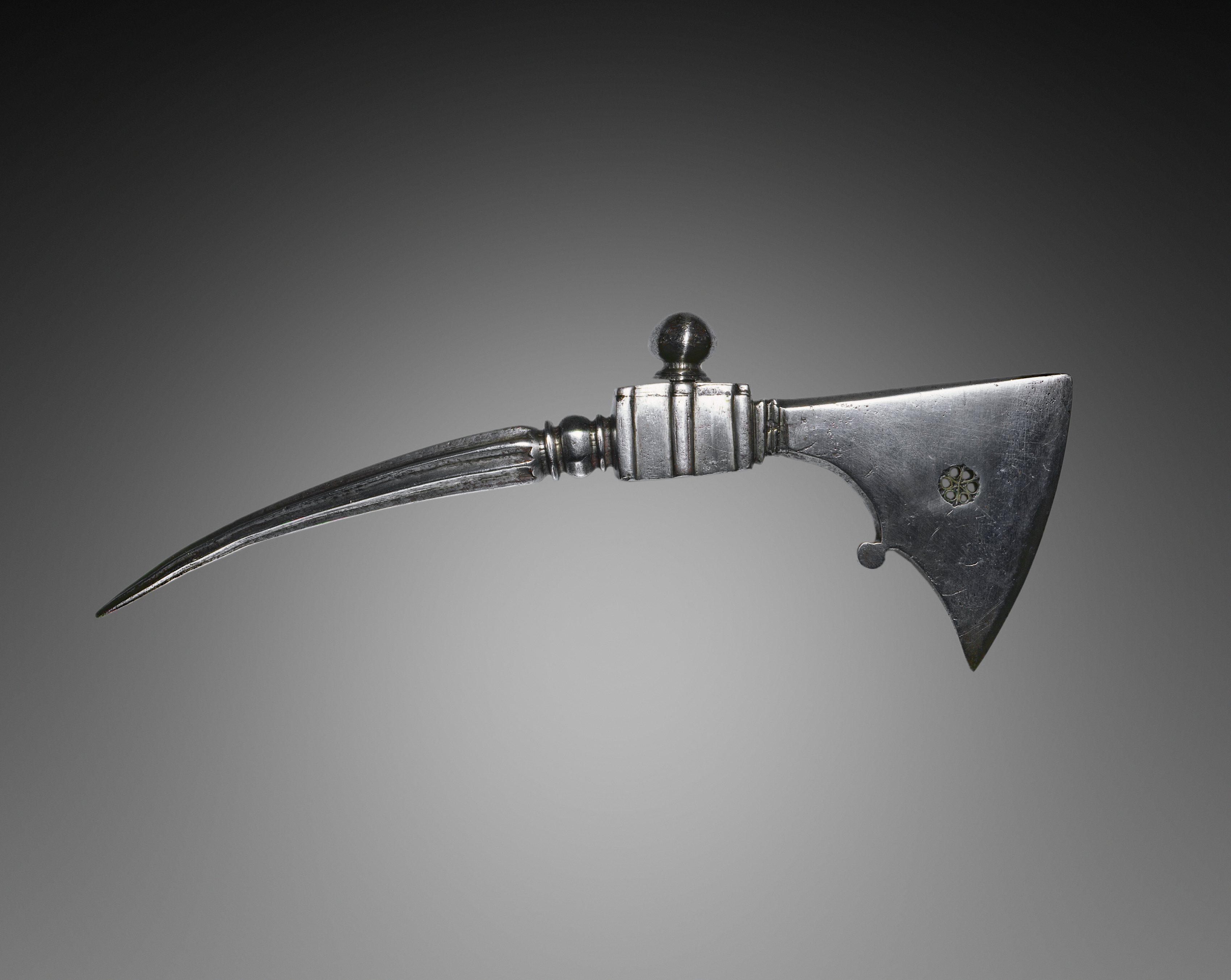
At Zoey Fashion Lab, we do not merely study artifacts; we dissect them for their latent structural and narrative potential. Our role as Chief Fabric Deconstructionist is to translate the language of historical weaponry into the dialect of avant-garde fashion. The subject of this analysis—a late 16th-century Italian battle axe, forged in steel and inset with copper rosettes—presents a unique challenge and an extraordinary opportunity. This object is not a relic of violence but a New DNA Strand for textile innovation. Its synthesis of brutal functionality and ornamental precision offers a blueprint for a collection that redefines strength, vulnerability, and the very architecture of wearable form.
I. The Axe as Structural DNA: Forging a New Silhouette
The battle axe’s primary DNA is its silhouette: the aggressive, sweeping curve of the blade married to the rigid, linear shaft. In avant-garde fashion, this translates directly into a radical reimagining of the human form. We propose a deconstructed outerwear capsule where the blade’s crescent shape informs exaggerated, asymmetrical shoulder lines. Imagine a tailored wool coat where the right shoulder extends into a sharp, metallic-finish panel—a steel-gray synthetic leather that mimics the axe’s original patina—while the left shoulder remains clean, creating a visual imbalance that is both confrontational and elegant.
The shaft, typically a straight wooden or metal pole, becomes the backbone of a new drape. In our lab, we would translate this into a series of columnar skirts or elongated tunics with internal, hidden boning. This boning—constructed from lightweight, blackened aluminum or carbon fiber—would not merely support the garment but dictate its movement. The wearer’s stride would be a controlled, deliberate act, echoing the weapon’s functional purpose. The steel’s cold, unyielding nature is reinterpreted through high-density, double-faced wool and liquid metallic jacquards, fabrics that hold their shape yet possess a subtle, fluid shimmer. The DNA here is not about literal armor, but about a structural rigidity that empowers the wearer, offering a second skin of calculated power.
II. The Copper Rosette: Ornament as Subversion
The copper rosette, a delicate floral inset on a brutal steel surface, is the most provocative element of this artifact. It represents a deliberate juxtaposition: the organic against the industrial, the decorative against the destructive. For Zoey Fashion Lab, this becomes a core principle of subversive embellishment. We deconstruct the rosette not as a simple appliqué, but as a three-dimensional structural element that can be embedded within the fabric itself.
Our approach involves developing a new textile technique: “Rosette Weave.” Using a combination of copper-infused threads and high-tenacity nylon, we create raised, circular motifs that are not sewn on but woven into the garment’s foundation. These rosettes can be strategically placed along the seams of a deconstructed blazer or at the apex of a sculptural collar, where they function as both ornament and stress points that redirect the garment’s tension. The copper’s warm, reddish glow against the cold steel-gray of the base fabric creates a visual friction—a tension between the romantic and the ruthless. In a dress, these rosettes might be arranged in a spiral pattern along the spine, mimicking the axe’s original decorative placement while creating a tactile, almost armor-like back panel. The rosette is not a decoration; it is a narrative device that questions the relationship between beauty and brutality.
III. Material Alchemy: Translating Steel and Copper into Fabric
The technical challenge lies in translating the physical properties of steel and copper into pliable, wearable textiles. Steel is defined by its weight, reflectivity, and resistance. Copper is defined by its malleability, conductivity, and warm luster. Our fabric deconstruction lab proposes a dual-texture system:
1. The Steel Base: We develop a metallic-coated neoprene that offers the visual weight of steel without the literal burden. This fabric is laser-cut and heat-sealed to create sharp, clean edges that mimic the axe’s blade. The surface is treated with a matte, gunmetal finish that catches light in a diffused, almost liquid manner. For areas requiring drape, we use a heavyweight silk satin with a metallic foil stamping, creating a fluid, reflective surface that moves like molten steel.
2. The Copper Accent: The copper rosette is reinterpreted through thermoplastic polyurethane (TPU) films embedded with actual copper dust. These films are die-cut into rosette shapes and then heat-bonded to the steel-base fabric. The result is a flexible, durable embellishment that retains the metallic sheen and subtle warmth of the original metal. For a more dramatic effect, we experiment with copper chainmail—small, interlocking copper rings—applied as a patchwork over the steel base, creating a texture that is both protective and decorative. The material alchemy is complete: the garment feels heavy with history but moves with the lightness of modern engineering.
IV. The Avant-Garde Garment: A Case Study in Deconstruction
To concretize this analysis, we propose a signature piece: The “Rosetta” Deconstructed Gown. The gown is constructed from the steel-base neoprene, with a severe, asymmetrical neckline that drops sharply from one shoulder, mimicking the axe’s blade curve. The left side of the bodice is left deliberately raw—unfinished edges that suggest a weapon still in the forge. The right side is structured with internal boning, creating a rigid, armor-like panel that extends into a sweeping train.
The copper rosettes are not applied uniformly. Instead, they cluster along the raw edge of the neckline, forming a geometric, almost calligraphic pattern that leads the eye downward. A single, oversized rosette—constructed from the copper chainmail—is placed at the center of the chest, functioning as a literal and metaphorical heart of the piece. The gown’s back is a lattice of copper-infused straps, revealing the skin beneath, a nod to the weapon’s functional openings. The entire ensemble is grounded by a pair of deconstructed boots with steel-toe caps and copper rosette ankle cuffs, completing the transformation from historical artifact to avant-garde statement.
V. Conclusion: The New DNA in Context
The late 16th-century Italian battle axe is not a weapon of the past; it is a New DNA Strand for the future of fashion. At Zoey Fashion Lab, we have deconstructed its steel, copper, and rosette to reveal a language of power, tension, and subversive beauty. The resulting collection does not romanticize violence but rather reappropriates its visual vocabulary to empower the wearer. The axe’s brutal functionality is transformed into a structural silhouette that commands space. Its ornamental rosette becomes a tool of narrative disruption. By weaving these elements into the very fabric of our designs, we create garments that are not just worn, but inhabited—each piece a living artifact of deconstruction and reinvention. This is the avant-garde mandate: to see the weapon, and reforge it as a garment of uncompromising artistry.