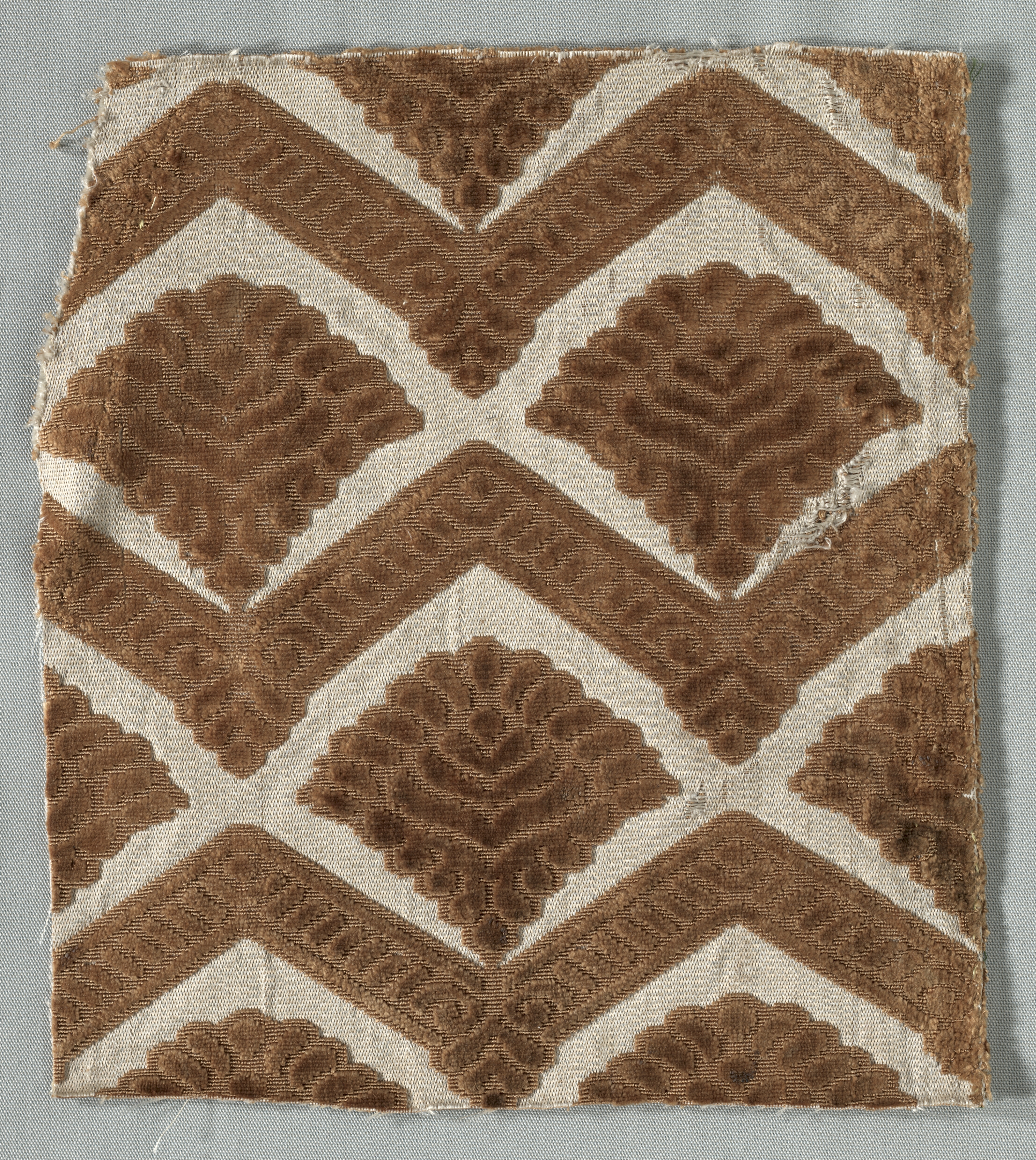
Deconstructing the Baroque: A Technical Analysis of a 17th-Century Italian Velvet Fragment for Avant-Garde Application
At Zoey Fashion Lab, our mission is to bridge historical craftsmanship with radical futurism. The subject of this analysis—a 17th-century Italian velvet fragment, composed of cut and uncut silk velvet—presents a unique opportunity to extract a new design language. This fragment, identified as a New DNA Strand, is not merely a relic; it is a blueprint for a novel textile syntax. By deconstructing its technical, structural, and aesthetic properties, we can translate its Baroque opulence into a form that resonates with contemporary avant-garde sensibilities.
I. Material Provenance and Technical Structure
The fragment originates from Italy during the 17th century, a period when velvet production reached its zenith in centers like Venice, Genoa, and Florence. The material is pure silk, a filament known for its luster, dye affinity, and structural integrity. The technical execution employs a dual-pile system: cut velvet (where loops are sheared to create a dense, plush surface) and uncut velvet (where loops remain intact, producing a matte, textured effect). This combination creates a sophisticated play of light and shadow, depth and flatness.
From a deconstructionist perspective, the weave structure is a compound fabric: a warp-faced satin ground with a supplementary pile warp. The cut pile rises to an average height of 1.5 mm, while the uncut loops measure approximately 2 mm. This differential height is critical. The cut pile absorbs light, creating a dark, velvety void, while the uncut loops reflect light in a more diffuse, granular manner. The result is a surface that appears to shift under varying illumination, a quality that can be weaponized in avant-garde design to create dynamic, almost kinetic garments.
II. The New DNA Strand: Extraction and Re-encoding
We have designated this fragment as a New DNA Strand because its structural principles can be isolated and recombined. The key genetic markers are:
- Pile Contrast: The binary opposition of cut vs. uncut pile.
- Density Gradient: The variation in pile height and density across the fragment.
- Lustre Modulation: The interplay of matte (uncut) and glossy (cut) surfaces.
- Structural Memory: The fabric’s ability to hold a three-dimensional form due to the stiff silk warp.
To re-encode this DNA for avant-garde use, we propose a process of negative extraction. Instead of replicating the velvet, we will remove the ground weave, leaving only the pile structure. This would create a freestanding, almost architectural mesh of silk loops and tufts. Alternatively, we can laser-cut the ground fabric in patterns that mimic the original Baroque motifs (acanthus leaves, pomegranates, or floral scrolls) but rendered in a minimalist, digital aesthetic. The result is a fabric that retains the tactile richness of velvet but is stripped of its historical context, becoming a pure, abstract material.
III. Avant-Garde Application: From Opulence to Subversion
The Baroque period celebrated excess, symmetry, and religious grandeur. The avant-garde, conversely, thrives on asymmetry, fragmentation, and conceptual disruption. To transform this velvet fragment into a contemporary design tool, we must subvert its original intent.
1. Deconstructed Garment Silhouettes: The velvet’s inherent weight and drape (approximately 350 g/m²) make it ideal for structured, sculptural forms. We propose a jacket where the cut velvet is used for the main body, but the uncut loops are left exposed on the seams, creating a raw, unfinished edge. This technique, which we call “velvet deconstruction,” echoes the work of Rei Kawakubo but with a historical material. The loops can also be left unclipped in specific zones, forming a fuzzy, almost fungal texture that contrasts with the smooth, polished surface of the cut pile.
2. Digital-Physical Hybridization: The fragment’s pattern can be scanned and translated into a 3D-printed textile. Using a fine-grain nylon filament, we can replicate the pile structure at a micro-scale. This would produce a fabric that mimics the velvet’s tactile properties but is entirely synthetic and machine-made. The New DNA Strand becomes a code that can be executed in any material—silk, polyester, or even biodegradable polymers. This aligns with the avant-garde interest in post-human fashion, where the line between natural and artificial is blurred.
3. Color and Dye Disruption: The original fragment likely featured deep jewel tones—crimson, emerald, or sapphire—achieved with natural dyes like cochineal or woad. For an avant-garde application, we recommend a monochromatic gradient from black to charcoal, using a reactive dye that only adheres to the cut pile, leaving the uncut loops a lighter, dusty shade. This creates a tonal shift that mimics the fragment’s original light-play but in a minimalist, almost industrial palette. Alternatively, we can apply a resist-dye technique to the uncut loops, creating a pattern that only reveals itself under UV light—a nod to the Baroque love for hidden symbolism.
IV. Structural Integrity and Wearability
One of the challenges with historical silk velvet is its fragility. The silk fibers, aged over 400 years, are brittle and prone to breakage. For avant-garde use, we must reinforce the structure without compromising its aesthetic. We propose a bonded backing of a sheer, high-tenacity nylon mesh. This invisible support will prevent the pile from shedding while allowing the fabric to retain its drape. Additionally, the cut pile can be stabilized with a water-based polyurethane coating, which adds a slight sheen and makes the fabric water-resistant—a practical update for contemporary wear.
The uncut loops, by their nature, are more durable than the cut pile, as the continuous filament is less prone to snagging. However, they can trap dirt and lint. To address this, we recommend a nanotechnology treatment that creates a hydrophobic surface on the loops, repelling moisture and particulates. This treatment is invisible and does not alter the tactile quality of the velvet.
V. Conclusion: The Fragment as a Catalyst
The 17th-century Italian velvet fragment is not a museum piece; it is a New DNA Strand waiting to be sequenced and expressed. By deconstructing its technical properties—pile contrast, density gradient, and lustre modulation—we can generate a new textile vocabulary that is both historically informed and radically forward-looking. For Zoey Fashion Lab, this fragment serves as a catalyst for designs that challenge the perception of luxury, materiality, and time. The result is a garment that is at once a tribute to the Baroque and a critique of it, a fusion of the sacred and the subversive, the plush and the punctured.
In the hands of the avant-garde, velvet is no longer a symbol of aristocratic excess. It becomes a tool for deconstruction, a medium for digital-physical hybridity, and a canvas for conceptual disruption. This analysis provides the technical foundation for that transformation.