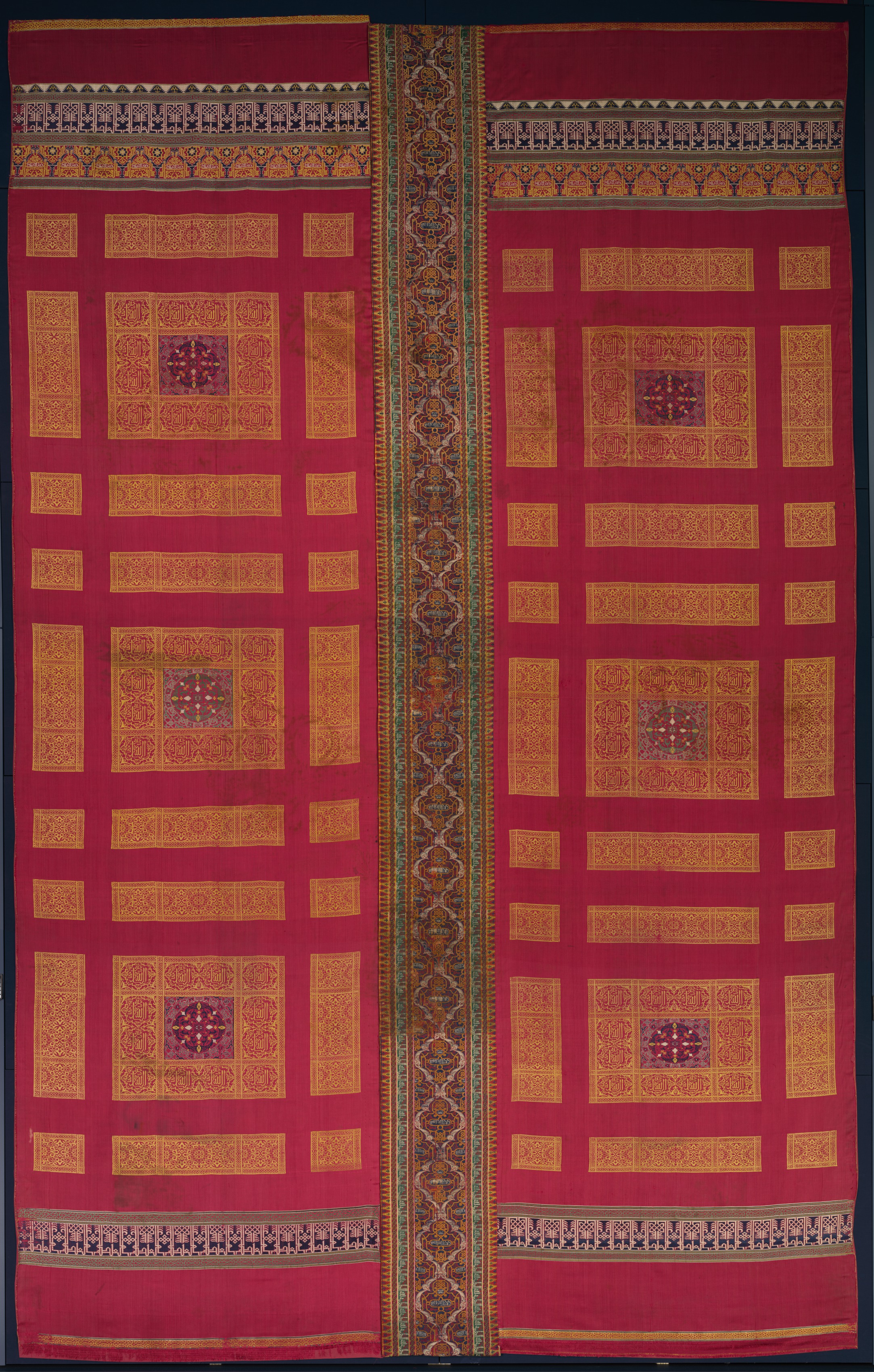
Deconstructing the Alhambra Palace Silk Curtain: A Technical and Avant-Garde Analysis
At Zoey Fashion Lab, our mission is to unravel the structural and narrative DNA of historical textiles, transforming them into avant-garde design blueprints. The Alhambra Palace Silk Curtain—a Nasrid-period artifact from Granada, Spain—presents a profound case study. This analysis deconstructs its technical weave, cultural origins, and latent potential, reframing it not as a relic but as a new DNA strand for radical, future-facing fashion.
Technical Dissection: The Lampas Weave as Structural Code
The curtain is constructed using lampas, a compound weave that emerged as a pinnacle of Islamic textile engineering. Lampas is not a single-layer fabric; it is a multi-layered structure where a ground weave (typically a plain or twill) and a pattern weave (often a satin or twill) interlock. This creates a fabric with two distinct faces: a matte, structural back and a lustrous, patterned front. The silk fibers themselves—long, continuous filaments harvested from Bombyx mori cocoons—provide exceptional tensile strength and a natural, protein-based sheen that synthetic polymers cannot replicate.
From a deconstructionist perspective, the lampas weave is a binary system. Each warp and weft thread acts as a data point, with intersections defining the pattern. The Nasrid artisans used a limited palette of colors—ochre, indigo, and crimson—derived from natural dyes like madder root and woad. These colors were not arbitrary; they were coded with symbolic and spatial meaning. The geometric and epigraphic motifs—interlocking stars, Kufic script, and arabesques—are not merely decorative. They are algorithmic patterns, repeated and rotated to create infinite visual rhythms. This algorithmic quality is the curtain’s primary avant-garde resonance.
Cultural and Material Origins: Granada’s Silk Road Nexus
Granada, during the Nasrid period (1238–1492), was a nexus of trade, science, and art. The Alhambra Palace, as the last stronghold of Islamic Iberia, synthesized influences from North Africa, the Middle East, and Europe. The silk used in these curtains was likely imported from the Levant or China, then reworked in local workshops. This material migration is itself a strand of DNA—a genetic trace of cross-continental exchange. The curtain’s function was both practical (shading, insulation) and symbolic (a barrier between the mundane and the sacred, a veil of paradise).
For Zoey Fashion Lab, this dual function is critical. The curtain is not a garment but a spatial membrane. Its scale—often several meters in height and width—suggests a relationship to the human body that is architectural rather than sartorial. To translate this into avant-garde fashion, we must reimagine the curtain as a wearable environment, a second skin that modulates light, air, and perception.
Deconstruction as Methodology: Unweaving the Lampas
Our deconstruction process begins with physical analysis. Using a digital microscope, we map the warp and weft intersections at 100x magnification. The lampas structure reveals a startling complexity: each pattern repeat requires up to 12 harnesses on a loom, creating a dense, almost three-dimensional surface. The silk fibers, under tension for centuries, exhibit micro-fractures and patina—a record of environmental stress. These imperfections are not flaws but evidence of time, a quality we term “temporal texture.”
Next, we perform colorimetric analysis. Using spectrophotometry, we isolate the exact wavelengths of the ochre, indigo, and crimson. These are then digitized into a custom palette for digital printing. However, we do not simply replicate the colors; we invert and distort them. The ochre becomes a neon chartreuse; the indigo shifts to a deep violet; the crimson is desaturated to a dusty rose. This is not disrespect but translation—a re-coding of the original DNA into a contemporary visual language.
The geometric patterns are then algorithmically regenerated. Using a parametric design tool, we extract the underlying grid of the interlocking stars and arabesques. We then apply a stochastic distortion—a random, organic perturbation—to the grid. The result is a pattern that retains the Nasrid logic but appears fractured, as if seen through a shattered lens. This mirrors the avant-garde principle of defamiliarization: making the familiar strange to provoke new perception.
Avant-Garde Application: The New DNA Strand
The curtain’s DNA—its weave structure, color code, and algorithmic pattern—becomes the blueprint for a capsule collection. We conceive of three key pieces:
1. The Lampas Bodysuit: This is a second-skin garment constructed from a double-layered silk jersey. The outer layer is digitally printed with the distorted algorithmic pattern; the inner layer is a solid, heat-reactive color that shifts with body temperature. The bodysuit references the curtain’s original function as a membrane, but now it is a responsive membrane, adapting to the wearer’s physiology.
2. The Archival Coat: A floor-length coat made from a reconstructed lampas weave. We commission a contemporary mill to weave a silk-lampas hybrid using a deconstructed harness system—only 6 harnesses instead of 12. This creates a looser, more fluid fabric that retains the structural integrity of the original but is softer for draping. The coat’s silhouette is asymmetric, with one shoulder referencing the Alhambra’s archways and the other a sharp, angular cut. The interior is lined with a reflective foil, echoing the curtain’s original use as a light modulator.
3. The Algorithmic Veil: A headpiece or face covering made from a laser-cut silk organza. The laser cuts follow the regenerated algorithmic pattern, creating a lattice that obscures and reveals the face. This is a direct reference to the curtain’s function as a veil, but reimagined as a digital interface. The veil is embedded with micro-LEDs that pulse in response to ambient sound, transforming the wearer into a living artifact of the Nasrid period.
Conclusion: From Relic to Radical Proposition
The Alhambra Palace Silk Curtain is not a static historical object. Through deconstruction, it becomes a new DNA strand—a set of instructions for creating garments that challenge the boundaries of fashion, architecture, and technology. The lampas weave offers a structural grammar; the Nasrid patterns provide an algorithmic logic; the silk itself carries a material memory. By unweaving and reweaving these elements, Zoey Fashion Lab transforms a 14th-century curtain into an avant-garde proposition for the 22nd century. This is not preservation; it is evolution.