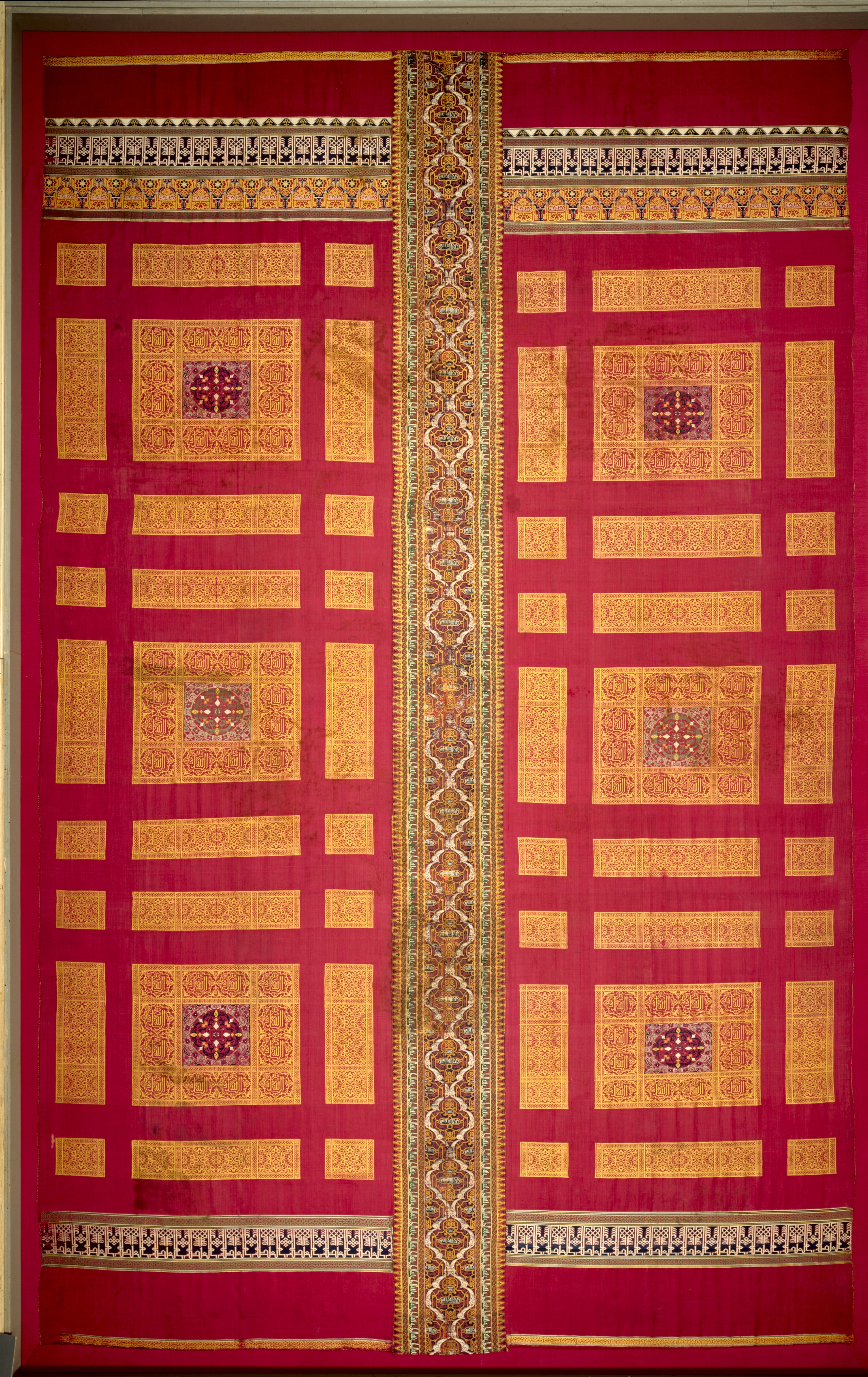
Alhambra Palace Silk Curtain: A Deconstructionist's Analysis for Zoey Fashion Lab
As Chief Fabric Deconstructionist for Zoey Fashion Lab, I present an in-depth analysis of the Alhambra Palace Silk Curtain, a textile artifact from the Nasrid period in Granada, Spain. This piece, woven from silk in a lampas technique, represents a pinnacle of medieval Islamic craftsmanship. Its reference as a "New DNA Strand" within our avant-garde framework signals a radical reimagining of historical textiles as foundational genetic material for future fashion. Below, I dissect its technical, cultural, and aesthetic dimensions to unlock its potential for Zoey Fashion Lab’s experimental collections.
Technical Mastery: The Lampas Weave and Silk Fiber
The Alhambra Palace Silk Curtain employs the lampas weave, a complex structure that interlaces a main warp and weft with supplementary patterning threads. This technique, perfected in Nasrid workshops, allows for intricate geometric and calligraphic designs to float above a ground fabric. The silk fiber, sourced from the Iberian Peninsula’s thriving sericulture, provides a luminous, fluid base that captures light with a subtle sheen. For Zoey Fashion Lab, the lampas weave offers a blueprint for structural layering—a method where surface and substrate interact dynamically. Deconstructing this weave reveals a potential for modular fashion: garments where patterned panels can be detached, rearranged, or worn as standalone accessories. The silk’s natural drape, when combined with modern synthetic blends, could yield fabrics that shift between opacity and transparency, echoing the curtain’s original role as a spatial divider.
Cultural DNA: Nasrid Symbolism and the Avant-Garde Lens
The curtain’s design is a repository of Nasrid cosmology, featuring repeating stars, interlacing polygons, and Arabic inscriptions that praise Allah. These motifs are not merely decorative but encode a worldview of infinity and divine order. Within Zoey Fashion Lab’s avant-garde practice, we treat this as a cultural DNA strand—a genetic code to be spliced, mutated, and re-expressed. For instance, the star patterns can be abstracted into laser-cut silks or 3D-printed embellishments that mimic celestial geometry. The calligraphy, originally sacred, can be fragmented into typographic prints that challenge traditional legibility. This process aligns with our ethos of deconstructive recontextualization: we honor the original meaning while allowing it to evolve into new, provocative forms. The curtain’s function as a barrier between interior and exterior spaces also inspires garments that blur boundaries—such as jackets with removable panels or dresses that transform into capes.
Material Alchemy: From Curtain to Garment
The transition from curtain to fashion requires a rethinking of scale and purpose. The Alhambra curtain’s dimensions—likely several meters in length—suggest a monumental fabric that can be repurposed into voluminous silhouettes. For Zoey Fashion Lab, this translates into oversized coats, tiered skirts, or cascading trains that reference the curtain’s original verticality. The lampas weave’s double-sided nature (pattern on one side, ground on the other) offers a binary aesthetic: one side can be worn as the exterior, the other as a hidden lining. This duality aligns with avant-garde principles of reversible design, where garments are never static. The silk’s inherent fragility, however, demands reinforcement with contemporary materials like micro-mesh or bonded fibers to ensure durability without compromising drape. We might also introduce deconstructed seams that expose the weave’s internal structure, turning technical details into visual statements.
The New DNA Strand: Genetic Metaphor for Design Innovation
Labelling this curtain a "New DNA Strand" is a deliberate provocation. In genetic terms, DNA carries instructions for growth and replication. Here, the curtain’s design is a template for algorithmic fashion. We can extract its geometric motifs and encode them into parametric design software, generating infinite variations of pattern placement, scale, and color. For example, a single star motif can be multiplied, rotated, and distorted to create a unique print for each garment—a nod to the Nasrid emphasis on repetition and variation. The lampas weave’s structure also mimics a double helix: two interlocking systems (warp and weft) that produce a third entity (the pattern). Zoey Fashion Lab can translate this into binary weaving, where two fabrics are interwoven to create hybrid textures—silk with metallic threads, or silk with recycled polyester—that embody sustainability and luxury simultaneously.
Avant-Garde Silhouettes: Translating Architectural Space
The Alhambra Palace itself is a study in light, shadow, and spatial division. The curtain, as a textile architecture, controlled views and airflow. For our collections, this translates into architectural silhouettes that manipulate the wearer’s environment. Consider a dress with built-in pleats that expand and contract like a curtain’s folds, or a jacket with detachable sleeves that function as independent scarves. The curtain’s original use as a threshold inspires garments that create personal space—such as capes with weighted hems or hoods that frame the face like an archway. The Nasrid palette of deep blues, golds, and greens can be reinterpreted through digital dyeing, where gradients mimic the fading light of the Alhambra’s courtyards. These pieces are not merely clothing but wearable environments that invite interaction and contemplation.
Deconstructive Process: Unweaving and Rebuilding
Zoey Fashion Lab’s methodology involves deconstruction as creation. For this curtain, we would begin by unweaving a sample to study its thread composition and tension. This process reveals the structural logic of the lampas weave, which we then replicate using modern looms or even hand-looming techniques for limited-edition pieces. The unthreaded silk can be re-spun into yarn for knitting or crochet, creating a new fabric that retains the original’s DNA. The deconstructed motifs—fragments of stars or calligraphy—can be appliquéd onto sheer bases, creating a palimpsest effect where the old and new coexist. This approach challenges the notion of preservation; instead, we activate the historical textile by allowing it to be transformed into contemporary wearables.
Conclusion: A Living Textile for Zoey Fashion Lab
The Alhambra Palace Silk Curtain is not a relic but a living blueprint for avant-garde fashion. Its lampas weave, cultural symbolism, and architectural origins offer a rich vocabulary for deconstruction and reinvention. By treating it as a "New DNA Strand," Zoey Fashion Lab can generate collections that are both historically informed and radically futuristic. The curtain’s silk becomes a medium for sustainable luxury, its patterns a code for algorithmic design, and its function a template for garments that redefine space and identity. In our hands, this Nasrid masterpiece is unbound from its palace walls and reborn on the runway—a testament to the enduring power of textile deconstruction.