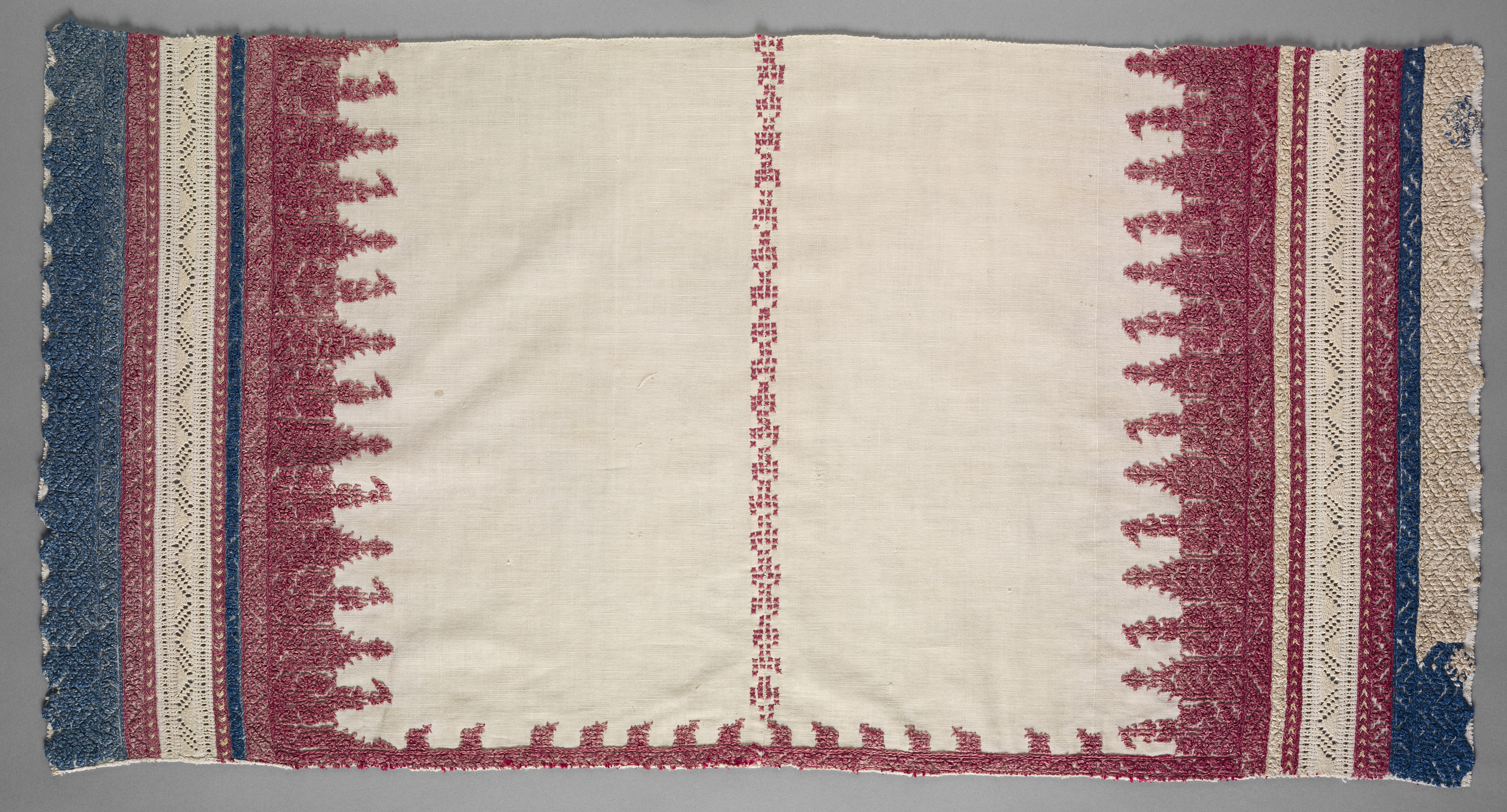
Deconstructing the Salé Embroiderer: An Avant-Garde Analysis of a Moroccan Furnishing Textile
At Zoey Fashion Lab, our practice of fabric deconstruction is not merely an act of unstitching; it is an archaeological excavation of narrative, technique, and cultural resonance. The subject before us—a furnishing textile originating from Salé, Morocco, crafted by a local embroiderer using cotton and silk, and dyed with natural pigments—presents a profound case study. This object, rooted in the 16th to 17th centuries, is far more than a decorative artifact. It is a silent witness to cultural collision and aesthetic synthesis. An avant-garde lens compels us to strip away its conventional identity as a "furnishing" and re-imagine it as a radical text of resistance, adaptation, and pure material poetry.
I. Material Memory: Cotton, Silk, and the Archive of Touch
The technical composition of this textile—a union of cotton and silk—is the first site of deconstruction. Cotton, a fiber of the earth, speaks to the pragmatic, the daily, the grounded. Silk, a filament of luxury and trade, evokes the Silk Road's tendrils reaching into the Maghreb. In the hands of the Salé embroiderer, these materials are not simply threads; they are antagonistic partners. The cotton ground provides a stable, absorbent canvas, while the silk embroidery sits atop it, gleaming with a light that refuses to be absorbed.
From an avant-garde perspective, we must interrogate the dye. The natural pigments—likely indigo for blues, madder for reds, and saffron or henna for yellows—are not just colors. They are chemical records of the land. The indigo, a product of trans-Saharan trade, carries the weight of nomadic knowledge. The madder, grown in the fertile valleys, is a stain of rootedness. The act of dyeing is an act of alchemical transformation, turning plant matter into permanent statements. For the modern deconstructionist, these dyes are volatile archives: they fade, bleed, and shift over centuries, reminding us that all material is in a state of becoming, not being.
The embroidery technique itself—likely a dense, geometric counted-thread stitch—is a form of pre-industrial coding. Each stitch is a binary decision: thread present, thread absent. This is a proto-digital language, a manual pixelation of pattern. The Salé embroiderer was not merely decorating; she was writing a spatial algorithm onto the fabric. The tension between the soft cotton ground and the rigid, structured silk embroidery creates a topographical map of labor, patience, and precise intention.
II. Cultural Collision: The 16th-17th Century as a Fissure
Archive Resonance speaks of the 16th to 17th centuries as a period of "cultural collision." For Morocco, this was the era of the Saadian dynasty, a time of intense diplomatic and commercial exchange with Europe, particularly Spain and Portugal, alongside the enduring influence of the Ottoman Empire and sub-Saharan Africa. This textile from Salé, a city known for its corsairs and its intellectual rigor, is a tectonic plate of history.
An avant-garde reading refuses to see this textile as a harmonious blend. Instead, we see the scars of contact. The geometric motifs—octagons, stars, and interlacing bands—are not purely Islamic. They echo the muqarnas of Andalusian architecture, the Roman mosaics of Volubilis, and the abstract patterns of sub-Saharan strip-weaves. The embroiderer was not synthesizing; she was layering dissonances. The silk thread, a luxury good often imported from Italy or China, was stitched onto local cotton using techniques passed down through generations of women. This is an act of domestication of the foreign.
Consider the function: a furnishing textile. It was likely a wall hanging, a cover for a low divan (sofa), or a ceremonial panel. This object was meant to be seen, not touched. It was a surface of status. But in the private, domestic space of the riad, it also served as a boundary—a visual demarcation between the public and the intimate. The embroiderer, working in the female-dominated sphere of the harem or the home, was encoding a form of visual sovereignty. Her patterns were a silent language of identity, resistant to the male, public, and colonial gaze.
III. Avant-Garde Recontextualization: From Archive to Intervention
For Zoey Fashion Lab, the avant-garde is not a style; it is a method of rupture. To deconstruct this Salé textile is to pull it out of the museum vitrine and into the present tense. We ask: What happens when we reverse the stitch? When we expose the raw edges of the cotton ground, allowing the silk to fray? When we re-dye the faded areas with synthetic, neon pigments that scream against the muted natural palette?
The avant-garde intervention would be to treat this textile as a score for performance. The embroiderer's hand is the composer. The needle is the baton. The pattern is the notation. A contemporary deconstructionist might unpick a single motif and re-embroider it using conductive thread, turning the geometric star into a circuit that lights up with the touch of a viewer. This is not a desecration; it is a continuation of the archive through new media.
Alternatively, we might isolate the dye. A laboratory analysis of the indigo and madder could be used to create a new palette for a digital print. The original textile becomes a source code for a collection that is simultaneously ancient and futuristic. The cotton and silk are deconstructed into their molecular components and then re-synthesized into a bio-fabricated textile that grows in a lab. The "furnishing" becomes a "wearable architecture," a garment that references the wall hanging but now drapes the body as a second skin.
IV. The Resonance of Rupture: A Conclusion
The Salé embroiderer, working in the 16th-17th century, was already an avant-garde artist. She was collaging cultures under the pressure of history. She was using the most intimate of technologies—the needle—to negotiate power, identity, and beauty. Her textile is not a relic; it is a living document of resilience.
For Zoey Fashion Lab, our deconstruction is an act of critical love. We do not seek to destroy the archive; we seek to activate its dormant energies. By analyzing the cotton, silk, and dye, by acknowledging the cultural collisions of the 16th-17th centuries, and by applying an avant-garde methodology of rupture and recontextualization, we transform this furnishing textile from a passive object into an active agent of dialogue. It speaks to us of trade, of gender, of labor, and of the eternal human desire to impose order on chaos through pattern. In the hands of the deconstructionist, the stitch becomes a sentence, the dye a declaration, and the textile itself a poem written in thread.