Deconstructing the Fibula: An Avant-Garde Analysis for Zoey Fashion Lab
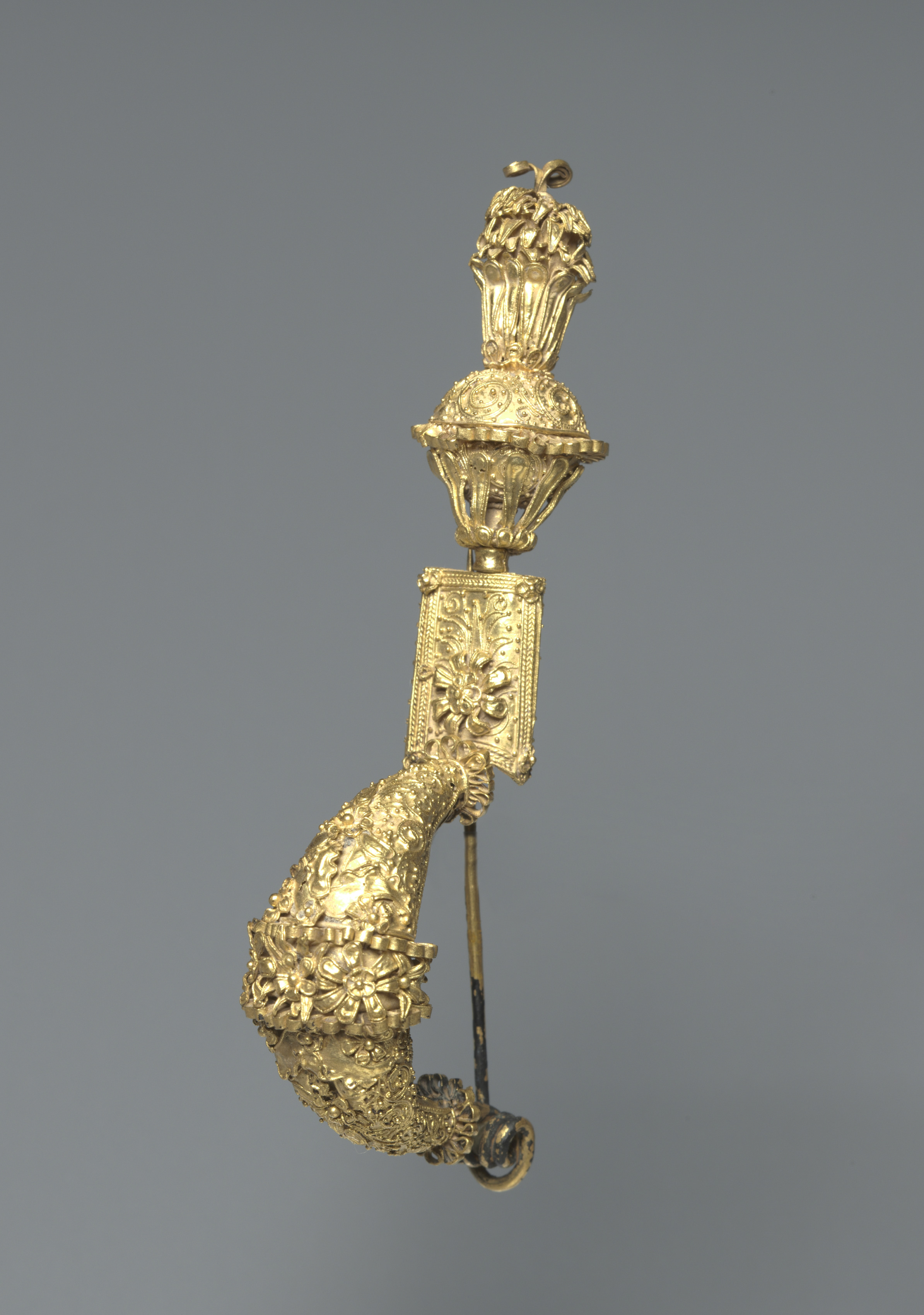
As Chief Fabric Deconstructionist for Zoey Fashion Lab, I am tasked with interrogating the material, cultural, and symbolic DNA of historical artifacts to extract their avant-garde potential. The object under analysis—a gold fibula from South Italy, Campania—is not merely a functional pin. It is a narrative device, a tension between adornment and mortality, surface and depth. Its reference, Archive Resonance: “Mirror with Split-Lea…”, evokes a duality: a polished silver mirror inlaid with gold acanthus leaves versus a cold sarcophagus relief telling a life story. This fibula, in its gold materiality and Campanian origin, becomes a catalyst for deconstructing body, time, and ornament. Below, I present a multi-layered analysis, focusing on material, form, context, and the avant-garde reinterpretation for Zoey Fashion Lab.
Materiality: Gold as a Dual Agent of Light and Weight
Gold is the primary technical medium of this fibula. In Campania, a region historically rich in Hellenistic and Etruscan influences, gold signified divine permanence and earthly status. However, for an avant-garde lens, we must deconstruct gold’s traditional associations. Gold is not merely precious; it is a material of contradiction. It reflects light with an almost aggressive brilliance, yet it carries a substantial weight—both physical and symbolic. In the context of the fibula’s function (pinning fabric), gold becomes a point of tension: it holds the garment together while simultaneously drawing attention to the body’s vulnerability (the pin’s sharp point).
For Zoey Fashion Lab, this suggests a deconstruction of value. We might consider oxidized gold or matted finishes to subvert its shine, or integrate gold with unexpected materials like resin, concrete, or recycled synthetic fibers. The fibula’s gold is not a static luxury; it is a recording surface for time, wear, and narrative. The reference to the “mirror with split-lea” implies a reflective surface that is fractured. Thus, the gold in our avant-garde interpretation could be hammered, etched, or partially obscured—a mirror that reflects not just the wearer’s image but the fragmented self in a post-digital age.
Form and Function: The Fibula as a Threshold Object
Historically, the fibula served as a clasp, a practical tool for securing garments like the chiton or himation. But its form—often bow-shaped, with a pin and catch—is inherently architectural. It creates a point of entry and exit on the body. In Campanian culture, fibulae were also votive offerings and burial goods, linking them to transitions: life to death, public to private. The Archive Resonance’s duality of “mirror” and “sarcophagus” reinforces this threshold quality. The fibula is a liminal object—it is both a tool for dressing (life) and a marker for the tomb (death).
For an avant-garde fashion lab, the fibula’s form can be exaggerated and distorted. Imagine a fibula that is oversized, transforming from a pin into a wearable sculpture that alters the silhouette of a garment. Its bow could be asymmetrical, its pin detachable, or its catch reimagined as a clasp for multiple layers. The reference to “split-lea” (split leaf) suggests a fractured organic form. We might deconstruct the fibula into modular components—the pin, the bow, the spring—each piece capable of being rearranged, like a deconstructed garment. This challenges the traditional fixed function, turning the fibula into a dynamic system that responds to the wearer’s movement or intent.
Context: Campania and the Archive Resonance
Campania, home to Pompeii and Herculaneum, is a region of volcanic preservation and sudden destruction. The fibula from this area carries the weight of catastrophe and memory. The Archive Resonance’s “mirror with split-lea” likely references a specific artifact: a silver mirror with gold inlay of acanthus leaves, found in a burial context. The mirror’s reflective surface contrasts with the sarcophagus’s narrative relief—one is immediate, the other historical. This duality is essential for avant-garde design: the fibula can be a mirror of the present (a fashion accessory) and a sarcophagus of the past (an archaeological relic).
For Zoey Fashion Lab, this context suggests a layering of time. The fibula could incorporate fossilized materials or reconstructed fragments—like glass mimicking volcanic ash or gold leaf applied over distressed fabric. The “split-lea” motif (acanthus) is a symbol of life and growth, often used in Greco-Roman art. In an avant-garde context, we might deconstruct this motif into geometric or abstract forms, or render it in non-traditional materials like laser-cut steel or 3D-printed bioplastic. The fibula becomes a palimpsest: a surface where multiple narratives (life, death, fashion, archaeology) are inscribed and erased.
Avant-Garde Reinterpretation: The Fibula as a Deconstructive Tool
At Zoey Fashion Lab, we do not simply replicate historical forms; we deconstruct their logic. The fibula’s primary function—to pin—can be subverted. Instead of securing fabric, the avant-garde fibula might puncture, tear, or suspend the garment. It could be designed to leave a mark—a permanent crease or hole—challenging the idea of preservation. The reference to the “mirror” suggests self-reflexivity. Our fibula could incorporate a small reflective surface that distorts the wearer’s image, or a digital screen that displays fragmented text or images from the Archive Resonance.
Furthermore, the fibula’s gold materiality can be devalued through industrial processes. Consider gold-plated steel with deliberate scratches, or gold leaf applied over decaying organic matter (like dried leaves or fabric scraps). This echoes the “split-lea” motif’s organic decay. The fibula’s size and placement on the body can also be radicalized. Instead of a shoulder or chest pin, imagine a fibula that clasps the spine or pierces a sleeve, creating a structural disruption. The pin itself could be elongated to function as a stylus or tool, blurring the line between ornament and instrument.
Conclusion: The Fibula as a Narrative Generator
In conclusion, the Campanian gold fibula, when deconstructed through an avant-garde lens, becomes a powerful narrative generator for Zoey Fashion Lab. Its material (gold) is a contradiction of light and weight; its form (pin and bow) is a threshold between life and death; its context (Campania) is a memory of catastrophe; and its reference (mirror and sarcophagus) is a duality of surface and depth. Our reinterpretation must fracture these elements, reassembling them into a new syntax that challenges the wearer’s relationship to time, body, and adornment.
For Zoey Fashion Lab, this fibula is not a relic to be preserved but a blueprint for deconstruction. It invites us to reimagine the pin as a point of rupture, the gold as a recording surface, and the garment as a site of archaeological excavation. The Archive Resonance’s “split-lea” is not a decorative motif but a metaphor for fragmentation—a mirror that reflects a shattered self, a sarcophagus that tells a story in pieces. In our avant-garde practice, the fibula becomes a tool for unmaking fashion, revealing the tensions between preservation and destruction, between the polished mirror and the stone relief. This is the essence of our work: to deconstruct the past in order to construct the future of wearable narrative.