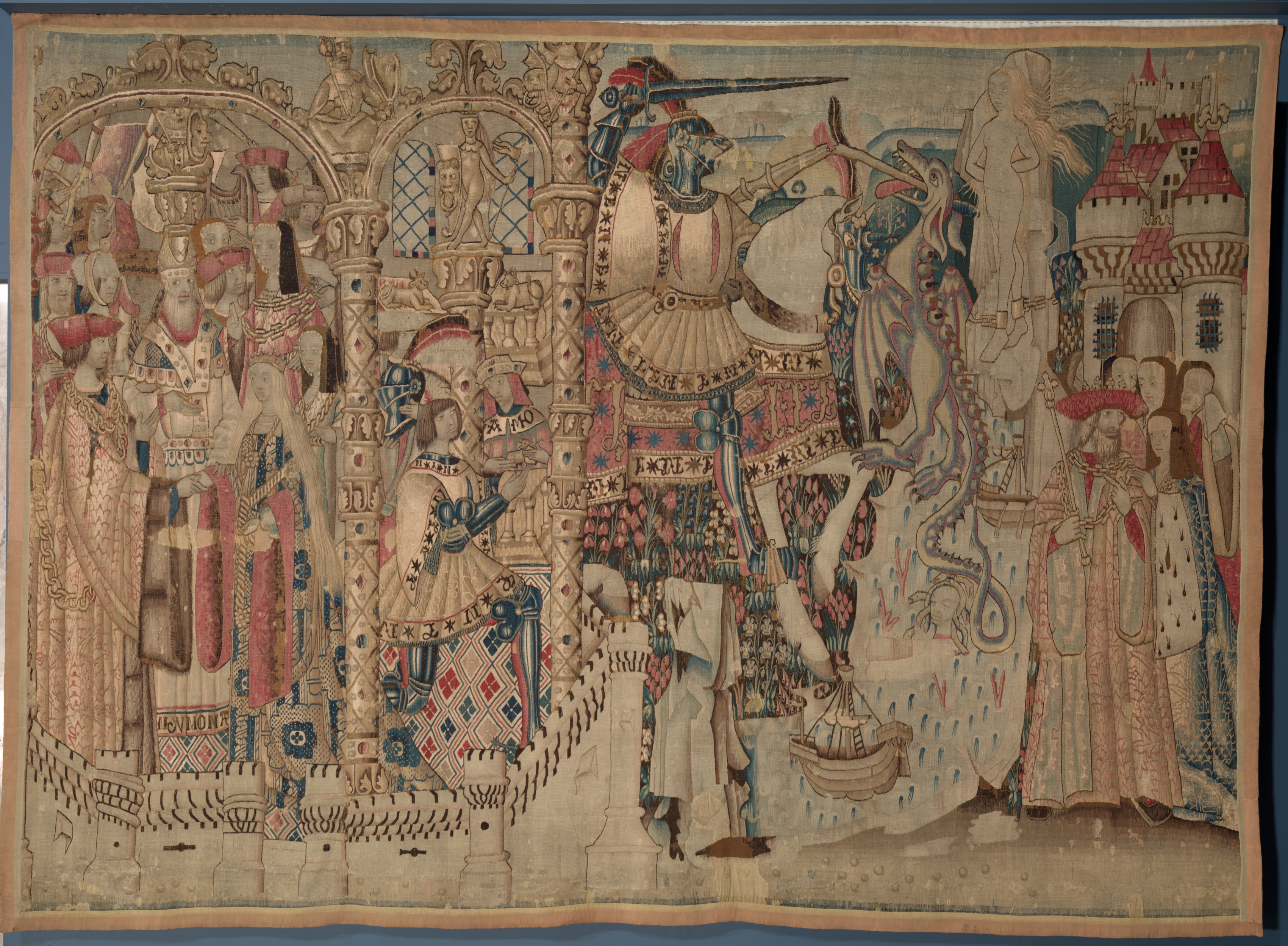
Deconstructing the Myth: Perseus and Andromeda in Avant-Garde Tapestry
As the Chief Fabric Deconstructionist for Zoey Fashion Lab, my role is to interrogate the material, narrative, and cultural DNA of textiles, extracting their latent potential for avant-garde reinterpretation. The subject under analysis—a tapestry depicting the Story of Perseus and Andromeda, originating from the Netherlands in the early 16th century, woven in wool and silk—presents a rich, paradoxical foundation. It is a classical myth rendered in a traditional medium, yet its structural and symbolic complexities offer a fertile ground for deconstruction. This analysis will dissect the tapestry’s technical, narrative, and historical layers, proposing a radical reimagining through the lens of a “New DNA Strand,” a concept that treats the textile as a living, mutable organism rather than a static artifact.
Technical Deconstruction: The Wool-Silk Binary
At its core, the tapestry is a study in contrast: the earthy, matte texture of wool against the lustrous, reflective quality of silk. This binary is not merely aesthetic but functional. Wool, derived from sheep, carries connotations of pastoral life, labor, and warmth—the tangible, grounded world. Silk, imported from the East via complex trade routes, embodies luxury, fragility, and the exotic. In the 16th-century Netherlands, this combination signified wealth and global connectivity, a statement of power through material consumption. For the avant-garde, this binary becomes a site of tension. The wool provides a structural anchor, a base that can be frayed, felted, or distressed. The silk offers a surface of illusion, a shimmering skin that can be peeled away, sliced, or re-embroidered. The tapestry weave itself—a plain weave where weft threads are beaten down to cover the warp—creates a dense, almost impenetrable surface. This density is the first element to challenge. In our deconstruction, we would introduce negative space, cutting away sections of the wool to expose the warp threads, creating a lattice-like structure that reveals the underlying mechanics of the weave. The silk, once removed from its background, could be reconfigured into floating filaments, suspended like DNA strands, suggesting a genetic code waiting to be rewritten.
Narrative Deconstruction: The Hero, the Monster, and the Gaze
The myth of Perseus and Andromeda is a foundational narrative of Western art: the hero slays the sea monster Cetus to rescue the chained princess Andromeda. In the tapestry, this scene is likely rendered with Perseus in mid-action, sword raised, Andromeda in a state of passive vulnerability, and the monster as a chaotic, scaly form. The avant-garde deconstruction must challenge this linear, patriarchal narrative. The “New DNA Strand” approach treats the myth as a sequence of genetic markers that can be spliced, edited, and mutated. First, we isolate the gaze. In the original, the viewer is positioned to identify with Perseus, the active agent. We would disrupt this by re-weaving the monster’s scales into a pattern that mirrors the human eye, turning the creature into a witness rather than a threat. Andromeda’s chains, traditionally made of metal, would be re-imagined as woven ligaments, connecting her to the tapestry’s structural warp, suggesting she is not a victim but a biological node in a larger system. Perseus’s sword, a phallic symbol of intervention, could be deconstructed into a threaded needle, transforming the act of killing into an act of stitching—a reparation of the fabric of the story. The narrative is not destroyed but recombinant, allowing for multiple, simultaneous readings: Andromeda as a weaver of her own fate, Perseus as a caretaker of the ecosystem, the monster as a guardian of the deep.
Historical Deconstruction: The Netherlands and the Global Thread
The tapestry’s origin in the early 16th-century Netherlands is crucial. This was a period of burgeoning trade, religious upheaval, and the rise of a merchant class that used tapestries as portable status symbols. The wool-silk combination directly references the global textile economy: wool from local sheep, silk from the Silk Road. The myth of Perseus and Andromeda, a Greek story, was filtered through a Northern European lens, often interpreted as an allegory for Christian salvation (Perseus as Christ, Andromeda as the soul). The avant-garde deconstruction must expose this colonial and theological layering. We would introduce anachronistic materials—synthetic fibers, recycled plastics, or digital threads—that mimic the original wool and silk but are produced through contemporary, often exploitative, global supply chains. This creates a palimpsest, where the 16th-century narrative is overwritten by 21st-century concerns: fast fashion, environmental degradation, and the digital displacement of craft. The tapestry becomes a time-traveling artifact, its “New DNA Strand” encoding both its original context and its future mutations. For instance, the sea monster’s scales could be re-woven using ocean plastic, transforming it into a symbol of ecological crisis. Andromeda’s chains could be made from discarded smartphone cables, linking her captivity to modern digital dependence. Perseus’s shield, often depicting Medusa’s head, could be replaced with a QR code that, when scanned, reveals the tapestry’s carbon footprint or the labor conditions of its production.
Avant-Garde Application: The Tapestry as Living System
The ultimate goal of this deconstruction is not to destroy the tapestry but to activate it as a living, responsive system. The “New DNA Strand” is a metaphor for biomimetic design, where the tapestry’s structure is treated as a genetic code that can be expressed, silenced, or mutated. In practice, this means creating a modular tapestry composed of interchangeable panels. Each panel represents a different genetic sequence: one for the wool base, one for the silk surface, one for the narrative elements. These panels can be recombined, removed, or replaced, allowing the tapestry to evolve over time. The avant-garde fashion application would be a wearable tapestry, a garment that incorporates these deconstructed elements. For example, a jacket might feature a frayed wool collar (the monster’s scales), a silk lining printed with Andromeda’s chains (the narrative), and a detachable panel that references Perseus’s sword, now a functional zipper pull. The garment would be interactive, with embedded sensors that alter the pattern based on the wearer’s movement or the environment. This is not a costume but a cyborg textile, a fusion of history and technology, craft and code. The original tapestry’s function as a wall covering is subverted; it becomes a second skin, a narrative that is worn, performed, and rewritten daily.
Conclusion: The Thread as Mutation
The Story of Perseus and Andromeda, as rendered in this 16th-century Dutch tapestry, is not a fixed artifact but a starting point for mutation. By deconstructing its technical, narrative, and historical layers, we reveal a “New DNA Strand” that connects the past to the present, the craft to the concept, the static to the dynamic. For Zoey Fashion Lab, this analysis serves as a blueprint for avant-garde design that respects tradition while radically reimagining its potential. The wool and silk are not materials to be preserved but languages to be spoken. The myth is not a story to be retold but a genome to be edited. The tapestry is not a relic but a living system, breathing through its threads, waiting for the next stitch to be made.