Technical Deconstruction & Material Resonance
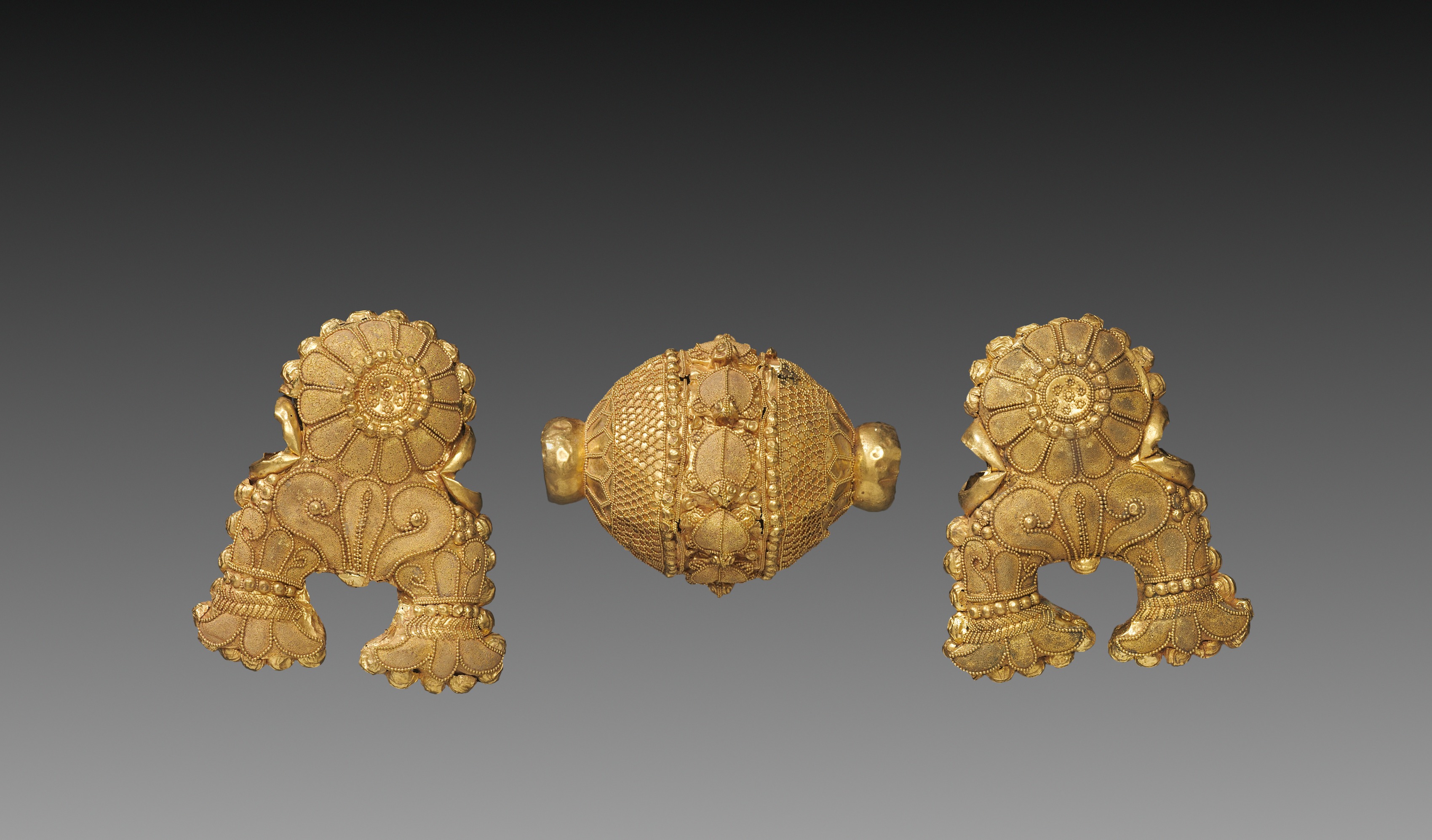
The provided objects—a necklace bead and a pair of pendants—are not merely gold; they are high-karat, hand-hammered, and likely cold-worked gold from the Shunga period. This technical specification is paramount. The absence of advanced soldering techniques typical of later periods suggests construction through meticulous seaming, riveting, and the strategic use of granulation. The "bead" form implies a hollow construction, a feat requiring sophisticated metal manipulation to create a lightweight yet durable ornament. The surface, under magnification, would likely reveal the subtle, organic textural memory of the hammer—a far cry from the sterile perfection of modern machine-rolled sheet gold. This inherent materiality carries an archive of the hand, a direct kinetic link to the artisan. For the avant-garde, this is not a deficit but a core asset. We do not seek to mimic this handwork, but to let its principle inform contemporary fabrication. Imagine 3D-printed titanium structures whose latticework echoes the hollow bead's efficiency, or laser-welded gold seams left proudly visible as topographic design features, celebrating the join rather than hiding it.
Formal Archeology: The Auspicious Symbol
The "auspicious symbol" shape is the conceptual nucleus. While specific iconography (possibly a kalpavriksha [wish-fulfilling tree], a śrīvatsa, or a floral medallion) is crucial for historical context, our avant-garde methodology engages with its archetypal function rather than its literal form. This symbol was a portable talisman, a concentrated node of meaning and protective energy worn against the body. In deconstructing this, we ask: what is an auspicious symbol for the contemporary body and psyche? It may not be a mythical tree, but perhaps a data glyph, a biometric signature, or an abstract form representing ecological balance. The Shunga pendants operated within a shared cultural lexicon; our avant-garde interpretation must navigate a global, pluralistic one. The form-factor of the "pair" is also critical—it speaks to duality, balance, and symmetry, concepts ripe for subversion. Could a pendant pair be split, one half worn by each of two individuals, connected virtually? Or could the "auspicious" form be rendered in a mutable, fluid metal that changes shape with body temperature?
Contextual Dissonance & The Avant-Garde Proposition
The archive reference is revelatory: "一面是光洁银镜上以黄金镶嵌的纷繁棕叶纹,另一面是冰冷石棺板上以浮雕诉说的生命叙事" ("On one side, the intricate palmette pattern inlaid in gold on a smooth silver mirror; on the other, the narrative of life told in relief on a cold stone coffin panel."). This perfectly encapsulates the dialectical essence of adornment—it exists between the mirror (vanity, the present self, reflection, light) and the sarcophagus (mortality, memory, the eternal, stone). The Shunga gold objects navigated this space, being both luxurious adornment for life and likely funerary goods for the afterlife.
Our avant-garde response must amplify this dissonance. We propose a collection titled "Between Mirror and Stone." The materials will consciously mediate between these poles:
- The Mirror Pole (Reflection/Temporality): Polished micro-mirrored stainless steel, dichroic glass that shifts color with movement, RFID-embedded acrylic that reflects data.
- The Stone Pole (Memory/Permanence): Basalt-look ceramics, recycled concrete composite, etched slate, or even lab-grown diamond set in rough form.
- The Mediating Element (The Shunga Gold): Sustainable, traceable gold used not as a primary surface but as a conductive trace, a sealing filament, or a microscopic gilding on the edges of "stone" elements, symbolizing the persistent, precious thread of life and craft connecting the two states.
Collection Manifesto: Wearable Dialectics
The bead and pendants become points of departure for a system of adornment that is both personal and critical.
1. The Data Talisman Series: Pendants shaped by algorithmic interpretations of "auspicious" data (clean air readings, personal achievement milestones, encrypted love messages). Their forms, while abstract, retain the compact, amuletic scale of the Shunga originals. They are "read" not by sight alone but by scanning with a smartphone, revealing the layered narrative within—a direct translation of the sarcophagus relief's "life narrative."
2. The Dichotomy Pairs: Asymmetric pendant sets where one element is of "mirror" material (highly reflective, fragile) and its partner is of "stone" material (matte, rugged). They can be worn together or separately, challenging the Shunga symmetry and representing the fragmented, multifaceted self. The connection point, when separated, is a flash of visible gold—the enduring link.
3. The Hollow Bead Re-Engineered: The hollow bead form is reinterpreted as a modular, wearable vessel. Units can be filled with personal relics (ashes, soil, seeds), micro-encapsulated scents, or light-emitting gels. They are assembled by the wearer, becoming a kinetic, customizable necklace that literally carries one's narrative. The construction method—perhaps using magnetic joins or tension-fit systems—echoes the ingenious, solder-free engineering of the ancient originals.
Conclusion: The Resonance of the Fragment
The profound power of these Shunga-period fragments lies in their survival as discrete, decontextualized objects. We no longer see the full necklace, the exact wearer, or the complete ritual. This fragmentation is not a loss but a provocation for the avant-garde. It mirrors our own postmodern condition—assembling identity from fragments of culture, history, and technology.
Zoey Fashion Lab's collection, inspired by this analysis, will not produce archaeological replicas. It will produce contemporary fragments—objects that sit consciously between the mirror of the present self and the stone of deep time. They will be talismans for a new era, where the auspicious is defined not by fixed symbols but by personal meaning, ethical materiality, and a conscious engagement with the dialectics of life, death, memory, and adornment. The gold of Shunga, once a symbol of divine and royal power, is transformed in our hand into a conductor of critical thought, a slender, precious line connecting two millennia of human desire to make meaning tangible upon the body.