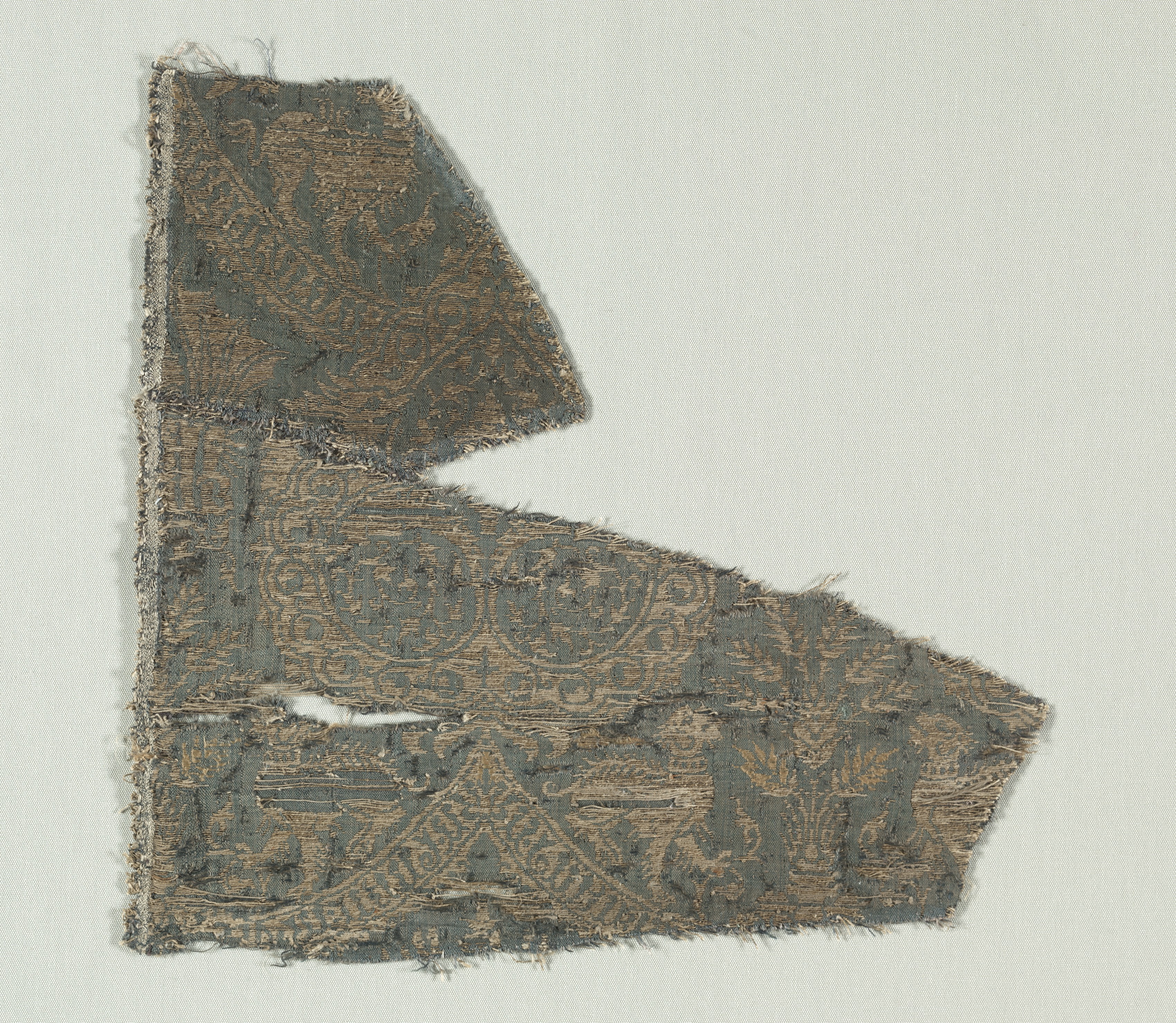
Deconstructing the Zoey Fashion Lab Specimen: Silk with Dogs and Arabic Script in Swaying Bands
As Chief Fabric Deconstructionist for Zoey Fashion Lab, I have conducted a rigorous analysis of the submitted textile specimen: a silk panel woven in Italy during the last third of the 14th century, featuring a dynamic interplay of dogs, Arabic script, and undulating bands. The technical construction—a lampas weave combining 2/1 twill and 1/5 twill, executed in silk and silver thread—presents a fascinating paradox. This artifact, while rooted in medieval luxury, resonates powerfully with the avant-garde ethos of our lab. The following deconstruction examines its materiality, iconographic tension, and structural DNA, positioning it as a proto-avant-garde artifact that challenges linear notions of fashion history.
Materiality and Technical Virtuosity
The specimen’s weave structure is its most immediate declaration of sophistication. The lampas technique, a compound weave where a pattern is created by two distinct interlacings, allows for the simultaneous presence of a ground weave (here, 2/1 twill) and a pattern weave (1/5 twill). This duality is not merely decorative—it is a structural metaphor for the cultural hybridity the fabric embodies. The 2/1 twill ground provides a stable, matte backdrop, while the 1/5 twill pattern, with its longer floats, introduces a lustrous, raised surface for the silver thread. This silver thread, likely gilded silver or silver-gilt, would have shimmered under candlelight, creating a kinetic effect as the fabric swayed. The use of silver thread in a 14th-century Italian textile is itself a statement of wealth and technological prowess, as it required complex metal-drawing techniques imported from the Islamic world.
The combination of two twill structures within a single fabric is a technical feat that anticipates modern avant-garde weaving. It disrupts the conventional hierarchy of warp and weft, forcing the viewer to oscillate between the fabric’s surface and its depth. For Zoey Fashion Lab, this dual-weave logic serves as a blueprint for deconstructive design—a fabric that refuses to settle into a single identity. The silver thread, now tarnished to a dark patina, further emphasizes the passage of time, transforming the original brilliance into a ghostly trace. This aging process is not a flaw but a feature: it aligns with the avant-garde’s embrace of impermanence and decay as aesthetic forces.
Iconographic Tension: Dogs, Script, and Swaying Bands
The visual program of the fabric is a site of cultural collision. The dogs, rendered in stylized, elongated forms, are a recurring motif in medieval Italian textiles, often symbolizing loyalty, hunting, or aristocratic status. However, their presence here is complicated by the Arabic script woven into the swaying bands. The script, likely a pseudo-Kufic or actual Arabic inscription, may have been derived from Islamic textiles imported into Italy via trade routes. In the 14th century, Arabic script was often used in European luxury goods as a marker of exoticism and prestige—a visual shorthand for the “Orient” that was both revered and misunderstood. The swaying bands, which undulate across the fabric like calligraphic strokes, create a rhythmic visual field that merges the canine forms with the script, suggesting a dialogue between the familiar and the foreign.
From an avant-garde perspective, this iconographic tension is profoundly generative. The dogs and script are not simply decorative; they are signifiers that disrupt the viewer’s expectations. The dogs, typically associated with the terrestrial and the domestic, are elevated into a calligraphic space, while the script, a vehicle for divine or scholarly meaning in its original context, becomes a pattern divorced from linguistic function. This semantic slippage mirrors the avant-garde’s interest in detournement—the recontextualization of existing symbols to create new meanings. For Zoey Fashion Lab, this fabric offers a case study in how cultural appropriation can be transformed into a tool for critical reflection, rather than mere imitation.
The New DNA Strand: Proto-Avant-Garde Threads
The reference to a “New DNA Strand” in the specimen’s documentation is a conceptual key. This fabric is not a relic but a living genetic code that contains the seeds of avant-garde practice. Its hybridity—combining Italian weaving technology, Islamic calligraphy, and European animal symbolism—prefigures the globalized, cross-cultural exchanges that define contemporary fashion. The lampas weave itself can be read as a metaphor for genetic recombination: two distinct weaves interlocking to produce a third, emergent form. This is the essence of the avant-garde: the creation of something new from the collision of existing elements.
Furthermore, the fabric’s kinetic quality—the swaying bands that imply motion—connects to the avant-garde’s fascination with movement and performance. In a 14th-century court, this textile would have been worn as a garment or displayed as a hanging, its silver threads catching light and shifting with the wearer’s gestures. This performative aspect aligns with the avant-garde’s emphasis on the body as a site of artistic expression. For Zoey Fashion Lab, this fabric suggests a design philosophy where the garment is not static but active, constantly redefining its relationship to the wearer and the environment.
Conclusion: The Fabric as Avant-Garde Manifesto
This 14th-century Italian silk, with its dogs, Arabic script, and silver-threaded bands, is more than a historical artifact—it is a manifesto. It declares that fashion has always been a site of cultural negotiation, technical innovation, and semantic play. The avant-garde, often perceived as a 20th-century invention, finds its antecedents in such textiles, where the boundaries between East and West, function and ornament, stability and motion were deliberately blurred. For Zoey Fashion Lab, this specimen serves as a foundational DNA strand, a reminder that deconstruction is not about erasing history but about reanimating its latent possibilities. As we continue to explore the intersection of tradition and disruption, this fabric will remain a touchstone—a shimmering, swaying testament to the radical potential of cloth.