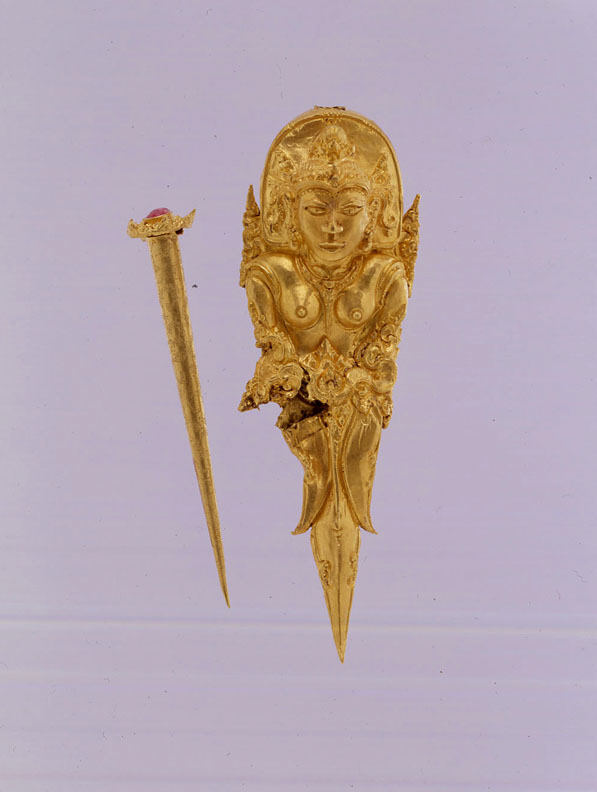
Deconstructing the Javanese Gold Hair Ornament: A Proto-Futurist Manifesto for SS26
The archive node, referencing a mirror of polished silver inlaid with gold palm fronds on one side and a sarcophagus of cold stone narrating life in relief on the other, serves as the philosophical crucible for our SS26 analysis. The subject—a Javanese gold hair ornament with pin—is not merely an artifact of adornment. It is a tectonic diagram of structural tension, a micro-architectural blueprint for the deconstruction of the silhouette. Within the Zoey Fashion Laboratory, this object is decoded as a precognitive signal for a season defined by rigid fragility, kinetic weight, and the subversion of the human form’s natural axis.
I. The Pin as Structural Fulcrum: Redefining the Silhouette’s Axis
The conventional hairpin is a passive tool, a fastener. The Javanese gold pin, however, is an active structural node. Its function is not to hold but to pierce and suspend. For SS26, we extrapolate this principle into a new category of garment engineering: the “pinned silhouette.” Imagine a garment that does not drape, cling, or stand rigidly via internal corsetry, but is instead tethered to the body at strategic, non-anatomical points.
The gold pin’s penetrating action becomes a metaphor for the futuristic seam. We propose garments constructed from modular, rigid panels—perhaps of laser-sintered bio-resin or recycled metallic foils—that are connected not by thread, but by gold-toned, oversized pins. The wearer’s body becomes the negative space, the void around which the architecture is assembled. The silhouette is no longer a continuous line but a series of discrete, suspended planes. The hair ornament’s pin, in this context, is the fulcrum upon which the entire garment’s tension is balanced. A cape might be pinned at a single clavicle point, its weight cascading in a controlled, gravitational arc, mimicking the way the ornament’s gold finials anchor the hair’s mass.
II. The Split-Leaf Motif: A Geometry of Fracture and Flow
The archive reference to “split-leaf” patterns on a mirrored surface is critical. In the Javanese ornament, we find a similar logic: the gold is not a solid mass but a matrix of interlocking, fragmented forms. This is not decoration; it is a structural diagram for biomimetic armor. For SS26, we translate this into a new textile logic: fractured surfaces.
Imagine a jacket constructed from overlapping, petal-like scales of gold-lacquered aluminum, each scale cut with a “split” or void. These scales are not sewn but pinned to a sheer, almost invisible base of technical mesh. The result is a surface that breathes, moves, and refracts light like a shattered mirror. The “split” becomes a functional seam, allowing for articulation where a solid plate would restrict. This directly correlates to the hair ornament’s design: the gold leaves are not static; their split forms allow the pin to pass through, creating a dynamic interplay of positive and negative space. In our SS26 garment, the body’s movement will cause the scales to shift, revealing the skin or an under-layer of polished silver, echoing the mirror’s duality.
III. The Sarcophagus Dialectic: Weight, Memory, and the Futurist Garment
The archive’s second face—the stone sarcophagus with its life narrative carved in relief—introduces the critical element of weight as a design material. The Javanese gold ornament, despite its preciousness, carries a physical heft. It is an object of ceremony, of stillness. In the context of SS26, we weaponize this weight. The silhouette is no longer about flight or ethereality; it is about grounded gravity.
We propose a series of “sarcophagus coats”—garments that are heavy, structured, and almost funerary in their formality. The gold pin becomes the key to their deconstruction. A coat might be a single, massive panel of compressed felt or recycled carbon fiber, held together at the shoulders and hips by a series of gold pins. The weight of the material pulls the garment into a severe, architectural drape, creating a silhouette that is both monumental and precarious. The “life narrative” of the sarcophagus is translated into surface treatment: laser-etched or hand-embroidered patterns that tell a story of motion, of the body’s struggle against the weight of the garment. The hair ornament’s pin, therefore, is the tool that both binds and liberates, holding the narrative in place while allowing the wearer to interact with its gravity.
IV. The Pin as a Futurist Closure System: Rejecting the Zipper
The most radical innovation for SS26 is the complete rejection of the zipper and button in favor of the pin as a primary closure system. The Javanese hair ornament demonstrates the pin’s ability to secure dense material with a single, decisive point of entry. We extrapolate this into a new wardrobe logic: garments that are installed, not worn.
Imagine a dress constructed from a single, continuous ribbon of gold-threaded silk. The wearer does not step into it; instead, a series of gold pins are inserted at key anatomical points—the sternum, the sacrum, the seventh cervical vertebra—to create the garment’s shape. The fabric is tensioned between these pins, creating a silhouette that is unique to each wearer’s posture. This is the ultimate expression of the futurist silhouette: a form that is not predetermined but generated by the act of pinning. The hair ornament’s pin, in this light, is the ultimate tool of customization, transforming the act of dressing into a performance of structural assembly.
V. Conclusion: The Ornament as Blueprint for a New Structural Language
The Javanese gold hair ornament with pin is not a relic; it is a prophetic design brief. Its fusion of precious metal, functional piercing, and fractured geometry provides the exact vocabulary needed for SS26. We are not reviving tradition; we are hacking its structural DNA. The future of couture lies in the tension between the rigid and the fluid, the heavy and the suspended, the narrative and the abstract. The hair ornament teaches us that the smallest point of connection—the pin—can redefine the entire silhouette. For Zoey Fashion Laboratory, SS26 will be the season of the pinned body, where every garment is a temporary, sacred architecture, held together by the piercing logic of a gold point against the void of the human form.