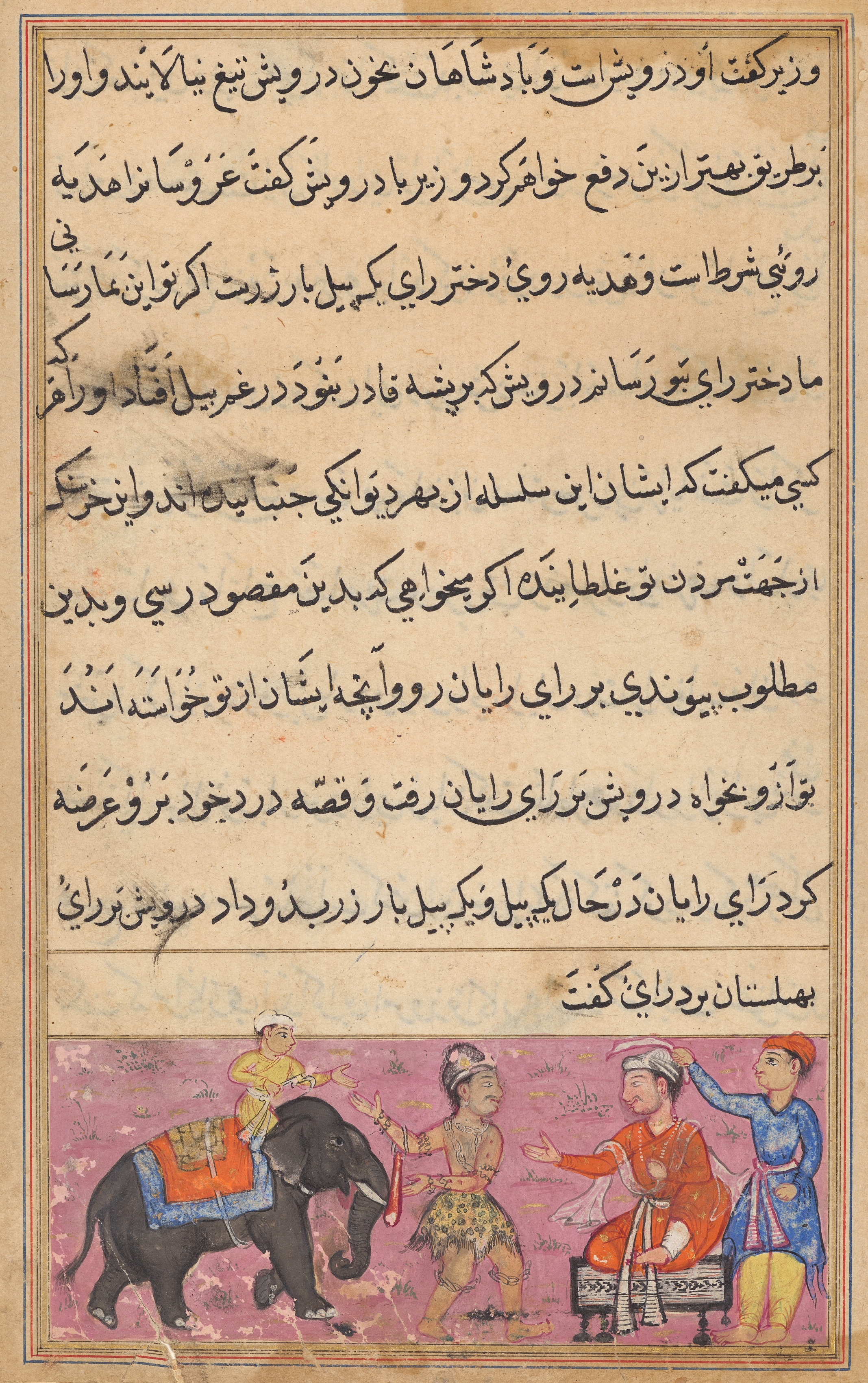
Deconstructing the Dowry: Avant-Garde Analysis of a Mughal Miniature
Zoey Fashion Lab presents a radical deconstruction of a folio from the Tuti-nama (Tales of a Parrot), specifically the Seventh Night scene: “The dervish brings in as dowry an elephant laden with gold.” This Mughal masterpiece, executed in gum tempera, ink, and gold on paper under the patronage of Emperor Akbar (r. 1556–1605), is not merely a historical artifact. It is a repository of latent structural, chromatic, and symbolic tensions that, when subjected to an avant-garde lens, reveal a blueprint for subversive fashion. Our analysis, informed by the Archive Resonance of a mirror with split-leaf palmettes and a sarcophagus of narrative relief, will dismantle the miniature into its core components: material weight, spatial compression, chromatic dissonance, and narrative rupture. We will then reassemble these elements into a conceptual collection that challenges the very notion of adornment, value, and storytelling.
Material Weight: The Elephant as Structural Armature
The elephant, laden with gold, is the visual and conceptual anchor of the composition. In traditional Mughal painting, the elephant is a symbol of royal power, stability, and burden. However, for Zoey Fashion Lab, this creature becomes a structural armature—a living, breathing framework upon which excess is displayed. The gold is not merely ornament; it is a weighted tension that distorts the beast’s natural silhouette. The avant-garde interpretation strips the elephant of its literal form and reimagines it as a metallic exoskeleton for a garment. Imagine a gown where the spine is a segmented, gold-plated structure mimicking the elephant’s vertebrae, with the “laden gold” translated into cascading, asymmetrical chains of hammered brass and copper. The dowry becomes a wearable burden, a commentary on the commodification of the body in marriage and trade. The Archive Resonance of the “cold sarcophagus” informs the material choice: the gold is not warm and lustrous but cold, matte, and heavy, like a funerary mask. The garment’s weight, distributed via a harness system, forces the wearer into a deliberate, processional gait—a slow, ceremonial movement that echoes the elephant’s ponderous step. This is not fashion for comfort; it is fashion as structural performance.
Spatial Compression: The Flatness of the Picture Plane as Fabric Canvas
Mughal miniatures operate on a radically compressed spatial plane. Figures are stacked vertically, depth is suggested through overlapping rather than perspective, and the background is often a flat, vibrant color field. This denial of three-dimensional space is a powerful avant-garde tool. Zoey Fashion Lab translates this into fabric manipulation: the garment becomes a two-dimensional canvas that refuses to drape naturally. Instead of tailoring to the body, the fabric is stiffened with resin and layered in pictorial strata. A coat, for example, might feature the dervish at the hem, the elephant on the torso, and the gold on the shoulders, all rendered in embroidered or appliquéd detail. The viewer is denied a single focal point; the eye must scan the garment as one scans the miniature—vertically, in sections. The Archive Resonance of the “split-leaf palmettes” on the silver mirror inspires a mirroring technique: the garment is bisected, with the left half depicting the scene in reverse, creating a fractured, kaleidoscopic effect. The fabric itself becomes a narrative field, where the story is not told linearly but through simultaneous, overlapping motifs. This challenges the Western tradition of the garment as a three-dimensional object, pushing it toward a textile painting that hangs on the body as if on a wall.
Chromatic Dissonance: The Alchemy of Gum Tempera and Gold
The miniature’s palette is both opulent and jarring: deep ultramarine, vermilion, malachite green, and the blinding brilliance of gold leaf. In Mughal art, these colors are symbolic—blue for the divine, red for power, gold for the sacred. For the avant-garde, they become chromatic weapons. Zoey Fashion Lab proposes a collection where these pigments are not dyed into fabric but applied as surface treatments. Imagine a dress made of raw silk, its surface painted with gum tempera and gold leaf, cracking and flaking with movement. The garment is not meant to last; it is a temporary artifact, a performance piece that degrades over time. The Archive Resonance of the “cold sarcophagus” and “life narrative on relief” informs the color application: the gold is used not to highlight but to obscure. A jacket might be entirely gilded, blinding the viewer, while the inner lining reveals the vibrant, narrative colors of the original scene. This is a commentary on the duality of value—the external display of wealth versus the internal, hidden story. The chromatic dissonance is further heightened by the use of aniline dyes in unnatural, fluorescent variations of the Mughal palette: a neon ultramarine, a toxic vermilion. This creates a toxic beauty, a fashion that is visually stunning but chemically aggressive, mirroring the colonial extraction of resources that funded such art.
Narrative Rupture: The Dervish as Disruptor
The dervish, a wandering ascetic, is an unlikely figure to bring an elephant laden with gold as a dowry. This narrative rupture—the holy man turned merchant—is the key to the avant-garde interpretation. The dervish represents a disruption of expectation, a performance of contradiction. Zoey Fashion Lab embodies this through deconstructed tailoring. A traditional Mughal jama (coat) is cut asymmetrically, with one sleeve long and flowing, the other short and tight. The fabric is patched with gold and raw linen, mixing the sacred and the profane. The elephant’s burden is translated into a portable dowry: a series of gold coins sewn into the hem, jingling with each step, turning the garment into a sound sculpture. The dervish’s staff becomes a wearable appendage, a metal rod that extends from the collar, forcing the wearer into a stooped posture. This is fashion as narrative deconstruction, where the story is not told but enacted through the body’s distortion. The Archive Resonance of the “relief on the sarcophagus” inspires a textured surface: the garment is embossed with scenes from the miniature, but the figures are fragmented—a hand here, a trunk there—forcing the viewer to piece together the narrative. The wearer becomes a walking palimpsest, a surface upon which stories are written and erased.
Reassembly: The Collection as Conceptual Armor
The final collection, titled “Dowry of the Dervish,” is not clothing but conceptual armor. Each piece is a response to the miniature’s tensions: the elephant’s burden, the flatness of the picture plane, the dissonance of the colors, the rupture of the narrative. The garments are heavy, restrictive, and performative. They are designed for the catwalk as a processional space, where models move slowly, laden with gold and narrative weight. The collection includes: a Gilded Exoskeleton (a gold-plated spine harness with cascading chains), a Compressed Narrative Coat (a stiffened, resin-coated canvas with layered appliqués), a Toxic Palette Dress (raw silk painted with fluorescent gum tempera that flakes), and a Ruptured Jama (an asymmetrical coat with sound-producing coins and an extending staff). Each piece is a fragment of a larger story, a relic of a world where value is questioned, and the body becomes a site of historical and material conflict.
In conclusion, the Mughal miniature, when deconstructed through an avant-garde lens, reveals itself as a blueprint for radical fashion. Zoey Fashion Lab’s analysis strips away the historical reverence to expose the raw, structural, and chromatic tensions beneath. The result is a collection that is not beautiful in the traditional sense but is intellectually and materially provocative. It forces the wearer and viewer to confront the weight of history, the commodification of the body, and the narrative power of adornment. The dervish’s dowry is no longer a gift; it is a burden we choose to wear.