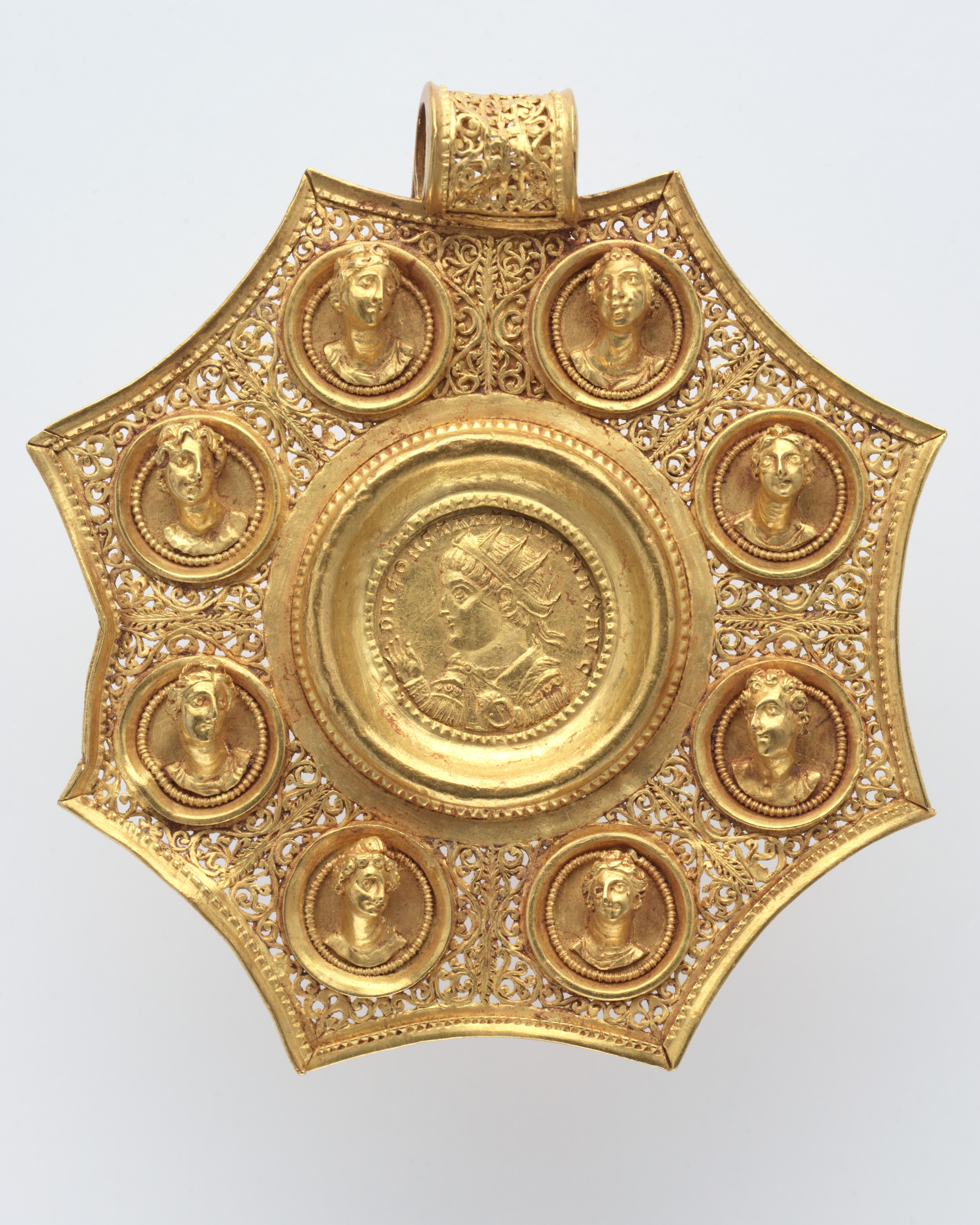
Deconstructive Analysis: The Octagonal Pendant as Temporal Rupture
In the hallowed archives of Zoey Fashion Lab, where historical artifacts are dissected not for preservation but for resurrection, the Octagonal Pendant from the Byzantine period emerges as a profound anomaly. Dated to the late Roman era and originating from the Eastern Mediterranean—likely Sirium or Nicomedia—this gold pendant defies its material constraints. It is not merely a relic; it is a temporal rupture, a fragment of a forgotten future that the Avant-garde must reclaim. The Archive Resonance, referencing the duality of a silver mirror inlaid with gold palmettes and a sarcophagus relief narrating life, provides the conceptual framework. This pendant embodies the dialectic between surface and depth, ornament and narrative, light and shadow—a tension that Zoey Fashion Lab exploits to deconstruct contemporary fashion’s obsession with the ephemeral.
Materiality as Paradox: Gold as Frozen Light
The pendant’s composition—pure gold—immediately establishes a paradox. Gold, in Byzantine theology, was not a metal but incarnate light, a substance that mediated between the earthly and the divine. Yet, the pendant’s octagonal form disrupts this sacrality. The octagon, a shape bridging the square (earth) and the circle (heaven), becomes a geometric fissure. In the Avant-garde framework, we reject gold’s historical symbolism of eternal value. Instead, we read it as a frozen scream—a material that captures the tension of a civilization in decline. The pendant’s technical execution, with its intricate goldsmithing, suggests a mastery that borders on obsessive. But for Zoey Fashion Lab, this mastery is a trap. The pendant’s beauty is a seductive lie, a distraction from the violence of its creation. The Archive Resonance’s “silver mirror” and “stone coffin” remind us that gold, when polished to a mirror finish, reflects only the surface; when hammered into relief, it tells stories of death. The pendant, therefore, is not an ornament but a memento mori—a reminder that fashion’s quest for perfection is a form of cultural embalming.
Formal Deconstruction: The Octagon as Broken Circle
The pendant’s octagonal geometry is its most subversive feature. In Byzantine art, the circle symbolized eternity, the square the material world. The octagon, as a compromise, represented the intersection of time and timelessness. However, from an Avant-garde perspective, the octagon is a broken circle—a shape that fails to close, that leaves gaps for chaos to enter. Each of the eight sides is a facet of a shattered mirror, reflecting not a unified self but a fragmented identity. This resonates with the Archive Resonance’s imagery: the “silver mirror” is a surface that reflects without depth, while the “stone coffin” is a depth that refuses reflection. The pendant, suspended between these poles, becomes a threshold object. It does not adorn the body; it dismembers it, creating a new topology where the wearer is both subject and object, alive and dead. For Zoey Fashion Lab, this pendant is a blueprint for garment construction. We must design not for the body’s contours but for its fractures. The octagon teaches us that fashion is not about covering but about exposing the gaps in our cultural armor.
Narrative Disruption: The Pendant as Palimpsest
The Archive Resonance’s reference to “palm leaves in gold on a silver mirror” and “life narrative on a stone coffin” suggests a palimpsest—a text written over another text. The pendant, with its gold inlay and relief, is a physical manifestation of this layering. In Byzantine culture, such objects were meant to stabilize meaning, to fix the wearer’s identity within a divine order. But the Avant-garde sees the pendant as a narrative disruption. The palm leaves, symbols of victory and martyrdom, are not decorative; they are scars on the mirror’s surface. The coffin’s reliefs, depicting life’s stages, are not memorials but prophecies of the wearer’s death. The pendant, therefore, is a time bomb. It carries within it the seeds of its own destruction—the tension between the eternal gold and the decaying body. Zoey Fashion Lab must harness this tension. Our designs should not tell a coherent story but fragment narratives, forcing the wearer to confront the impossibility of a unified self. The pendant is a cipher for a lost language, one that speaks of the void between ornament and meaning.
Avant-Garde Recontextualization: The Pendant as Weapon
In the hands of Zoey Fashion Lab, the Octagonal Pendant is not a historical artifact but a weapon against the tyranny of the new. The Avant-garde has long been obsessed with the future, but this pendant forces us to look backward—not with nostalgia but with violent reappropriation. The Byzantine goldsmiths, working in the shadow of Rome’s fall, created objects that were both defiant and despairing. Their gold was a shield against time, but it was also a prison. The pendant’s octagonal form, its mirror-like finish, its narrative reliefs—all are strategies for containing chaos. But chaos, as the Avant-garde knows, cannot be contained. It leaks through the cracks, through the eight sides of the octagon. For fashion, this means that our garments must be porous, allowing the outside world to intrude. The pendant teaches us that beauty is a lie we tell ourselves to avoid the truth of decay. Zoey Fashion Lab’s designs must embrace this lie, but also expose it. We will create garments that are mirrors that crack, reliefs that dissolve, gold that tarnishes. The pendant is not a model to be copied but a virus to be unleashed on the sterile body of contemporary fashion.
Conclusion: The Pendant as Threshold to the Void
The Octagonal Pendant from Byzantium is, ultimately, a threshold object. It stands at the edge of the Roman world, at the brink of the medieval, at the cusp of the divine and the mortal. For Zoey Fashion Lab, it is a portal to a new mode of design—one that rejects the binary of ornament and function, surface and depth, past and future. The Archive Resonance’s duality—mirror and coffin, palm leaf and life story—is not a contradiction but a synthesis. The pendant is both a reflection of the self and a burial of the self. It is a fashion object that negates fashion. In our Avant-garde practice, we will use this pendant as a prosthetic for the imagination, a tool to deconstruct the very idea of adornment. The gold is not valuable; it is heavy with the weight of history. The octagon is not geometric; it is a wound in space. The pendant is not beautiful; it is true. And truth, in the Avant-garde, is the most radical fashion statement of all.