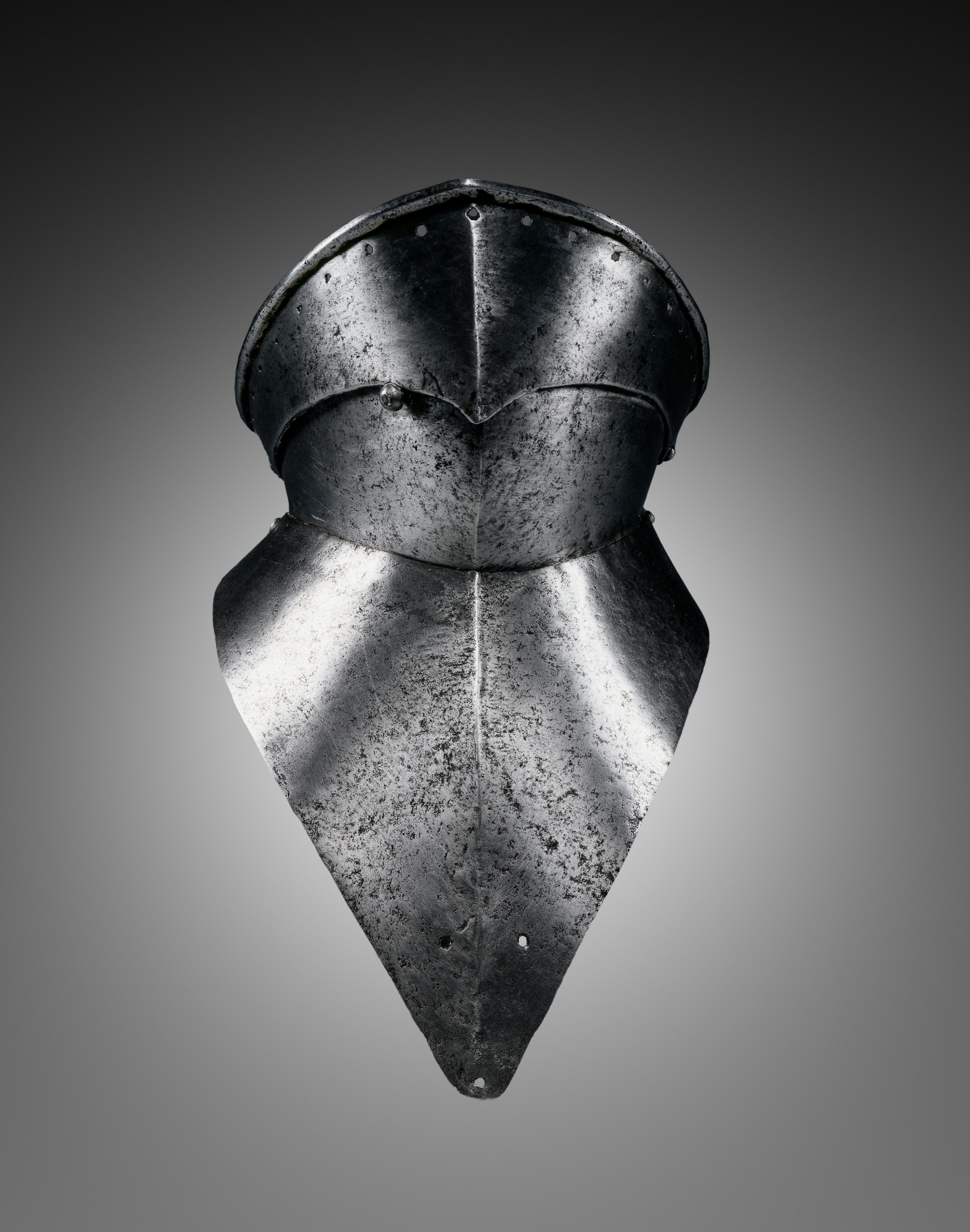
Deconstructing the Gothic Bevor: A Hispano-Flemish Steel Collar Reimagined for the Avant-Garde
At Zoey Fashion Lab, our mission is to dismantle historical artifacts of protection and power, extracting their essential DNA to forge new narratives in contemporary fashion. The subject of this analysis—a Gothic Bevor, forged in 15th-century Spain under Hispano-Flemish influence, crafted from hardened steel—presents a unique challenge. This piece is not merely armor; it is a sculptural statement of identity, a collar that once signified martial readiness and noble status. Our task is to deconstruct its technical, structural, and symbolic codes, then reassemble them into an avant-garde garment component. We call this process: New DNA Strand.
I. Historical and Technical Context: The Hispano-Flemish Bevor
The Gothic Bevor emerged during a period of intense military and artistic exchange between Spain and the Burgundian Netherlands. The Hispano-Flemish style is characterized by its fusion of Spanish robustness with Flemish decorative precision. This specific bevor—a plate that protects the chin, throat, and neck—was part of a larger harness, designed to be worn with a sallet helmet. Its primary function was defensive, but its form was deeply expressive.
Technically, the piece is forged from medium-carbon steel, heat-treated to achieve a balance of hardness and flexibility. The surface shows evidence of hammering and planishing, creating a subtle, undulating texture that catches light differently from every angle. The edges are rolled and wired for safety and rigidity, a hallmark of high-quality Flemish armorers. The bevor’s shape is a masterpiece of ergonomics: it wraps around the jawline, extends down to the collarbone, and flares outward slightly at the base to allow for head rotation. The interior would have been lined with leather or padded fabric, but the exterior is pure, unyielding metal.
Key structural features include:
- The central ridge: A pronounced vertical line that reinforces the piece and creates a sharp, angular silhouette.
- The neck flange: A flared lower edge that overlaps with the breastplate, providing seamless protection.
- The articulation points: Riveted hinges and straps that allowed the bevor to be fastened and adjusted.
II. Deconstructing the DNA: Core Elements for Avant-Garde Translation
To extract the New DNA Strand, we must identify the essential genetic markers of the Gothic Bevor that can be mutated, exaggerated, or inverted for contemporary use. These are not literal copies but rather conceptual and material essences.
1. The Collar as a Second Skin: The bevor’s primary function is to encase the neck and jaw, creating a barrier between the vulnerable human body and the external world. In avant-garde fashion, this translates to a collar that is both armor and adornment. We can reinterpret the steel’s rigidity through materials like carbon fiber, molded leather, or 3D-printed resin, maintaining the structural integrity while allowing for organic, irregular forms.
2. The Geometry of Power: The bevor’s sharp central ridge and flared base create a powerful, almost architectural silhouette. This geometry—triangular, angular, and asymmetrical—can be abstracted. Imagine a collar that extends into sharp, wing-like projections over the shoulders, mimicking the bevor’s protective flare but rendered in translucent, laser-cut acrylic or polished aluminum. The ridge becomes a spine of light, a conductive channel for embedded LEDs or reflective surfaces.
3. The Tension Between Rigidity and Movement: The historical bevor allowed for limited head movement, but its primary purpose was to restrict vulnerable motions. In our avant-garde strand, we can explore this tension through kinetic elements. Hinges and rivets become design features, not just functional necessities. We can create a collar that shifts shape when the wearer moves, using memory alloys or flexible lattice structures that stiffen or relax based on posture.
4. The Surface as Narrative: The hammered texture of the steel is a record of the armorer’s labor. In our translation, the surface becomes a canvas for digital or manual mark-making. Imagine a bevor-like collar with a surface of hand-painted enamel, or one that is chemically etched with patterns that reference both heraldic symbols and modern data streams. The patina of age can be simulated through oxidized finishes or layered resin that mimics rust and wear.
III. The Avant-Garde Reassembly: A New DNA Strand for Zoey Fashion Lab
Our proposed design—codenamed “Bevor 2.0: The Cervical Envelope”—is not a reproduction but a mutation. It takes the core genetic material of the Gothic Bevor and splices it with contemporary technology and subversive aesthetics.
Materiality: We replace steel with a composite of carbon fiber and titanium mesh, creating a piece that is incredibly strong yet lightweight. The interior is lined with a shape-memory foam that molds to the wearer’s neck, offering a personalized fit. The exterior is coated in a matte black nano-ceramic that is both scratch-resistant and heat-sensitive, changing color with body temperature.
Form and Silhouette: The central ridge is exaggerated into a high, asymmetrical fin that rises above the head, resembling a crest or a blade. The neck flange is extended and fragmented into a series of overlapping, petal-like plates that cascade down the chest and back. These plates are connected by exposed, industrial hinges that allow for dramatic articulation. The overall shape is both protective and predatory, evoking the exoskeleton of an insect or the hood of a cobra.
Function and Interaction: The collar is designed to be worn as a standalone piece over a bare neck or integrated into a garment. It features magnetic closures at the back for easy fastening. Embedded within the fin are micro-LEDs that pulse in response to the wearer’s heartbeat, detected by a sensor in the lining. The surface also incorporates conductive threads that can transmit data to a smartphone, turning the collar into a wearable interface.
Symbolic Reinterpretation: The original bevor was a symbol of military readiness and social hierarchy. Our version subverts this by making the armor vulnerable and expressive. The heat-sensitive coating reveals the wearer’s emotional state. The open, fragmented plates expose the neck rather than hiding it, creating a paradox of protection and exposure. The piece becomes a statement about the armor we wear in contemporary society—the psychological and digital barriers we construct.
IV. Conclusion: The Future of Armor as Fashion
The Gothic Bevor, in its original form, is a relic of a bygone era of chivalry and violence. But through the lens of Zoey Fashion Lab’s New DNA Strand methodology, it becomes a living, evolving concept. By deconstructing its technical and symbolic codes, we have created a blueprint for an avant-garde collar that is at once historical and futuristic, protective and expressive, rigid and fluid. This is not just fashion; it is wearable sculpture that interrogates the boundaries of the body, technology, and identity.
The Cervical Envelope is a prototype for a new kind of armor—one that does not defend against swords and arrows, but against the invisible forces of modern life: surveillance, anxiety, and the pressure to conform. In this strand, the steel of the 15th century is reborn as a neural exoskeleton, a second skin for the digital age. This is the future of deconstruction at Zoey Fashion Lab.