Deconstructing the Archive: A Zoey Fashion Lab Analysis of the Isfahan Silk Textile
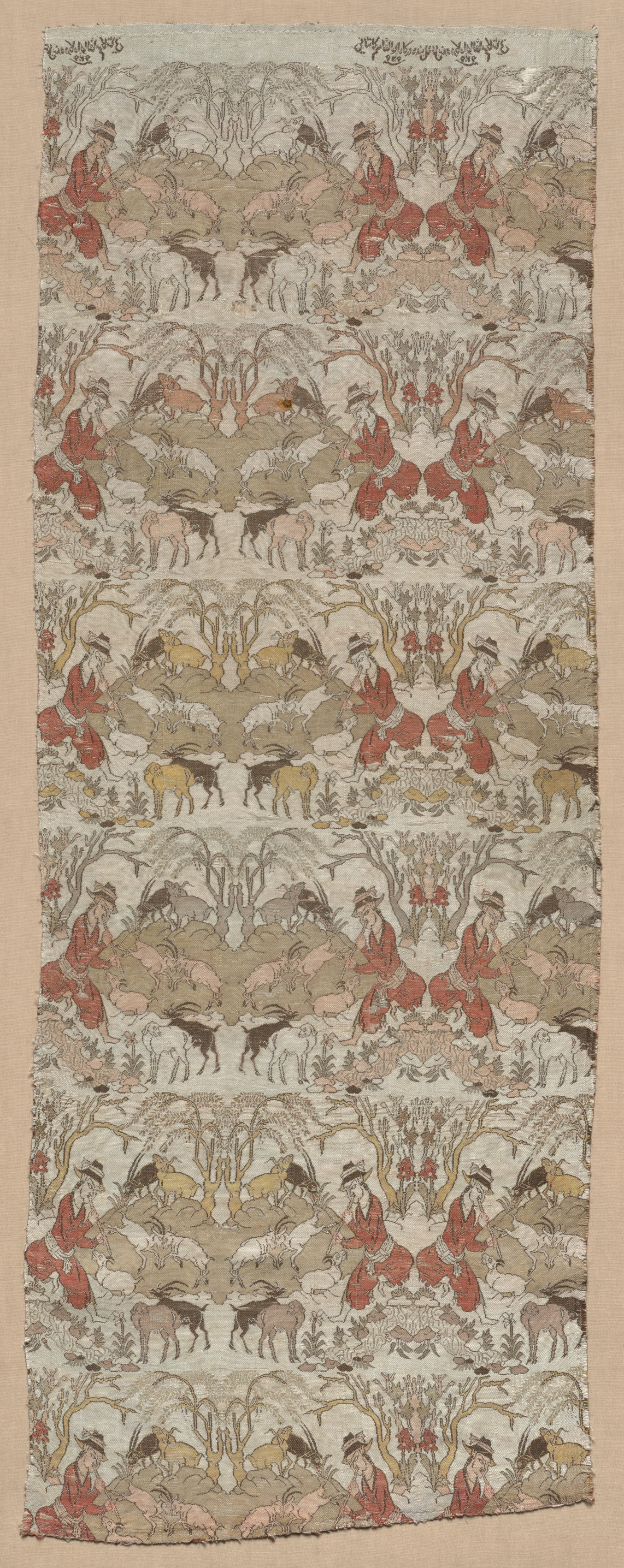
At Zoey Fashion Lab, our mission is to dismantle the historical artifact and reassemble it as a catalyst for avant-garde design. The subject of this analysis—a 16th-17th century Iranian silk textile from Isfahan, depicting goatherds in a pastoral landscape—is not merely a relic. It is a codex of cultural collision, technical mastery, and aesthetic subversion. Through the lens of Archive Resonance, we deconstruct its material, narrative, and symbolic layers to extract principles that can inform a radical, future-facing fashion language.
Technical Foundation: The Loom as a Subversive Instrument
The textile employs a lampas weave for the silk ground, a technique that creates a complex, multi-layered structure. This is not a simple weave; it is a matrix of floating warps and wefts that allow for intricate, polychromatic patterns. The lampas weave, historically used for opulent courtly garments and furnishings, is a testament to the weaver’s ability to control light and texture. The silk itself—a protein fiber that captures and refracts light—becomes a medium for visual depth. The lining, a twill tapestry with double-locked joins, is equally significant. Twill tapestry, often associated with robust, utilitarian textiles, is here used as a hidden counterpoint. The double-locked join is a structural innovation that prevents unraveling, ensuring the textile’s integrity. This duality—the luminous, aristocratic face versus the resilient, hidden back—is a precursor to the avant-garde concept of exposing the construction process. In our practice, we would invert this: the twill tapestry could be brought to the surface, its rugged texture and locked seams becoming a deliberate, deconstructive statement.
Narrative and Symbolism: The Goatherd as a Disruptive Protagonist
The iconography of goatherds in a landscape is a deliberate departure from the typical Safavid courtly scenes of hunting, feasting, or princely repose. Goatherds, in the context of 16th-17th century Iran, represent the pastoral, the nomadic, and the liminal. They are figures who exist at the edges of settled society, tending animals that are both sustenance and symbol. The goat, in Persian culture, is associated with vitality, independence, and even the demonic (the "goat of the desert" in Zoroastrian lore). By centering these figures, the textile subverts the hierarchical gaze of the court. The landscape itself—likely a stylized representation of the Zagros Mountains or the plains around Isfahan—is not a backdrop but an active participant. The goatherds are in motion, their staffs and flocks creating a rhythmic, almost choreographed composition. This is not a static pastoral idyll; it is a narrative of labor, migration, and survival. For the avant-garde, this is a powerful metaphor: the marginalized figure, the worker, the wanderer, becomes the focal point of luxury. We can translate this into a collection where the "worker" archetype—the artisan, the migrant—is celebrated through exaggerated silhouettes, utilitarian details, and a palette of earth tones punctuated by the iridescence of silk.
Cultural Collision: The Safavid Cosmopolitanism
The textile’s origin in Isfahan, the Safavid capital under Shah Abbas I, is crucial. Isfahan was a melting pot of cultures: Persian, Turkic, Armenian, Chinese, and European influences converged in its bazaars and workshops. The lampas weave itself owes debts to Chinese silk techniques, while the narrative of pastoral life echoes earlier Persian manuscript paintings and even European pastoral motifs that filtered through trade routes. This is not a pure "Iranian" artifact; it is a hybrid, a product of global exchange. The goatherds, in their stylized robes and hats, might wear fabrics that hint at Indian or Ottoman designs. The landscape might incorporate Chinese cloud bands or European perspectival hints. This cultural collision is the textile’s true avant-garde quality: it refuses a singular identity. In fashion, this translates to a rejection of purism. We can design garments that layer motifs from disparate sources—a Safavid-inspired sleeve with a deconstructed European corset, a Chinese silk brocade patch on a utilitarian twill base. The result is not pastiche but a deliberate, critical dialogue.
Archive Resonance: The Silent Witness
The Archive Resonance statement—"在人类文明的长河中,器物与绘画不仅是时代技艺的结晶,更是文化碰撞与美学交融的无声见证"—positions this textile as a silent witness to history. It has survived centuries, its threads holding the memory of the weaver’s hands, the merchant’s journey, the collector’s gaze. The "silent witness" is a powerful concept for the avant-garde. We can imagine a garment that bears the marks of time: frayed edges, faded dyes, deliberate repairs. The double-locked join of the lining becomes a visible scar, a testament to resilience. The goatherds’ gaze, directed outward from the textile, challenges the viewer to acknowledge their presence. In a fashion context, this could manifest as a garment that "looks back" at the wearer—through asymmetrical cuts, mirrored panels, or embedded digital interfaces that record and reflect the environment. The textile becomes a living archive, not a static object.
Avant-Garde Translation: Principles for Zoey Fashion Lab
From this analysis, we extract the following design principles:
1. Structural Inversion: The lampas weave’s complexity and the twill tapestry’s ruggedness should be reversed. The hidden becomes visible. Use twill tapestry as the primary fabric, with silk lampas as a lining or accent. The double-locked join can be exaggerated into a visible, structural seam that becomes a design feature.
2. Narrative of the Marginalized: The goatherd is the protagonist. Design silhouettes that evoke labor and movement: loose, layered trousers, oversized tunics with multiple pockets, and headpieces that reference nomadic headscarves. Use earthy tones—ochre, umber, sage—punctuated by the luminous sheen of silk.
3. Cultural Hybridity: The textile’s cosmopolitanism demands a layered approach. Combine Persian-inspired geometric patterns with Chinese cloud motifs and European Renaissance floral elements. Use digital printing to create a "collage" effect, where different cultural references are superimposed, not blended.
4. Archive as Material: The textile’s age and wear should be simulated or celebrated. Use techniques like shibori, chemical fading, and intentional fraying to create a "patina of time." The double-locked join can be reinterpreted as a zipper or a series of visible knots, referencing the textile’s construction.
5. The Gaze of the Object: The goatherds’ outward gaze can be translated into a design that engages the viewer. This could be achieved through asymmetric hemlines that create a sense of movement, or through the use of reflective materials that mirror the environment. The garment becomes a participant in the space, not just a covering.
Conclusion: From Archive to Avant-Garde
The Isfahan silk textile is not a museum piece; it is a blueprint for disruption. Its technical mastery, narrative subversion, and cultural hybridity offer a rich vocabulary for the avant-garde. At Zoey Fashion Lab, we do not seek to replicate the past. We deconstruct it, extract its radical potential, and weave it into garments that challenge, provoke, and transform. The goatherd, the weaver, the silk, and the twill—all become agents in a new fashion narrative, one that honors the silent witness of history while speaking in the urgent, fragmented language of the future.