Deconstructing the Avant-Garde Cuff: A Technical and Cultural Analysis
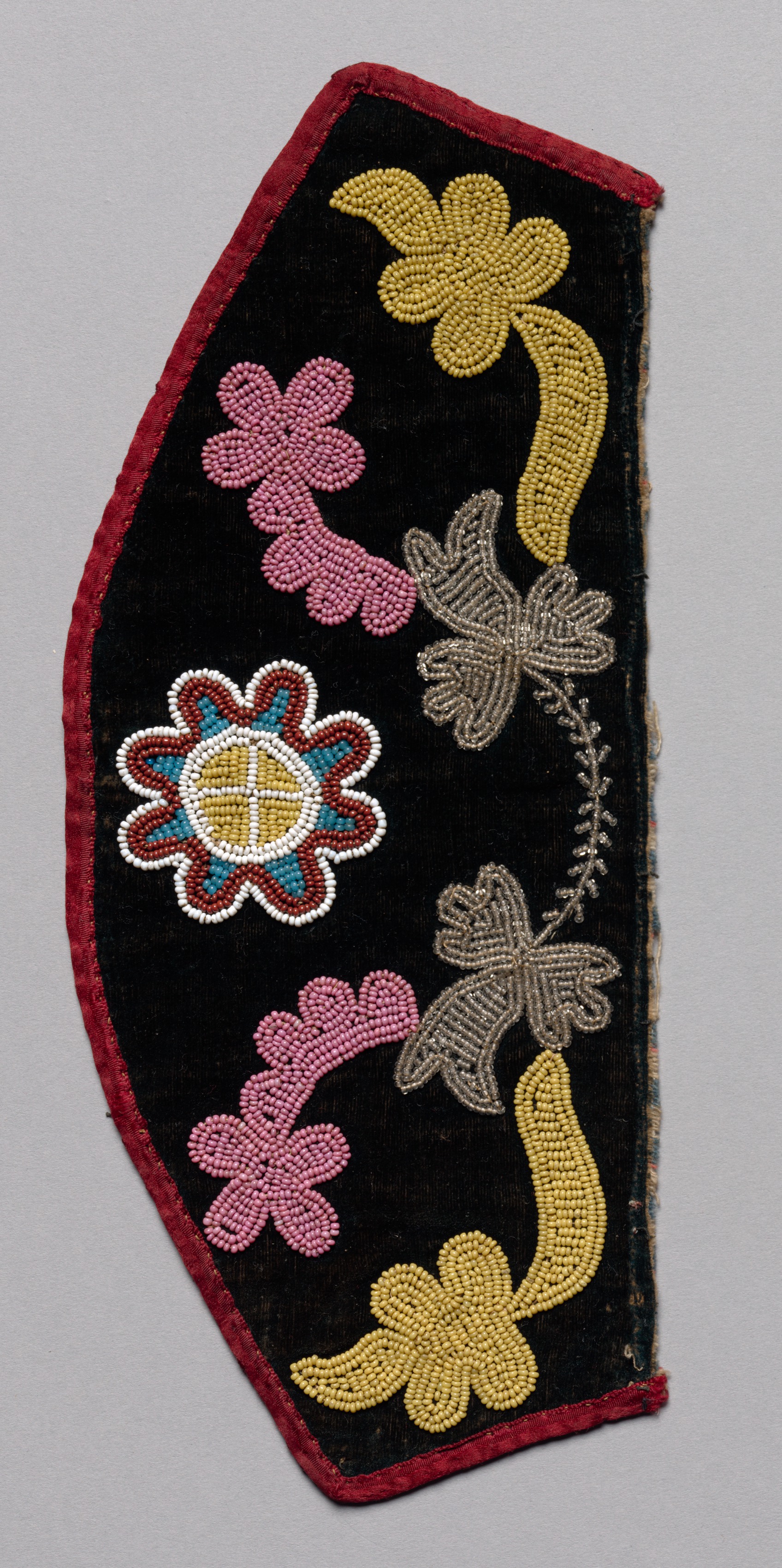
At Zoey Fashion Lab, the role of the Chief Fabric Deconstructionist is to interrogate the intersection of materiality, cultural heritage, and speculative design. The subject of this analysis is a cuff of potential Anishinaabe (Ojibwe) or Nehiyawak (Cree) origin from the Northeast Woodlands and Great Lakes Region. Its technical composition—velvet, satin, and glass beads—presents a paradox: a traditional object rendered in luxurious, imported materials. When viewed through the lens of the "New DNA Strand" reference, this cuff transforms into an avant-garde artifact that challenges linear narratives of craft, colonization, and fashion. This analysis will deconstruct its material components, cultural context, and speculative potential as a fragment of a future fashion genome.
Material Deconstruction: Velvet, Satin, and Glass Beads
Velvet serves as the foundational substrate of this cuff. Historically, velvet was a high-status fabric in European courts, made from silk and requiring complex weaving techniques. Its use by Indigenous peoples of the Great Lakes region, particularly after trade with Europeans, signifies a strategic adoption of foreign materials for local aesthetic and ceremonial purposes. In this cuff, the velvet’s deep pile and rich color (likely black or deep crimson) create a tactile contrast to the smooth satin. The velvet absorbs light, giving the cuff a sense of gravity and depth. From a deconstructionist perspective, velvet is not merely a background; it is a site of tension—a material that both conceals and reveals. Its nap can be crushed or brushed to create patterns, suggesting a dynamic surface that responds to touch and wear.
Satin, often used as a lining or accent, introduces a different textural language. Its glossy, reflective surface plays with light, creating a shimmer that contrasts with velvet’s matte absorption. In traditional Anishinaabe and Cree beadwork, satin ribbons were sometimes incorporated into garments and accessories, particularly after the introduction of European trade goods. The satin in this cuff likely serves as a structural element, stabilizing the beadwork while adding a fluid, almost liquid quality. Its synthetic or silk composition (depending on the era) further complicates the object’s material identity. Is it a sign of adaptation, or a marker of colonial entanglement? For the avant-garde, satin’s sheen can be read as a critique of surface-level beauty—a reminder that the most seductive materials often hide complex histories of exchange and appropriation.
Glass beads are the most potent element in this cuff. These tiny, mass-produced objects became a cornerstone of Indigenous artistic expression in the 19th and 20th centuries. The beadwork on this cuff likely follows geometric or floral patterns, referencing Anishinaabe and Cree visual languages. However, the glass beads themselves are not "traditional" in a pre-contact sense; they are products of European industry. Their presence on velvet and satin creates a hybrid materiality that defies easy categorization. In the context of the "New DNA Strand," these beads can be seen as data points—a code that carries cultural memory, trade routes, and aesthetic choices. Each bead is a nucleotide in a larger genetic sequence of fashion, linking the wearer to a network of makers, traders, and colonial forces.
Cultural and Geographic Context: Anishinaabe and Nehiyawak Cuff Traditions
The cuff is a common accessory in both Anishinaabe (Ojibwe) and Nehiyawak (Cree) cultures, often worn during ceremonies, powwows, or as part of regalia. Its placement on the wrist—a site of pulse, action, and adornment—makes it a powerful symbol of identity and resilience. However, determining the specific origin of this cuff requires careful analysis of beadwork patterns. Anishinaabe beadwork frequently features floral motifs, often with symmetrical designs and a preference for clear or white backgrounds. Nehiyawak beadwork may incorporate more geometric patterns, such as diamonds or stepped lines, and often uses darker backgrounds. The velvet base here could suggest a Nehiyawak preference for rich, dark fabrics, while the satin lining might indicate Anishinaabe influence from trade with French or British settlers.
This ambiguity is not a weakness but a strength for avant-garde analysis. The cuff becomes a "New DNA Strand"—a hybrid artifact that refuses to be pinned down to a single lineage. It embodies the fluidity of cultural exchange in the Great Lakes region, where borders were porous and materials traveled vast distances. The velvet, satin, and glass beads are not just materials; they are evidence of a complex genetic code of adaptation, survival, and creativity. In the language of fashion deconstruction, this cuff is a mutant—a beautiful anomaly that challenges the purity of cultural categories.
The "New DNA Strand" Reference: Speculative Fashion Genetics
The "New DNA Strand" is a conceptual tool for reimagining fashion objects as living, evolving entities. In this framework, the cuff is not a static artifact but a genetic sequence that can be read, edited, and recombined. The velvet is the backbone, providing structure and depth. The satin is the coding region, adding flexibility and shine. The glass beads are the exons—the expressed traits that carry meaning. Together, they form a strand that encodes stories of trade, colonization, and artistic innovation.
For an avant-garde fashion lab, this cuff can be deconstructed and recombined into new forms. Imagine isolating the beadwork pattern and translating it into a digital code for 3D-printed jewelry. Or extracting the velvet’s texture and layering it with biodegradable polymers to create a living garment. The satin’s sheen could be replicated in holographic films that respond to light. The "New DNA Strand" approach allows us to see this cuff as a prototype for a future where fashion is both ancestral and algorithmic, rooted in tradition yet open to mutation.
Avant-Garde Implications: The Cuff as a Fragment of Future Fashion
In the avant-garde context, this cuff is a fragment of a larger, unfinished narrative. Its velvet, satin, and glass beads are not relics but catalysts. They challenge the fashion industry to reconsider its relationship with Indigenous materials and techniques. Too often, Indigenous craft is appropriated without acknowledgment, reduced to a "trend" or "aesthetic." This analysis insists that the cuff be seen as a complex, living document—a strand of DNA that carries the weight of history and the potential for transformation.
As Chief Fabric Deconstructionist, I propose that Zoey Fashion Lab use this cuff as a starting point for a speculative collection. Each garment could be a "gene" that expresses a different aspect of the cuff’s materiality: a velvet dress with satin seams that glow under UV light, a beadwork pattern that maps trade routes, or a cuff that incorporates sensors to track the wearer’s pulse—a literal heartbeat of cultural memory. The goal is not to replicate the original but to honor its complexity by evolving it into new forms.
In conclusion, this cuff from the Northeast Woodlands is a masterclass in material and cultural hybridity. Its velvet, satin, and glass beads are not just components; they are characters in a story of survival and creativity. When viewed through the "New DNA Strand" lens, the cuff becomes a blueprint for an avant-garde fashion that is both deeply rooted and radically futuristic. At Zoey Fashion Lab, we do not preserve the past; we deconstruct it to build the future.