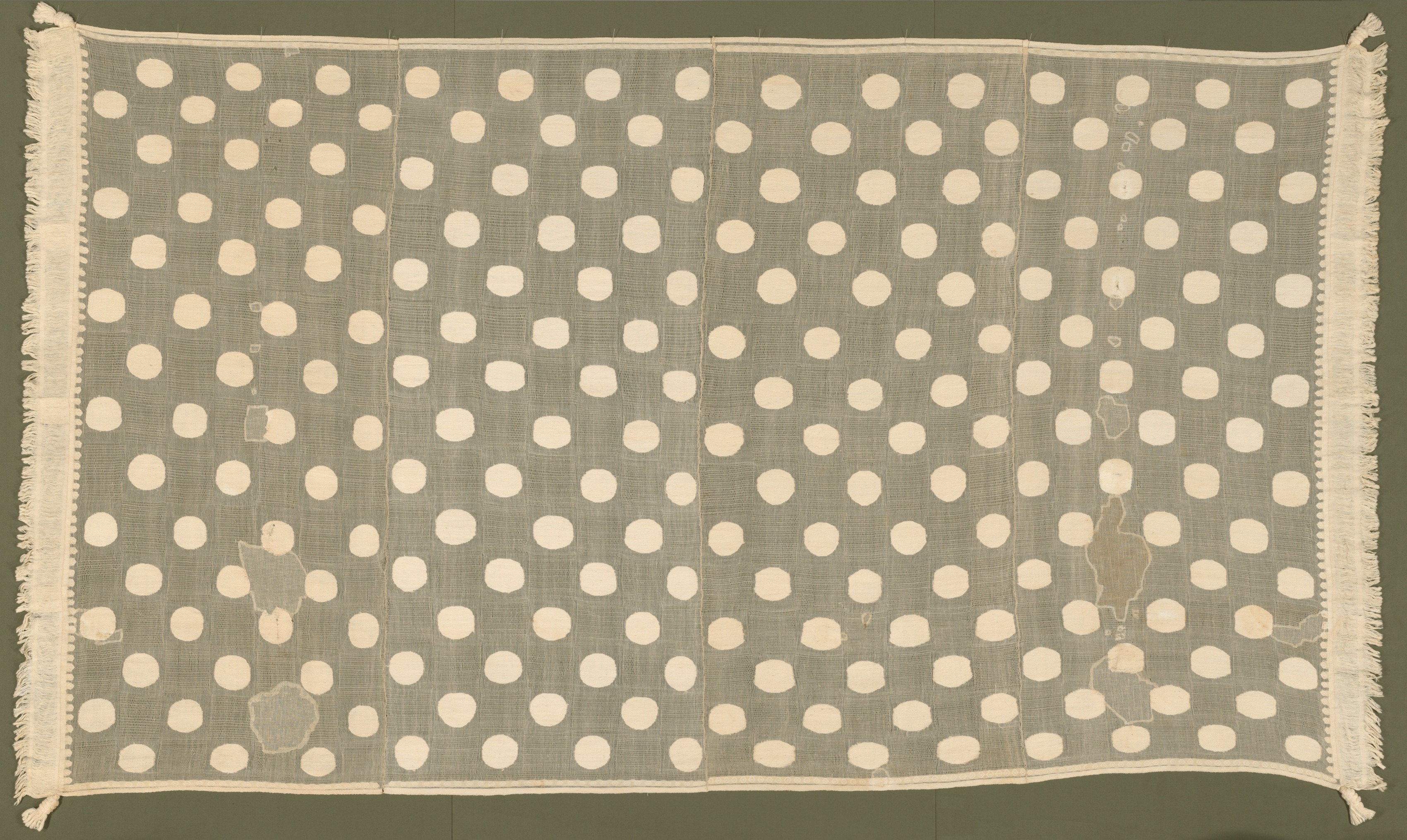
Deconstructing the Chimú Codex: An Avant-Garde Reading of Pre-Columbian Textile Technologies
In the relentless pursuit of new formal languages, Zoey Fashion Lab turns its gaze not to the future, but to the deep, material intelligence of the past. The subject of this analysis—a suite of Chimú-style textile artifacts from the North Coast of Peru (1200-1460s)—offers a radical blueprint for avant-garde design. These are not mere garments or decorative hangings; they are sophisticated, three-dimensional structural systems articulated in cotton. Our deconstruction will focus on the technical innovations of complex alternating gauze and brocading, revealing how these ancient weavers engineered fabric with a logic that prefigures contemporary modularity, transparency, and kinetic tension.
I. The Artifact Suite: Beyond Categorization
The collection comprises a Mantle or Hanging, a Loincloth, a Turban, a Padded Hat, and a Band with Tassels. In a conventional historical analysis, these items would be classified by function: ritual covering, status marker, or bodily adornment. For Zoey Fashion Lab, we read them as a unified system of architectonic fragments. The mantle is a planar field; the loincloth, a kinetic drape; the turban and padded hat, volumetric sculptures; the band with tassels, a dynamic edge condition. The Chimú artisan did not see these as separate items but as a cohesive vocabulary of form, tension, and release. This holistic approach is the first lesson for the avant-garde: design is a relational system, not a collection of objects.
II. Technical Core: The Radicality of Complex Alternating Gauze
The most significant innovation is the complex alternating gauze structure, executed in cotton with 3 or 5 shots of plain weave between gauze shots. This is not a simple lace or openwork. It is a deliberate, engineered play of density and void. The plain weave intervals create stable, opaque fields—a "ground" of solid fabric. The gauze shots, by contrast, involve the systematic twisting of warp threads around each other, creating a locked, transparent, and structurally rigid grid.
Deconstructing the Gauze Logic:
- Alternation as Rhythm: The 3:1 or 5:1 ratio of plain weave to gauze is not random. It establishes a pulse. This rhythmic alternation creates a visual and tactile beat, a kind of textile meter. For the avant-garde designer, this is a direct precedent for parametric patterning—a rule-based system where variation is generated by a simple numerical shift. Changing from 3 to 5 shots alters the fabric's transparency, weight, and drape, offering a tunable spectrum of material behavior.
- Structural Tension: The twisted warps of the gauze are under constant tension. They want to return to a straight state, creating a fabric that is inherently pre-stressed. This is a profound concept: the fabric is not a passive sheet but an active, self-tensioning membrane. This pre-stress allows the fabric to hold complex, three-dimensional shapes without internal armatures. The padded hat and turban are not merely stuffed; they are shaped by the inherent structural logic of the gauze itself.
- Brocading as Counterpoint: The brocaded patterns—supplementary wefts that float over the ground weave—are not mere decoration. They are counter-structures. While the gauze creates transparency and tension, the brocading introduces opacity and mass. This creates a dialectic between the open, structural grid and the dense, figurative surface. The brocading becomes a "skin" that can be read against the "skeleton" of the gauze, a layering of information that is both visual and tactile.
III. From Artifact to Avant-Garde: Design Principles for Zoey Fashion Lab
We extract four core principles from the Chimú textile system, each a direct challenge to conventional fashion design:
1. The Fabric as a Structural System, Not a Surface:
Modern fashion often treats fabric as a 2D canvas to be cut and draped. The Chimú approach treats the fabric itself as a load-bearing structure. The alternating gauze is a truss system in textile form. For Zoey Fashion Lab, this means designing the weave before the garment. The pattern is not printed on the surface; it is the surface. We must design the internal logic of the fabric—its tension, transparency, and rigidity—as the primary generative act. A garment cut from a 3:1 gauze will behave fundamentally differently from one cut from a 5:1 gauze. The weave is the architecture.
2. Transparency as a Material, Not a Visual, Property:
In contemporary design, transparency is often a visual effect—sheer fabrics, cutouts, or digital prints. The Chimú gauze achieves transparency through structural displacement. The warp threads are physically moved aside, creating a hole that is locked in place. This is a material transparency, where the void is as engineered as the fiber. For the avant-garde, this suggests a new category: architectural transparency in dress. Garments can be designed with zones of structural openness that are not fragile but are, in fact, the strongest parts of the fabric. The void becomes a structural element.
3. The Edge as a Site of Performance:
The Band with Tassels is a critical element. The tassels are not mere fringe; they are a terminal condition of the fabric's structural logic. They dissipate the tension of the woven field, converting the rigid grid into a cascade of loose, kinetic threads. This is a profound lesson in edge behavior. In avant-garde design, the edge of a garment is often a site of finishing or hemming. The Chimú approach treats the edge as a dynamic transition zone, where the fabric's internal structure is allowed to unravel into performance. Tassels, loops, and fringes become energy outlets for the pre-stressed textile system.
4. Volume Through Tension, Not Stuffing:
The Padded Hat and Turban appear to be volumetric, but their volume is not solely achieved by padding. The gauze's inherent tension allows it to be shaped into complex, self-supporting forms. The "padding" is a secondary element that works in concert with the fabric's structural memory. This suggests a new paradigm for volumetric fashion: instead of building volume through layers of stiffening or padding, we can design fabrics that are self-sculpting. By controlling the ratio of plain weave to gauze, we can create zones of varying rigidity, allowing a single piece of fabric to curve, stand, and drape in a controlled manner.
IV. Archive Resonance: A Dialogue Across Time
The reference to "Archive Resonance" and the "sixteenth to seventeenth centuries" is not a distraction but a crucial framing. The Chimú textiles were produced before the Spanish conquest, but their technical sophistication was not lost. They entered a new global system of exchange and influence. For Zoey Fashion Lab, this resonance is a call to action. We are not simply reviving an ancient technique; we are reactivating a technological lineage. The Chimú weaver's understanding of tension, rhythm, and structural transparency is a direct ancestor to contemporary interests in parametric design, kinetic textiles, and material computation.
The Chimú mantle is not a relic. It is a working prototype for a fashion system that prioritizes material logic over surface decoration. In an age of digital simulation and synthetic materials, the Chimú approach offers a return to a tectonic honesty—a design philosophy where the structure is the ornament, the void is a strength, and the edge is a performance.
V. Conclusion: A New Material Manifesto
Zoey Fashion Lab proposes a new manifesto derived from the Chimú textile codex:
- Design the weave, not the garment.
- Let the void be a structural element.
- Treat the edge as a dynamic system.
- Engineer volume through tension.
- Embrace rhythm as a generative principle.
The Chimú artisans, working with only cotton and the simplest of looms, achieved a level of material intelligence that challenges our most advanced digital design tools. Their legacy is not a style to be copied, but a methodology to be decoded. For the avant-garde, the path forward may lie not in the future, but in the forgotten complexity of the pre-Columbian past. The mantle is a message, and we are only beginning to read it.