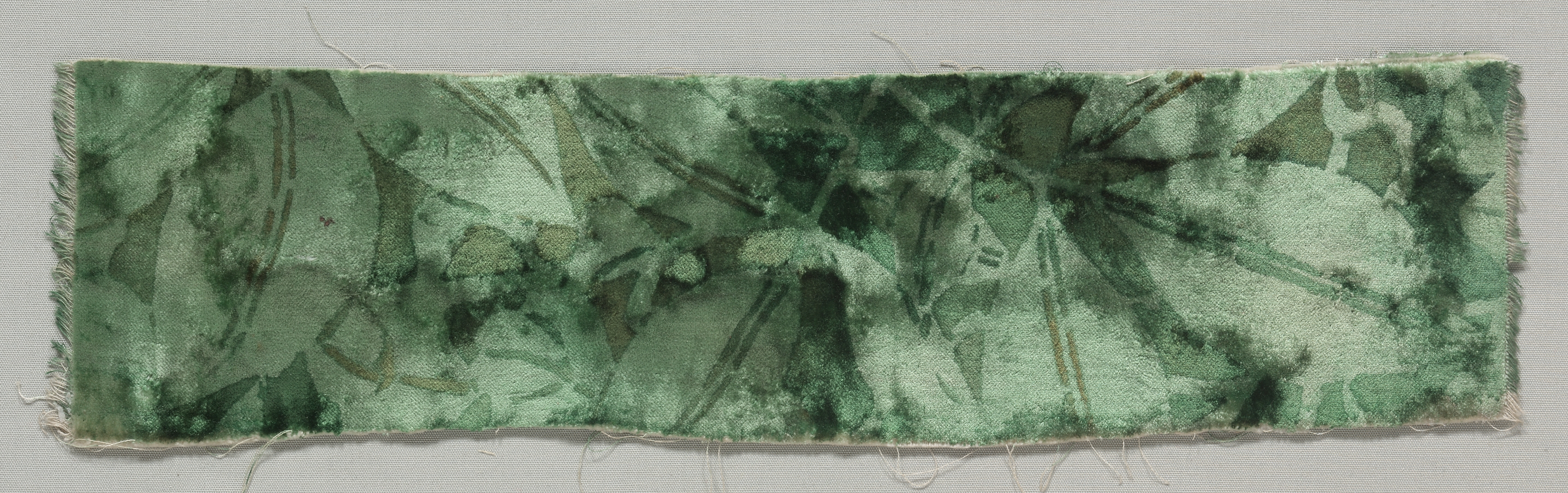
Deconstructing the Stenciled Velvet: An Avant-Garde DNA Strand from New York
As the Chief Fabric Deconstructionist for Zoey Fashion Lab, I have the distinct privilege of dissecting materials that challenge the very boundaries of textile art. Our latest subject, a piece of Stenciled Velvet originating from New York, presents a fascinating paradox. It is a fabric that speaks of historical craft while simultaneously embodying a futuristic, avant-garde aesthetic. This analysis will deconstruct its technical composition, its stylistic implications, and its conceptual resonance as a "New DNA Strand" for the fashion industry.
Technical Deconstruction: The Alchemy of Vegetable Dyes on Silk
At its core, this fabric begins with a foundation of plain silk cloth. Silk, a protein fiber, is inherently receptive to dyes, but its smooth, lustrous surface presents a unique challenge for stenciling. The choice of silk is deliberate; it allows for a high degree of color vibrancy and a subtle, organic sheen that synthetics cannot replicate. The stenciling process itself is a meticulous art, requiring the application of a resist or a direct dye paste through a cut-out design. In this case, the use of vegetable dyes elevates the fabric from mere textile to a botanical artifact. These dyes—derived from roots, leaves, and barks—interact with the silk in a non-uniform manner, creating slight variations in tone and saturation. This imperfection is not a flaw but a signature of authenticity, a hand-made quality that mass-produced digital prints lack.
The "velvet" descriptor adds another layer of complexity. True velvet is woven with a pile, but here, the term likely refers to the visual and tactile illusion of velvet achieved through the stenciling technique. The vegetable dyes, when applied in dense, overlapping patterns, can mimic the depth and shadow of cut pile. The stenciled motifs—perhaps geometric or organic—create a topography of light and dark. When viewed under magnification, the dye particles are absorbed into the silk fibers, leaving the un-dyed areas in stark relief. This creates a micro-texture that feels almost three-dimensional. The result is a fabric that is simultaneously flat and deep, a paradox that defines its avant-garde nature.
Stylistic Analysis: Avant-Garde as a State of Being
The style classification of Avant-garde is not merely a label but a philosophical stance. This Stenciled Velvet rejects the uniformity of industrial production. In an era of fast fashion and digital replication, this fabric demands attention through its deliberate imperfection. The stenciled patterns, likely asymmetrical or intentionally misaligned, suggest a rejection of symmetry as a design principle. The vegetable dyes, with their inherent variability, ensure that no two garments cut from this fabric will be identical. This aligns perfectly with the avant-garde ethos of individuality over conformity.
From a design perspective, this fabric is a tool for deconstructive silhouettes. Its visual weight and textural complexity make it ideal for garments that challenge the human form. Imagine a dress that drapes like liquid shadow, where the stenciled patterns create optical illusions of movement. Or a jacket that appears to be carved from a single piece of organic matter, with the dye acting as a topographical map. The avant-garde designer would not simply cut and sew; they would sculpt and manipulate, using the fabric's inherent contradictions to create tension between structure and flow. The stenciled motifs could be aligned to form a narrative across seams, or deliberately broken to suggest fragmentation.
Conceptual Resonance: The "New DNA Strand" for Fashion
The reference to a New DNA Strand is the most provocative element of this analysis. In biological terms, DNA is the blueprint for life. In fashion, a "DNA strand" suggests a foundational code that dictates a garment's identity, construction, and evolution. This Stenciled Velvet operates as a mutant genetic sequence. It takes the traditional code of silk (luxury, smoothness) and the code of velvet (opulence, depth) and recombines them through the stenciling process. The vegetable dyes act as the epigenetic markers, altering the expression of the fabric without changing its core structure.
This fabric represents a paradigm shift from mass production to individualized creation. Each stenciled piece is a unique iteration, much like a genetic mutation that leads to a new species. For Zoey Fashion Lab, this fabric is a tool for bio-inspired design. The patterns themselves could be derived from microscopic imagery of cellular structures or botanical cross-sections. The vegetable dyes reinforce this biological connection, creating a closed-loop system where the material is both derived from and inspired by nature. The avant-garde designer can use this fabric to explore themes of growth, decay, and regeneration, creating garments that appear to be alive, breathing, and evolving.
Implications for Zoey Fashion Lab
For our lab, this Stenciled Velvet is not just a material; it is a philosophical manifesto. It challenges us to rethink the relationship between technology and craft. While digital printing offers precision, this fabric offers soul. Its imperfections are its strengths. We must approach its construction with a mindset of controlled chaos. The cutting and sewing processes must honor the hand-made quality of the stencil. Seams should be exposed or deliberately placed to highlight the pattern's discontinuity. The garment should not hide its construction but celebrate it as part of the narrative.
Furthermore, this fabric demands a new vocabulary of design. We cannot apply traditional draping techniques designed for smooth, uniform textiles. Instead, we must work with the fabric's inherent unpredictability. The stenciled patterns may shift during cutting, requiring the designer to adapt in real-time. This is a collaborative process between the fabric and the maker, a dialogue where the material speaks and the designer listens. The final garment will be a living document of this interaction, a testament to the avant-garde belief that fashion is not about covering the body but about expressing the soul.
Conclusion: A New Lexicon for Textile Art
In conclusion, this Stenciled Velvet from New York is a masterclass in deconstructive artistry. Its technical foundation of plain silk and vegetable dyes creates a canvas for imperfection, while its avant-garde style invites radical reinterpretation. As a "New DNA Strand," it offers a blueprint for a future where fashion is personal, organic, and deeply connected to the natural world. For Zoey Fashion Lab, this fabric is not a product but a provocation. It challenges us to deconstruct our own assumptions about beauty, uniformity, and the very definition of fabric itself. We will continue to explore its potential, knowing that each cut, each seam, and each stitch is an act of genetic recombination, creating something entirely new from the threads of the past.