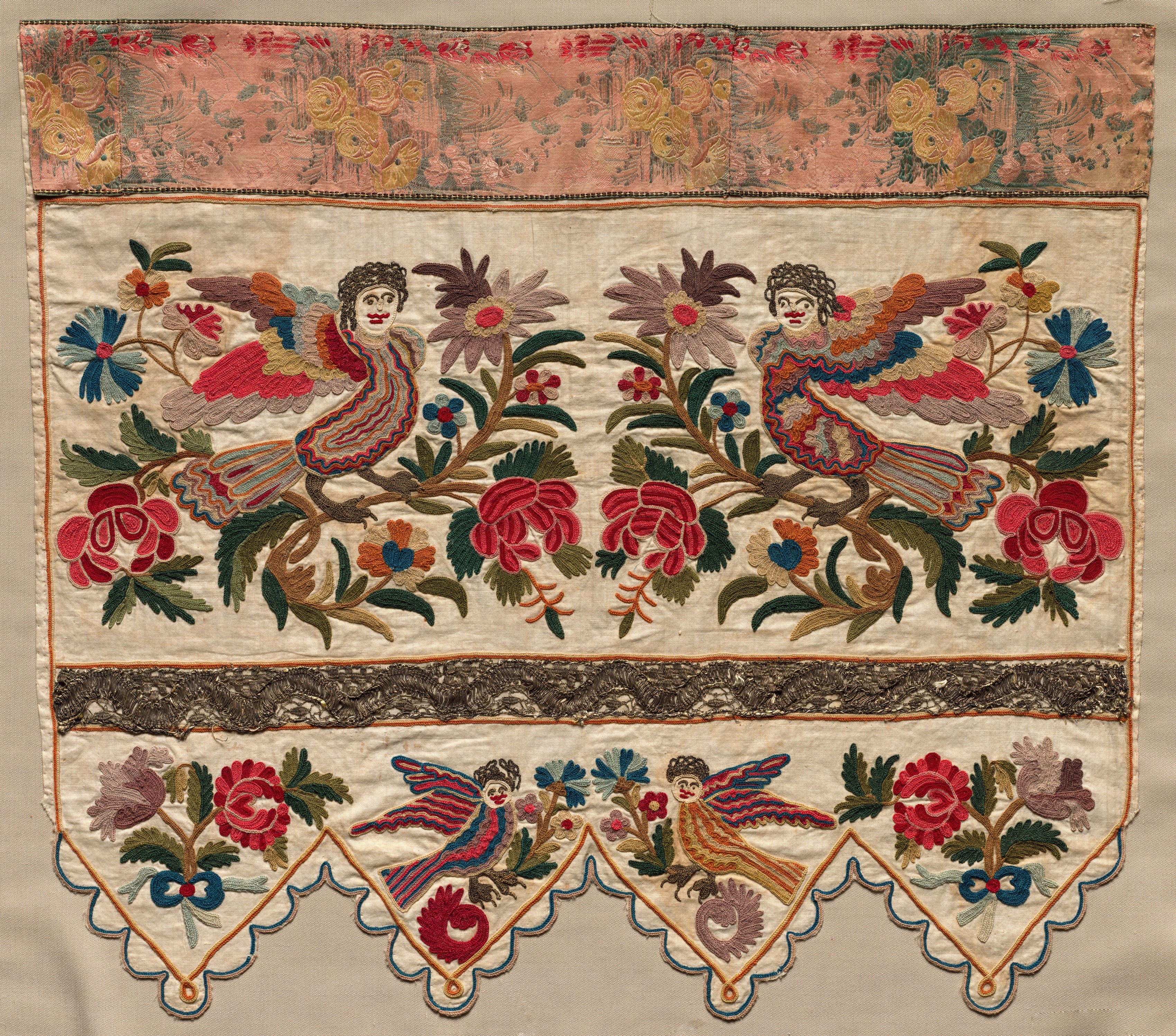
Deconstruction of a Cultural Artifact: The Nizhny-Novgorod Towel End as Avant-Garde Textile Catalyst
Introduction: The Towel End as a Silent Witness
In the vast archive of human civilization, objects and textiles are not merely functional remnants of past eras; they are silent witnesses to cultural collisions and aesthetic fusions. The Towel End from Russia’s Nizhny-Novgorod province, dating to the 18th–19th century, is a prime example. At first glance, it appears as a humble domestic artifact—a linen panel embroidered with wool, metal thread, and silk ribbon. Yet, for Zoey Fashion Lab, this object transcends its utilitarian origins. It becomes a catalyst for avant-garde deconstruction, a material manifesto that challenges contemporary fashion’s relationship with texture, memory, and cultural hybridity.
Technical Analysis: The Fabric as a Palimpsest
The towel end is constructed from plain weave linen, a ground fabric chosen for its durability and subtle texture. Linen, a staple of Russian peasant life, provides a neutral canvas that absorbs and contrasts with the vibrant embellishments. The embroidery employs polychrome wool in chain stitch, a technique that introduces a tactile, almost sculptural dimension. Wool’s natural resilience and color saturation create a deliberate tension against the linen’s austerity. The inclusion of metal thread—likely silver or gilt—elevates the piece from domestic craft to ritualistic art. This metallic element catches light, creating a shimmering dialogue between the humble and the precious.
The applied silk ribbon and metal thread trim are not mere decorations; they are structural interventions. Silk, with its fluid drape and luster, introduces a dynamic of movement, while the metal trim acts as a boundary, framing the composition. Together, these materials form a palimpsest—a layered text where each stitch and ribbon tells a story of trade, tradition, and transformation. The 18th–19th century Nizhny-Novgorod region was a crossroads of cultures, and this towel end reflects that: the metal thread hints at Byzantine or Oriental influences, while the wool embroidery echoes Slavic folk patterns.
Cultural Resonance: From Domestic Ritual to Avant-Garde Statement
In its original context, the towel end was not merely a functional item for drying hands or adorning icons. It was a symbol of transition—used in weddings, births, and funerals—a textile that marked life’s thresholds. The embroidery motifs, often geometric or zoomorphic, were charged with protective and auspicious meanings. For Zoey Fashion Lab, this ritualistic dimension is key. The avant-garde deconstruction of such an artifact involves extracting its symbolic weight and recontextualizing it within contemporary fashion narratives. The towel end becomes a metaphor for the body as a threshold, the garment as a boundary between the self and the world.
The reference to “Archive Resonance” in the provided text—a phrase evoking the echo of cultural memory—is crucial here. The towel end is not a static relic; it resonates with the tensions of its time: the clash between rural tradition and industrial modernity, between local craftsmanship and global trade. In the 18th–19th century, Russia was undergoing rapid change, and this textile embodies a hybrid identity. The avant-garde fashion designer can harness this resonance, not by replicating the pattern, but by abstracting its material logic—the interplay of rough and smooth, matte and shiny, organic and metallic.
Avant-Garde Deconstruction: A Methodological Framework
Zoey Fashion Lab’s approach to this towel end is rooted in deconstruction as a creative act. Rather than preserving the artifact’s original form, we seek to unravel its structural and symbolic threads. The plain weave linen, for instance, can be degraded and re-layered to create a distressed, fragmentary surface that speaks to the passage of time. The chain stitch embroidery can be extracted and re-scaled, transforming small motifs into oversized, abstract patterns that dominate a silhouette. The metal thread, traditionally used for highlights, can be woven into the warp of a new fabric, creating a shimmering, almost armor-like surface that challenges the softness of linen.
The applied silk ribbon offers a particularly rich avenue for deconstruction. In the original, it is a trim; in the avant-garde reinterpretation, it can become a structural element—used to bind, drape, or suspend fabric in unexpected ways. Imagine a coat where silk ribbons replace seams, creating a fluid, kinetic garment that moves with the body. The metal thread trim, once a border, can be reimagined as a chain mail-like mesh, inserted into panels of wool or linen to create a hybrid of soft and hard textures. This is not about copying the towel end; it is about dialoguing with its material intelligence.
Material Alchemy: Transforming Linen, Wool, and Metal
The avant-garde fashion lab is a space of material alchemy. For this project, the linen base can be treated with natural dyes derived from Russian plants—indigo, madder, or birch bark—to evoke the original palette but with a contemporary, almost painterly quality. The polychrome wool can be felted and cut into three-dimensional appliqués that mimic the chain stitch’s texture but on a larger, more abstract scale. The metal thread, rather than being embroidered, can be knitted or crocheted into openwork structures that allow light to pass through, creating a play of shadow and reflection.
The silk ribbon, in particular, offers opportunities for deconstructive draping. In the original, it is applied flat; in the avant-garde garment, it can be twisted, knotted, or looped to create a tactile, almost organic surface. This approach mirrors the Russian constructivist tradition of breaking down form into its essential components, but with a focus on texture as narrative. Each material is allowed to speak its own language—linen’s earthy humility, wool’s vibrant density, metal’s cold precision, silk’s fluid sensuality—and these languages are juxtaposed rather than harmonized, creating a visual and tactile dissonance that is quintessentially avant-garde.
Conclusion: The Towel End as a Blueprint for Future Fashion
The Nizhny-Novgorod towel end is more than a historical artifact; it is a blueprint for a new kind of fashion—one that embraces cultural hybridity, material experimentation, and symbolic depth. For Zoey Fashion Lab, deconstructing this object is an act of archaeological futurism: we dig into the past to excavate techniques and meanings that can be reanimated in the present. The result is not a reproduction of a 19th-century towel, but a garment that carries its memory—the memory of linen looms, of wool dyed with local plants, of metal threads traded along the Volga. This is fashion as archive resonance, where every stitch echoes across centuries, and every material is a vessel for cultural stories.
In the avant-garde context, the towel end challenges us to rethink the boundaries of textile design. It asks: What happens when we treat embroidery as sculpture? When we use trim as structure? When we let the roughness of linen and the shimmer of metal coexist without hierarchy? The answers lie in the deconstructed garment—a piece that is at once fragmented and whole, historical and futuristic, Russian and universal. Zoey Fashion Lab’s analysis of this artifact is not a conclusion but a beginning, a provocation to designers to listen to the whispers of textiles and transform them into avant-garde statements that resonate with our own complex, hybrid world.