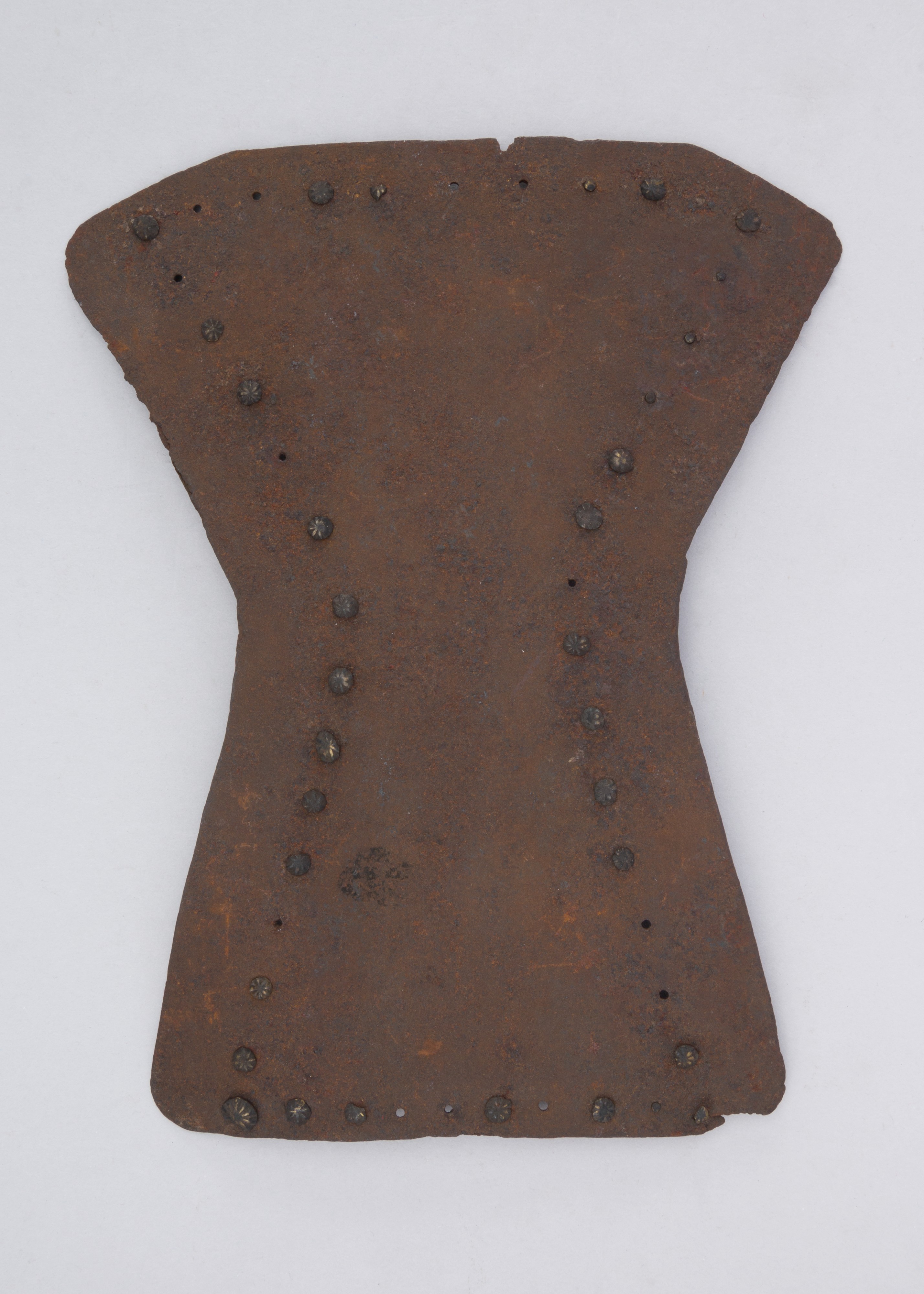
The Brigandine Plate: A Deconstructive Blueprint for SS26 Avant-Garde Silhouettes
In the relentless pursuit of sartorial evolution, Zoey Fashion Laboratory dissects the historical artifact not as a relic, but as a structural prototype for the future. The Italian brigandine plate—a composite armor of iron alloy scales riveted to a flexible backing—embodies a paradox central to avant-garde design: rigidity married to mobility. For SS26, this artifact transcends its martial origins, becoming a lexicon for deconstructive aesthetics and futuristic silhouette engineering. This analysis recontextualizes the brigandine as a standalone study in material alchemy, volumetric subversion, and the redefinition of the human form as an architectural vessel.
Material Dialectics: Iron and Copper as Kinetic Armature
The choice of materials—iron alloy and copper alloy—is not arbitrary. Iron, with its inherent density and tensile strength, offers a primary structural language akin to a building’s steel skeleton. In the brigandine, iron plates are not merely defensive; they are modular anchors that create a rigid exoskeleton. For SS26, this translates into garments that sculpt the body’s topography. Imagine a jacket where iron-alloy scales are laser-cut into asymmetrical, overlapping hexagons, each riveted to a bio-luminescent polymer base. The iron provides a matte, industrial weight, while the copper alloy—oxidized to a verdigris patina—introduces a chromatic counterpoint. Copper’s malleability allows for articulated joints at the shoulders and hips, enabling fluid movement while maintaining a formidable silhouette. This dialectic between hardness and flexibility echoes the brigandine’s original function: a second skin that protects without immobilizing. In the laboratory, we propose a gradient of opacity: dense iron clusters at the torso, thinning to copper mesh at the extremities, creating a visual narrative of controlled entropy.
Silhouette Innovation: The Exoskeletal Cocoon and Inverted Torso
The brigandine plate’s historical silhouette—a fitted chest piece often flaring at the waist—is a blueprint for volumetric subversion. For SS26, we deconstruct this into two primary avant-garde silhouettes: the Exoskeletal Cocoon and the Inverted Torso. The Exoskeletal Cocoon reimagines the brigandine as a floating armor carapace that sits off the body, suspended by carbon-fiber struts. The iron-copper scales are arranged in concentric, overlapping rings, expanding outward from the spine to create a biomorphic shell. This silhouette defies gravity, suggesting a creature in metamorphosis—part human, part architectural organism. The Inverted Torso, conversely, uses the brigandine’s structural logic to reverse the body’s natural proportions. Iron plates form a rigid, corset-like structure that flares dramatically at the shoulders, while copper scales taper into a sharp, asymmetrical hem at the hip. This silhouette inverts the classical hourglass, prioritizing the upper body as a fortress of angularity. The result is a deconstructive armor that questions the very notion of a garment’s center of gravity, forcing the eye to traverse the form in a non-linear path.
Structural Innovation: The Rivet as a Generative Nexus
In the original brigandine, the rivet is a humble fastener. In our avant-garde study, it becomes a generative nexus for structural innovation. We propose a kinetic rivet system that allows individual plates to pivot and lock into multiple configurations. Using a micro-hydraulic mechanism embedded in the copper alloy, each rivet can be activated by body heat or manual pressure, transforming the garment’s silhouette in real-time. This adaptive armor can shift from a closed, protective sheath to an open, deconstructive lattice, echoing the flexibility of a second skin. Furthermore, the rivets serve as acoustic resonators; when the wearer moves, the iron plates strike the copper in a percussive cadence, turning the garment into a sonic sculpture. This multi-sensory approach—visual, tactile, auditory—elevates the brigandine from mere apparel to a performance instrument. The structural innovation lies in the non-linear relationship between components: the plates are not fixed but float in a magnetic field, allowing for spontaneous reconfiguration. This introduces a futuristic silhouette that is perpetually in flux, a living architecture responsive to the wearer’s biomechanics.
Deconstructive Aesthetics: The Unfinished Armor and Negative Space
Deconstruction in avant-garde couture is not about destruction but revelation of process. For SS26, the brigandine is presented as an unfinished armor, with raw edges, exposed rivet heads, and deliberate gaps where plates are missing. This aesthetic of controlled incompletion exposes the garment’s internal logic: the iron alloy’s grain, the copper’s oxidation patterns, the stitching that binds the scales. Negative space becomes a structural element; large voids between the plates reveal the body’s skin, creating a dialogue between armor and vulnerability. This is not a protective shell but a fragmented exoskeleton, where absence is as powerful as presence. The deconstructive approach also embraces asymmetry and imbalance. One shoulder is encased in dense iron scales, while the opposite side is bare, save for a few copper tendrils. This dissonant harmony challenges the viewer’s expectation of symmetry, forcing a reassessment of what constitutes a complete garment. The brigandine’s historical function—to shield the torso—is subverted; the armor now exposes the very parts it once protected, creating a tension between historical memory and futuristic expression.
Futuristic Silhouette and Wearable Architecture
The ultimate goal of this study is to translate the brigandine into a wearable architectural structure for the SS26 season. The silhouette is not merely a shape but a system of forces: tension, compression, and torsion. The iron alloy plates act as compression members, while the copper rivets and backing fabric provide tensile support. This creates a garment that stands independently, a self-supporting structure that can be worn as a cage, a shell, or a mobile sculpture. The futuristic silhouette is biomorphic yet industrial, evoking the exoskeletons of cybernetic organisms or the faceted surfaces of geodesic domes. We propose a modular system where the brigandine plates can be detached and reattached, allowing the wearer to customize the silhouette’s volume and opacity. This democratization of form aligns with avant-garde principles of agency and transformation. The garment becomes a dialogue between the wearer and the object, a collaborative act of creation. For SS26, the brigandine plate is not a historical reference but a catalyst for a new design language, one that prioritizes structural integrity, material honesty, and the relentless pursuit of the unprecedented. In the laboratory, we forge not armor for battle, but armor for the psyche, a shell that protects while exposing the radical potential of the human form.