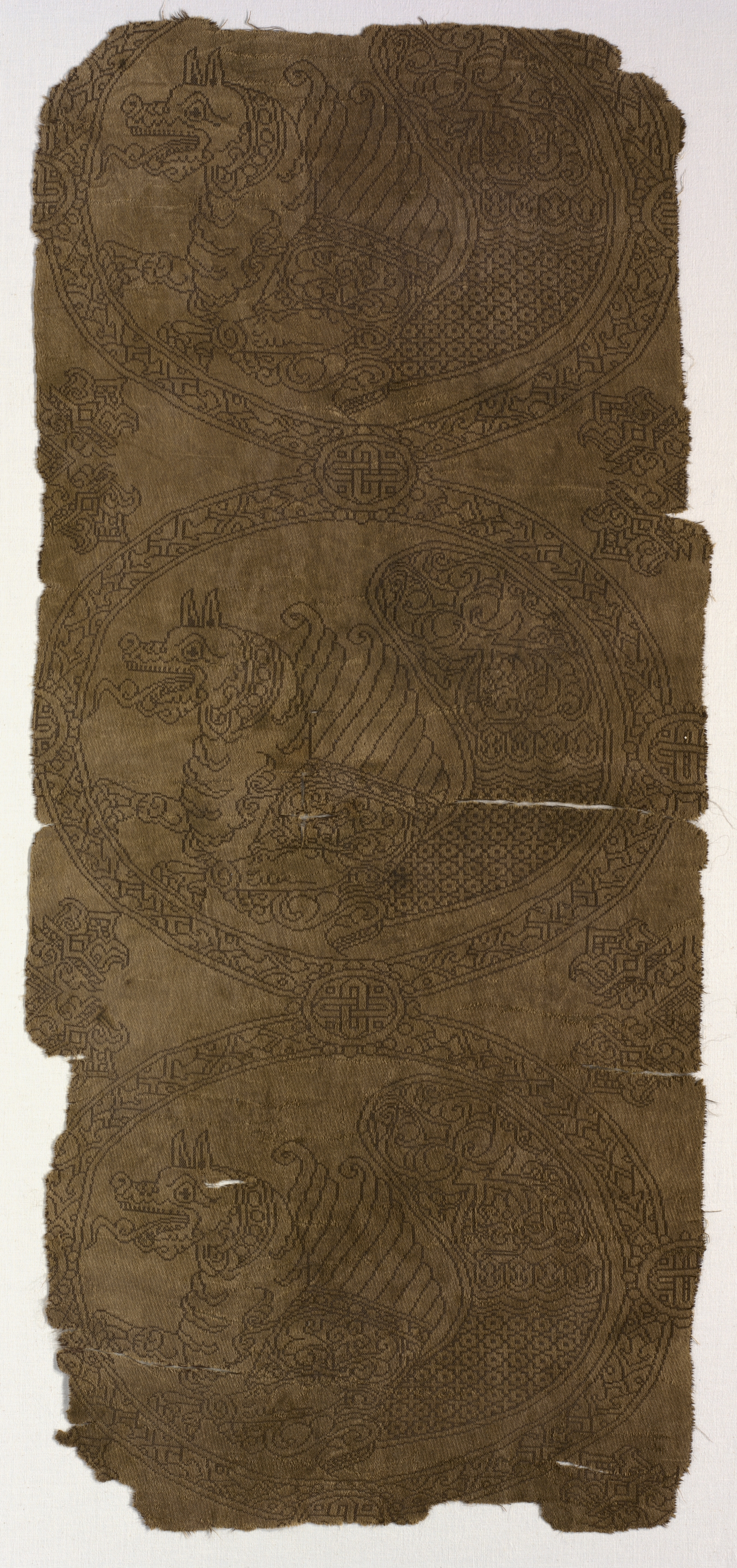
Fragment with Senmurvs: An Avant-Garde Deconstruction of Abbasid Silk
As the Chief Fabric Deconstructionist for Zoey Fashion Lab, I am tasked with dissecting not merely the physical structure of historical textiles, but the very cultural and aesthetic resonances they carry. The subject of this analysis is a fragment of silk in lampas weave, originating from Iran or Iraq during the Abbasid period (750–1258), featuring the mythical Senmurv. This piece is not a relic to be preserved in a static museum case; rather, it is a volatile archive of power, myth, and technical mastery. Our avant-garde methodology seeks to deconstruct this fragment to extract its latent energy, re-imagining its motifs, its weave structure, and its cultural dissonance for a contemporary, disruptive fashion context.
Technical Deconstruction: The Lampas Weave as a System of Control and Release
The lampas weave is a complex, compound structure that demands absolute precision. It is not a simple one-over-one-under; it is a dialogue between a ground weave and a pattern weave, often using two or more warps and wefts. In this Abbasid fragment, the ground is likely a fine silk tabby or twill, while the patterned Senmurv is created by a supplementary weft that floats across the reverse side. For the avant-garde designer, this technical structure is a metaphor for layered identity and controlled chaos.
Deconstruction Point 1: The Ground vs. The Figure. The ground weave represents the societal fabric—the stable, repetitive structure of Abbasid court life, trade, and religious order. The supplementary weft, which creates the Senmurv, is the disruptive element. It is a floating, non-structural thread that only becomes visible on the surface. In our avant-garde application, we would reverse this hierarchy. Imagine a garment where the “ground” is deliberately frayed, cut, or dissolved, leaving the supplementary Senmurv threads to stand as independent, fragile, yet dominant structures. This is a literal deconstruction: the mythical creature, once a decorative overlay, becomes the primary load-bearing element of the fabric.
Deconstruction Point 2: The Senmurv as a Structural Anomaly. The Senmurv—a hybrid of dog, bird, and perhaps lion—is not a natural creature. It is a composite, a chimera. In the lampas weave, its form is built from thousands of tiny, repetitive intersections. Our deconstruction would isolate these intersections. We would extract single Senmurv motifs from the fragment and re-weave them as three-dimensional, sculptural appliqués on a deconstructed silk base. The creature’s tail, often a peacock-like fan, could become a series of unspooled, raw-edge silk ribbons that cascade down a garment, mimicking the “floating” nature of the supplementary weft. This is not a reproduction; it is a fracturing of the original code to generate new, unpredictable forms.
Cultural Resonance: The Senmurv as an Archive of Power and Hybridity
The Archive Resonance reference speaks to “器物与绘画” (objects and paintings) as silent witnesses to cultural collision. The Abbasid period was a crucible of Persian, Turkic, and Arab influences, and the Senmurv itself is a pre-Islamic Persian symbol of royalty and protection, adopted and adapted by the Islamic court. This hybridity is the core of our avant-garde interpretation.
Deconstruction Point 3: The Myth as a Mask. The Senmurv was a guardian of the throne, a symbol of divine glory (khvarenah). In the Abbasid context, it was a visual claim to legitimacy. For Zoey Fashion Lab, we deconstruct this claim by rendering the Senmurv as a disjointed, fragmented mask. Imagine a hood or a collar constructed from multiple, unconnected pieces of the Senmurv’s anatomy—a single wing here, a paw there, a staring eye elsewhere. This is not a cohesive creature but a shattered icon, reflecting the fractured nature of power and identity in a globalized, post-colonial world. The wearer does not embody the Senmurv’s protection; they embody the process of its dissolution.
Deconstruction Point 4: The Archive as a Disruptive Loop. The reference to “十六至十七世纪” (16th–17th centuries) suggests a later, perhaps Safavid or Mughal, re-interpretation of earlier Abbasid motifs. This is a temporal deconstruction. Our avant-garde garment would not simply quote the 9th-century fragment. Instead, it would layer multiple temporalities. We would print a distorted, pixelated version of a 17th-century Safavid Senmurv over a hand-woven lampas base that mimics the 9th-century structure. The result is a ghost in the machine—a visual echo that destabilizes any single historical origin. The garment becomes a palimpsest, where each era’s interpretation of the Senmurv is visible, yet none is dominant.
Avant-Garde Application: From Fragment to Wearable Disruption
Our final output is not a dress; it is a statement of deconstruction. The garment will be a hybrid of preserved and destroyed elements.
Silk as a Contradiction. Silk is prized for its luster, strength, and smoothness. We will subvert these qualities. The lampas weave will be partially carbonized using a controlled heat treatment, creating areas of brittleness and fragility. The Senmurv motifs will be laser-cut with extreme precision, removing the ground weave around them so they float like islands on a transparent silk organza base. This creates a negative space where the Senmurv is both present and absent, a ghost of its former self.
Color as a Weapon. The original fragment likely used a limited palette—deep indigo, madder red, and undyed silk for highlights. Our deconstruction will amplify this palette into a dissonant harmony. The ground will be a deep, almost black indigo. The Senmurv will be woven in a metallic thread that has been treated to tarnish unevenly, creating patches of green, brown, and gold. This is not a restoration; it is a chemical and temporal assault on the original color scheme, forcing it to speak to decay and entropy.
Form as a Narrative. The garment will be a deconstructed coat—a traditional form of power and protection, now shattered. One sleeve will be entirely missing, replaced by a cascade of Senmurv wings that drape to the floor. The collar will be a rigid, sculptural ring made from multiple, stacked Senmurv heads, each facing a different direction. The back of the coat will be a lampas weave panel that is deliberately unraveled from the bottom, with the supplementary weft threads left to hang as a fringe. This is not a garment for protection; it is a garment for exposure—of the weave’s internal logic, of the myth’s constructed nature, of the archive’s fragility.
Conclusion: The Fragment as a Generative Force
This Abbasid silk fragment, with its Senmurv guardians, is not a dead object. It is a generative archive of technical mastery, cultural hybridity, and symbolic power. Through our avant-garde deconstruction, we do not preserve it; we unleash its latent potential. The lampas weave becomes a system of controlled chaos; the Senmurv becomes a shattered icon; the historical resonance becomes a disruptive temporal loop. The final garment is a witness to its own deconstruction—a wearable artifact that challenges the very notions of origin, authenticity, and beauty. For Zoey Fashion Lab, this is not the end of the fragment’s story; it is the beginning of its next, most radical iteration.