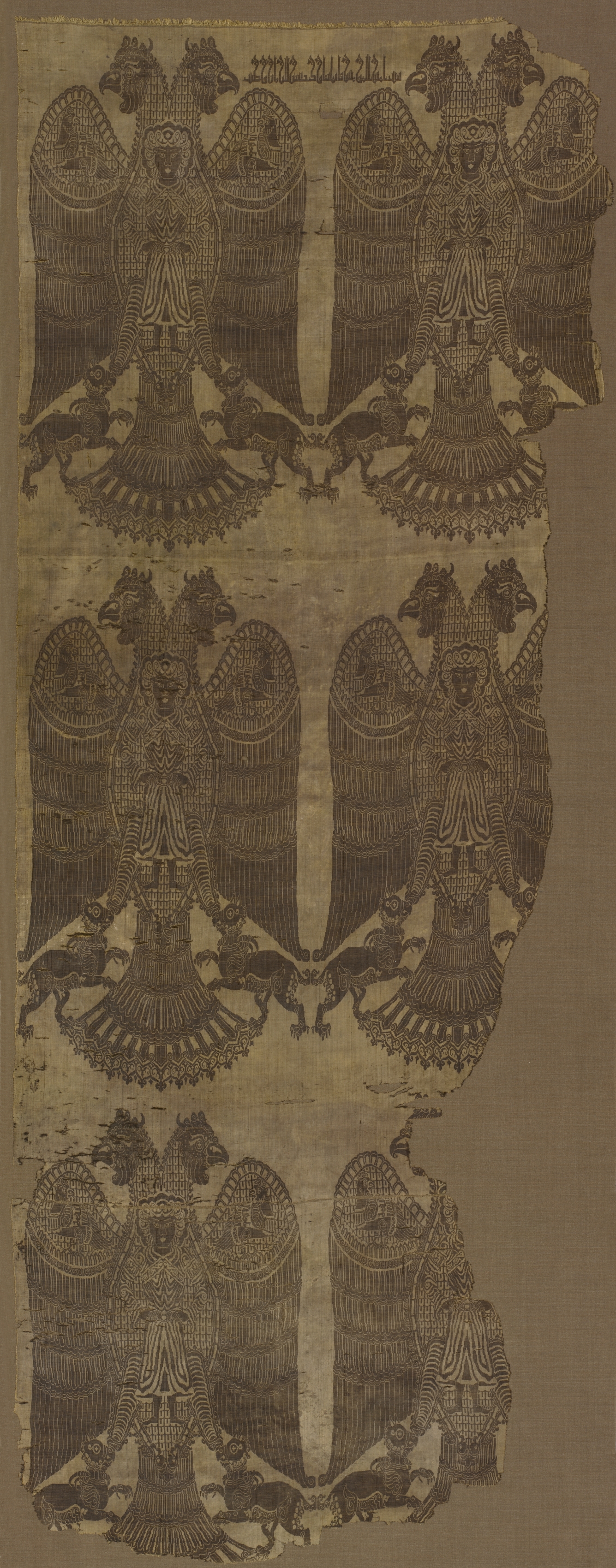
Fabric Deconstruction Report: Fragment with Inscription, Buyid Period (945–1055)
Artifact Overview and Provenance
This analysis, prepared for Zoey Fashion Lab, examines a silk fragment bearing an inscription, attributed to the Buyid period (945–1055) of Iran. The textile employs a lampas weave, a sophisticated technique that allows for the creation of intricate patterns through the interplay of warp and weft threads. The fragment, designated under the reference “Archive Resonance,” is a remnant of a broader cultural narrative—one that bridges the technical mastery of medieval Persia with the avant-garde sensibilities of contemporary fashion deconstruction. The Buyid era, marked by Persian cultural revival and patronage of the arts, produced textiles that were not merely functional but served as mobile canvases for political, religious, and aesthetic expression. This fragment, with its inscribed text, likely served as a band or trim for a larger garment or ceremonial object, its compact size belying its profound historical weight.
Technical Analysis: The Lampas Weave
The lampas weave is a compound structure that combines a foundation weave (often a plain or twill) with a supplementary patterning weft. In this fragment, the silk threads are dyed in hues that have aged to a muted palette of deep indigo, ochre, and faded crimson. The lampas technique allows for the inscription to emerge with clarity against a contrasting ground, creating a visual rhythm that mimics the flow of calligraphy. For Zoey Fashion Lab, this structural duality is of paramount interest: the weave’s ability to support both a base fabric and a decorative layer parallels the avant-garde practice of layering disparate elements—texture, meaning, and time—within a single garment. The technical precision of the Buyid weavers, who manipulated up to four different thread systems, anticipates the modular, deconstructive approaches used in contemporary fashion to challenge traditional garment construction.
Inscription and Iconography: Text as Texture
The fragment’s inscription, rendered in Kufic or a related angular script, is not merely decorative but carries semantic weight. In Buyid culture, textile inscriptions often included blessings, royal titles, or poetic verses, transforming the fabric into a medium for communication. Here, the text is woven into the very structure of the silk, its letters elongated and stylized to fit the loom’s constraints. For Zoey Fashion Lab, this integration of text and textile resonates with the avant-garde fascination with language as material. The inscription becomes a pattern, its meaning secondary to its visual impact—a deconstruction of literacy into pure form. This approach aligns with the lab’s practice of “fabric deconstruction,” where the original function of a textile element is subverted to create new aesthetic experiences. The fragment’s inscription, when isolated from its historical context, becomes a graphic element, its curves and angles offering a template for modern print designs or embroidered accents.
Cultural Resonance: The Buyid Synthesis
The Buyid period was a crucible of cultural synthesis, blending Persian, Islamic, and even pre-Islamic Sasanian motifs. This fragment reflects that hybridity: the lampas weave technique, while perfected in Islamic Persia, has roots in earlier Sasanian and Byzantine textile traditions. The inscription, though Arabic in script, often carried Persian content, asserting local identity within the broader Islamic world. For Zoey Fashion Lab, this historical layering is a direct precursor to avant-garde methodologies. The deconstructionist ethos—breaking down forms to reveal hidden structures—finds a parallel in the Buyid weavers’ ability to fuse multiple influences into a cohesive whole. The fragment’s survival as a “remnant” further echoes the avant-garde practice of using fragments, cuts, and unfinished edges to comment on the nature of time and decay. In the lab’s hands, this artifact becomes a source of inspiration for garments that celebrate incompleteness, where seams are exposed, and inscriptions are partially obscured, inviting the viewer to reconstruct meaning.
Avant-Garde Interpretations: From Archive to Runway
The reference “Archive Resonance” suggests a dialogue between the historical artifact and contemporary design. For Zoey Fashion Lab, this fragment is not a relic to be preserved but a catalyst for innovation. The avant-garde style demands that we interrogate the fragment’s materiality: the silk’s slight sheen, the stiffness of aged fibers, the way light catches the raised inscription. These qualities can be translated into modern fabrics—perhaps a silk organza with laser-cut lettering, or a jacquard weave that mimics the lampas structure. The inscription, when enlarged or abstracted, can become a repeating motif on a deconstructed trench coat or a asymmetrical dress, its original meaning dissolved into pure pattern. The fragment’s color palette, muted by centuries, can be revived in unexpected combinations—indigo paired with neon, ochre with metallic silver—to create tension between past and present.
Deconstruction Methodology: Breaking the Weave
Zoey Fashion Lab’s approach to this fragment involves several deconstructive strategies. First, the weave itself is analyzed as a system of tensions: the warp threads (vertical) and weft threads (horizontal) create a grid that the inscription disrupts. In an avant-garde garment, this grid can be deliberately broken—threads pulled, sections unraveled, or the inscription cut into strips and reassembled as fringe. Second, the fragment’s scale is manipulated: a tiny section of the inscription, magnified, becomes a bold graphic print, while the entire fragment, reproduced in a stretch fabric, wraps the body in a historical embrace. Third, the concept of “inscription” is expanded beyond text to include the body itself. A garment might feature the fragment’s pattern as a tattoo-like overlay, or the inscription might be embroidered onto a sheer mesh, allowing the wearer’s skin to become part of the message.
Conclusion: The Fragment as Future
This Buyid-period silk fragment, with its lampas weave and calligraphic inscription, is a testament to the enduring power of textile as a medium of cultural expression. For Zoey Fashion Lab, it is not a static artifact but a dynamic source of design language. The avant-garde deconstruction of this fragment—its technical structure, its iconography, its historical resonance—allows us to create garments that are both rooted in tradition and radically new. By breaking down the weave, we reveal the threads of history; by isolating the inscription, we liberate its form from its function. The result is a fashion that speaks to the past while crafting the future, a resonance that echoes through the archive and onto the runway.