Deconstructing the Sacred: The Trap Door of Countess Gertrude as an Avant-Garde Blueprint
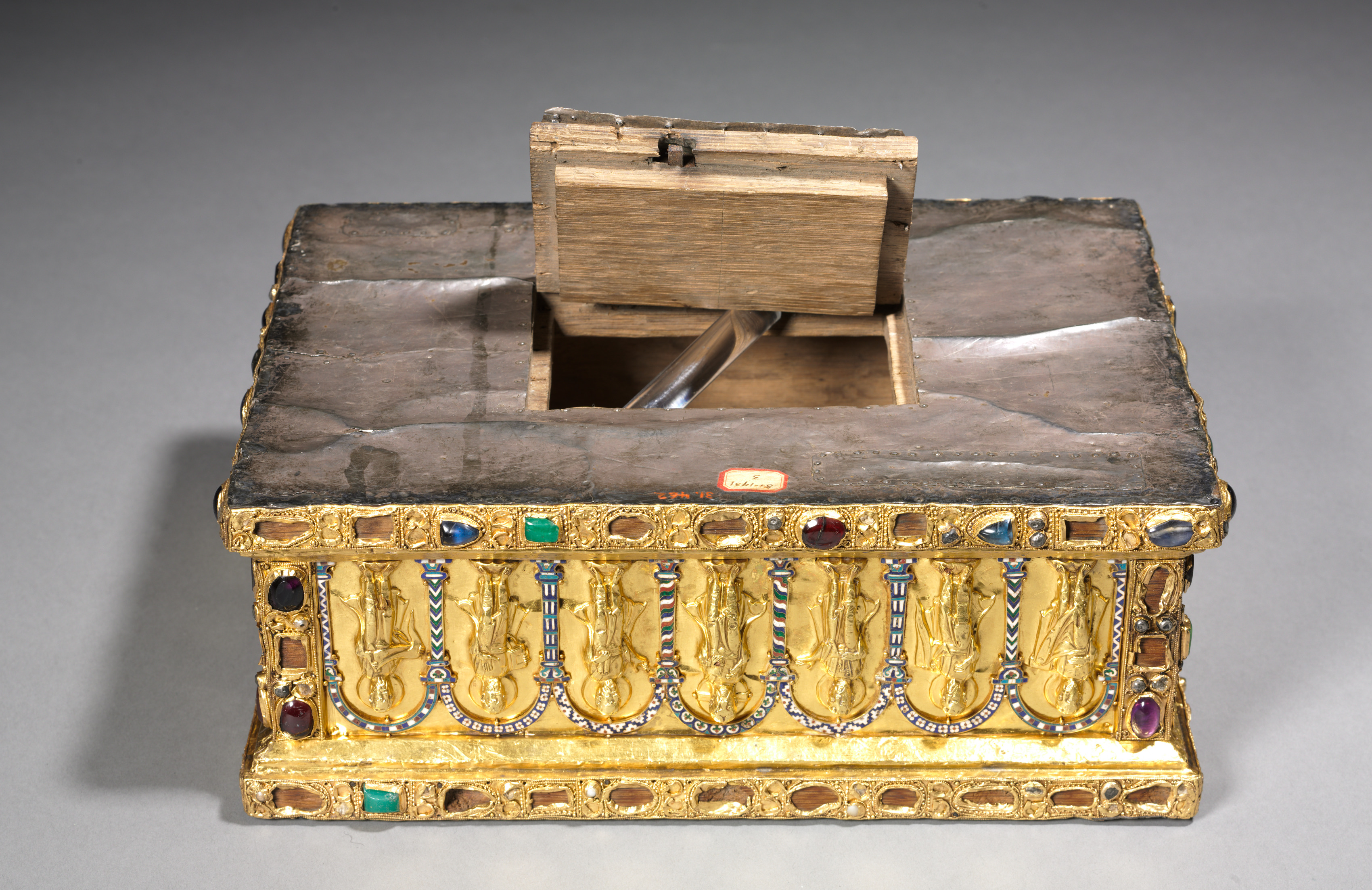
At Zoey Fashion Lab, our mandate is not merely to observe historical artifacts but to deconstruct their material and symbolic DNA, extracting the genetic code that can inform radical, contemporary design. The Trap Door for the Portable Altar of Countess Gertrude, originating from 11th-century Lower Saxony, presents a paradox of profound significance. It is an object of profound religious intimacy, yet its construction—a masterwork of gold, cloisonné enamel, porphyry, gems, pearls, niello, and a wood core—reads as a manifesto of layered complexity. For the avant-garde, this trap door is not a relic; it is a prototype for a new, fragmented, and sacredly profane aesthetic. Our analysis will reverse-engineer its technical and symbolic architecture, proposing how its elements can be woven into a new DNA strand for Zoey Fashion Lab’s upcoming collection.
I. Materiality as Narrative: The Composite Body
The trap door’s construction is a masterclass in stratified storytelling. The wood core provides the hidden, structural skeleton—the unseen foundation upon which all brilliance is mounted. This is the first lesson for the avant-garde designer: the invisible is as crucial as the visible. In fashion, this translates to the internal architecture of a garment—the boning, the hidden seams, the structural underlayers that enable dramatic silhouettes. The wood core is the skeletal system of the piece, a reminder that true innovation often begins with what is not immediately seen.
The gold, cloisonné enamel, and niello form a surface of deliberate discord. Gold, the eternal, unchanging metal, is juxtaposed with the brittle, luminous fragility of enamel and the dark, matte, almost alchemical quality of niello. This is not a harmonious marriage; it is a dialectic of materials. The cloisonné creates rigid, cellular compartments of color, while the niello etches dark, linear pathways. For Zoey Fashion Lab, this suggests a new technique: fabric as a cellular, partitioned surface. Imagine a garment where panels of iridescent silk (the enamel) are separated by laser-cut, oxidized metal threads (the niello), creating a visual rhythm of light and shadow, color and void.
The inclusion of porphyry—a hard, imperial stone associated with Byzantine and Roman power—and the organic pearls and gems introduces a third dimension of texture and weight. Porphyry is heavy, cold, and unyielding; pearls are soft, warm, and organic. This juxtaposition of the geological and the biological is a core tenet of avant-garde design. In our collection, this could manifest as hard, sculptural elements (cast resin mimicking porphyry, or actual stone inlay) embedded within flowing, liquid-like fabrics. The trap door teaches us that luxury is not about uniformity but about the tension between opposing forces.
II. The Trap Door as a Portal: Threshold and Revelation
The trap door’s function is its most potent symbolic element. It is a threshold between the sacred and the profane, the visible and the hidden. In the portable altar, it presumably concealed relics or the consecrated host—objects of immense spiritual power. For the avant-garde, this concept of concealment and revelation is a powerful design tool. The garment becomes a portable altar of the self, with hidden compartments, unexpected openings, and layers that must be actively engaged with to be understood.
We can translate this into a garment as a series of portals. Consider a coat with a trap door-like panel on the back or chest, secured by a complex system of clasps, hinges, or magnetic closures. When opened, it reveals a secondary surface—perhaps a hand-painted enamel-like pattern, a mirrored panel, or a pocket containing a personal relic. This is not mere decoration; it is a ritual of exposure. The wearer becomes the curator of their own hidden narrative, choosing when and to whom to reveal the interior. The trap door’s architectural hinge becomes a design detail: a visible, mechanical joint that celebrates the act of opening.
III. The Romanesque DNA: Geometry, Symmetry, and the Sublime
The Romanesque period is characterized by a rigorous, almost brutal geometry. The trap door’s design, likely featuring symmetrical patterns, interlocking circles, and stylized animal or vegetal forms, reflects a worldview rooted in divine order. For the avant-garde, this is not a call to replicate medieval motifs but to reinterpret their structural logic. The cloisonné technique itself is a form of geometric constraint: the design is built within rigid, metal boundaries. This suggests a new approach to pattern-making: fabric as a series of compartmentalized, enamel-like fields, where each color or texture is contained within a precise, metal- or thread-defined cell.
The use of niello—a black metallic alloy used to fill engraved lines—is particularly instructive. It creates a negative space that defines the positive forms. In fashion, this translates to cutouts, negative-space construction, and graphic seams. A garment could be designed with a niello-like black, matte piping that outlines every panel, creating a cartographic quality that maps the body’s geography. The pearls and gems, often placed at intersections or focal points, become nodes of attention—like buttons, but imbued with the weight of relic and treasure.
IV. The Avant-Garde Synthesis: A New DNA Strand
To weave the trap door’s DNA into Zoey Fashion Lab’s collection, we propose the following design principles:
1. Stratified Construction: Every garment will have a visible internal architecture. Exposed seams, hinged panels, and layered understructures will be celebrated, not hidden. The wood core becomes a metaphor for a rigid, yet flexible, internal frame made of lightweight, sustainable materials like molded bamboo or recycled resin.
2. Material Discord: We will combine high-contrast materials in a single piece: matte black oxidized metal with iridescent silk, rough-hewn stone with soft cashmere, glossy enamel-like resin with matte, porous fabrics. The goal is to create a tactile and visual friction that demands attention.
3. The Portal Silhouette: Key pieces—jackets, skirts, and bodices—will feature functional trap doors. These will be closures that are not merely zippers or buttons, but mechanical, hinged openings that reveal a secondary layer. The act of dressing becomes a performance of revelation.
4. Geometric Compartmentalization: Patterns will be designed using cellular, cloisonné-inspired grids. Each “cell” of fabric can be a different color, texture, or material, separated by raised, metallic or embroidered borders. This creates a mosaic effect that is both ancient and futuristic.
5. The Relic as Accessory: Small, precious objects—a gem, a pearl, a piece of porphyry-like resin—will be embedded into the garments as functional closures or decorative nodes. These are not mere adornments; they are talismans of personal significance, inviting the wearer to imbue the piece with their own history.
V. Conclusion: The Altar as Armor
The Trap Door of Countess Gertrude is, at its core, a device for protecting and revealing the sacred. In the hands of Zoey Fashion Lab, this concept is reimagined for the contemporary body. The garment becomes a portable altar, a confessional, and a fortress of personal identity. By deconstructing the technical and symbolic layers of this 11th-century artifact, we are not merely borrowing its aesthetic; we are extracting its operational logic. The result is a collection that is heavy with history yet light with possibility, where every seam is a story, every panel a portal, and every material a testament to the enduring power of the sacred, made strange and new. This is the new DNA strand: a fusion of Romanesque rigor and avant-garde rebellion, crafted for the modern countess who carries her own altar wherever she goes.